
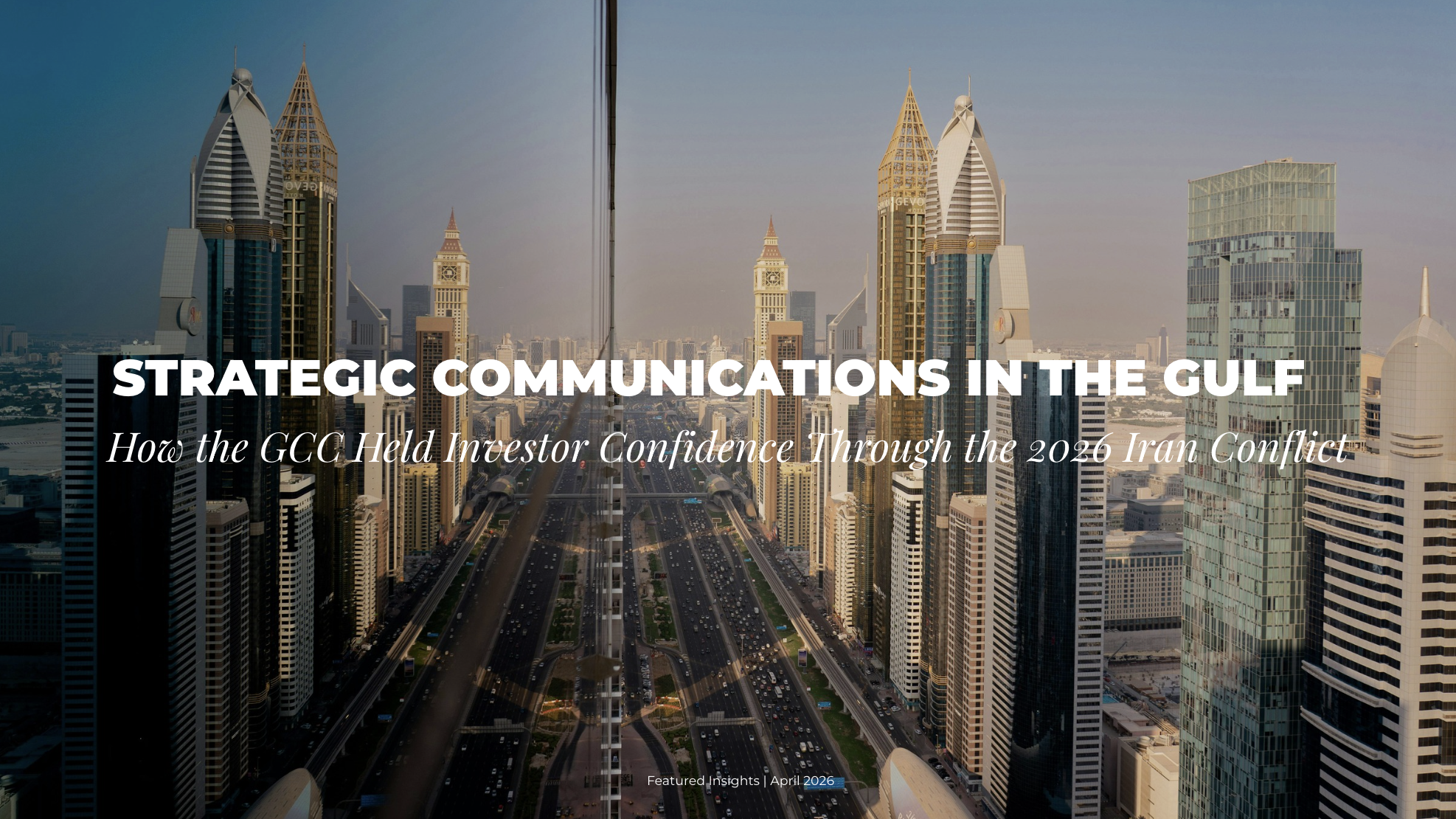
Strategic Communications in the Gulf: How the GCC Held Investor Confidence Through the 2026 Iran Conflict
On 28 February 2026, US and Israeli forces struck targets across Iran. Within days, Iranian missiles and drones were landing on UAE soil. Debris from intercepted strikes caused fires at the Ruwais refinery complex and the Habshan gas facility. Dubai International Airport briefly directed passengers and staff to bomb shelters. DP World suspended operations at Jebel Ali as a precaution. Fujairah, the critical Emirati port outside Hormuz, was periodically shut. Brent crude jumped 51% in March alone, one of the largest single-month oil price moves on record. By early April, the Strait of Hormuz was effectively shut.
By any reasonable measure, this was the hardest regional shock the Gulf has absorbed in a generation.
And yet. Sovereign capital kept deploying. The Dubai International Financial Centre continued to operate even after a direct impact on the DIFC Innovation Hub. Long-term programmes, including Saudi Arabia's giga-developments and Abu Dhabi's L'imad Holding initiative announced in mid-January, proceeded without abandonment. A ceasefire took hold from 7–8 April. Investor confidence, while stressed, did not collapse.
That distinction, between a system that doesn't get hit and one that absorbs the hit without breaking, is the more interesting story about modern Gulf strategic communications, and the one worth examining.
Narrative as Strategy, Not Message
In periods of geopolitical volatility, markets do not respond to rhetoric alone. They respond to signals: consistent, credible, and reinforced across multiple domains. During a regional shock, what investors look for is neither silence nor defiant messaging. They look for evidence that the operating environment can bend without breaking.
The GCC response to the 2026 conflict offers a study in narrative as a system: expressed physically through infrastructure behaviour, institutionally through policy continuity, and communicatively through calibrated signalling. The underlying message was not "business as usual" in its superficial sense. It was something more defensible: we took the hit, we absorbed the hit, and the fundamentals hold.
The Physical Layer: Absorption, Not Immunity
The most visible layer is the physical. The honest picture is not that nothing happened; it clearly did. The more important observation is how damage was contained, communicated, and resolved.
Saudi Aramco's Ras Tanura, the kingdom's largest crude processing plant, halted briefly after the initial drone attack and was restarted. Jebel Ali's precautionary suspension was explicit and time-bound, framed as risk management rather than crisis. The UAE Ministry of Defence issued near-daily interception reports (factual, numerical, non-escalatory) that gave markets and insurers something concrete to work with rather than speculation. Fujairah resumed operations between incidents. QatarEnergy declared force majeure on specific long-term supply contracts but did not attempt to conceal the impact.
Meanwhile, the structural investment machinery continued to operate. Abu Dhabi's three major sovereign wealth funds (ADIA, Mubadala, and ADQ) together manage over US$2 trillion, and Mubadala alone invested US$29.2 billion across 52 deals in 2024, a tempo that did not reverse during the crisis quarter.
The signal investors read was not "nothing happened." It was something more useful: the system responds to damage in a recognisable, predictable way.
The Institutional Layer: Policy Discipline Under Pressure
Equally important is what did not happen. No emergency capital controls. No abrupt regulatory tightening. No emergency export restrictions. Central banks maintained their pegs and their monetary policy stance. Free zone rules did not change. Foreign ownership structures remained intact. Investment incentives held.
Abu Dhabi went further. Six weeks before the war began, the emirate launched L'imad Holding as a fourth sovereign investment pillar alongside ADIA, Mubadala and ADQ, signalling a multi-decade horizon precisely as tensions were escalating. The message to international capital was unmistakable: we are not adjusting our long-term posture in response to short-term shocks.
This is where institutional credibility is built. Markets will tolerate geopolitical tension; they are far less tolerant of policy unpredictability. By resisting the impulse to respond visibly to external pressure, GCC governments reinforced a perception of maturity that cannot be performed into existence, only demonstrated over time.
The Communicative Layer: Low-Noise, High-Confidence Signalling
The communicative approach was perhaps the most distinctive. Unlike jurisdictions where crises trigger a surge in televised addresses and messaging campaigns, the GCC response was measured. Daily interception numbers from the UAE MoD. Restrained diplomatic statements. No attempt to dominate the news cycle. No triumphalism when interceptions succeeded. No panic when they didn't.
Crucially, the messaging matched the reality. When ports reopened, officials said so. When ports were shut, they said so. When the Habshan facility suspended operations, the Abu Dhabi Media Office announced it plainly. That congruence is what credibility is made of. In today's information environment, mismatches between statement and fact are exposed within hours; alignment, by contrast, compounds over time.
From an intercultural communications standpoint, this approach is particularly well-suited to the operating environment. The signal of resilience is not asserted; it is demonstrated, and stakeholders are allowed to draw their own conclusions.
Why the Signal Held: Structural Foundations
Three factors allowed this system to absorb rather than amplify the shock.
First, credibility built over two decades. The UAE in particular has spent a generation earning its reputation as a stable hub in an unstable region, and the 2026 crisis tested, and broadly validated, that positioning.
Second, economic diversification. While hydrocarbons remain central, finance, technology, logistics, tourism and advanced manufacturing now provide multiple pillars of stability rather than a single energy-dependent one.
Third, global integration. GCC sovereign wealth funds collectively manage an estimated US$4.9 trillion and are now embedded in global markets through trade, co-investment, and financial linkages. Disruption in the Gulf now carries global consequences, which creates a shared interest in regional stability extending well beyond the region itself.
Together, these factors mean the resilience narrative is not aspirational. It is structurally supported.
A View from Abu Dhabi
From a ground-level perspective in Abu Dhabi, what stood out most between February and April was not disruption, but continuity. Operations across sectors continued largely uninterrupted, even during the periods of heightened alert. Credit is due to the authorities for the clarity and consistency of their communication, as well as the calm, structured way the situation was managed. A system of designated shelter locations was rapidly operationalised, and guidance on where to go and what to do during alerts was both accessible and widely understood.
I experienced this firsthand during a missile alert while at the gym. Midway through a routine, everyone was calmly directed to the changing rooms, where we remained for around 20 minutes. There was no panic, no confusion. Once the alert passed, people returned to what they were doing, and the day resumed. That pattern (brief interruption, followed by immediate normalisation) became the rhythm.
Public life was, at times, more subdued. Larger outdoor events and gatherings were postponed, but core business activity continued. Notably, the tone between public-sector and private-sector communication remained closely aligned: measured, factual, and focused on continuity. That alignment reinforced confidence, ensuring that even in moments of uncertainty, the broader signal remained clear and credible.
Implications for International Businesses
For companies operating in or entering the GCC, the 2026 episode offers three practical lessons.
First, external perceptions of risk will not always match ground reality, in either direction. Over-reacting to global headlines costs credibility with local stakeholders; under-reacting to genuine operational disruption costs credibility with one's own board. Companies that rely solely on international media narratives to read the Gulf will systematically misread it.
Second, alignment matters. In an environment where governments carefully manage narrative through action, corporate communication needs to operate at the same register: fact-based, calibrated, and congruent with observable reality. Overstated risk language, premature market-withdrawal announcements, or reactive PR will misalign a firm with the local signalling system and with the stakeholders who read it.
Third, reading the signals is now a capability, not a sensibility. The distance between surface volatility and structural resilience is where most foreign companies lose their footing. Closing that distance requires preparation: not just market entry advice after a decision is made, but genuine readiness built before it.
What Serious Operators Do Next
The 2026 conflict will not be the last test of the GCC's signalling architecture, and the companies that navigate the region well through the next one will be those that built the capability to read it before they needed to. What that preparation actually looks like, and how sophisticated operators get ready for an environment where the signals that matter most are not the ones making the headlines, is the subject of the next piece in this series.
— Stephen Trinder (PhD), Senior Counsellor (EMEA)
mcg-asia.com | Abu Dhabi
MCG Arabia
Dr Stephen Trinder is General Manager of Oilfield Systems in Abu Dhabi, where he has led UAE operations through the 2026 Iran conflict and its aftermath. He also runs STHS Consulting, advising international firms on cross-cultural business engagement in the Gulf.
He holds a PhD in English and Media and an MA in Intercultural Communication from Anglia Ruskin University, and has lived and worked in the Emirates for over a decade.