
Thailand's Economy Since 1991: Where the Merit Went
The 1997 crisis is the part of Thailand's story everyone tells. The quieter story behind 2026 is what happened to investment after the boom ended, and why Thailand has struggled to convert capital and global integration into another sustained period of productivity growth.
Part I of MCG's series on Thailand and the 2026 IMF-World Bank Annual Meetings, Bangkok, 12 to 18 October
When the IMF and World Bank last held their Annual Meetings in Bangkok, in October 1991, the country receiving them was among the fastest-growing economies in the world. When they return in October, they will find one that is richer, more integrated and far better protected against financial crisis, and whose growth is now among the slowest in the region.
The usual explanation runs through 1997: the crisis broke the old model, the repair made Thailand safe, and safety has not been enough. That is true as far as it goes. It stops above the level where the difficulty actually sits, which is inside Thai firms, their balance sheets and the machinery that regulates them.
Thai commentary has a phrase for it, กินบุญเก่า, eating old merit, and it has been in circulation for years. Pisit Leeahtam, then policy chief of the Democrat Party, used it in 2022 of both the balance of payments and the budget.
Kobsak Pootrakool, senior executive vice president of Bangkok Bank, took it a step further in February, asking why an economy that once grew at more than 10 per cent now manages about 2, and suggesting that part of the answer was that the old merit was running out, with the country's core industries resembling an old man falling ill.
Finance Minister Ekniti Nitithanprapas uses it now of the investment rate. A description that has outlasted changes of government and crosses party and professional lines suggests the diagnosis is not what is in dispute. The phrase is also fair to the past.
The earlier model was not illusory: it produced industrial clusters, infrastructure, firms, skills and international relationships that are still in use. What it does not say is what has been happening to them since.
What the 1991 Annual Meetings in Bangkok were told
The warning delegates heard in Bangkok in 1991 was not the one that came true in 1997.
Prime Minister Anand Panyarachun told the meeting that Thailand had solved the problems of the early 1980s through fiscal austerity and monetary discipline, and now faced a different set of issues requiring a different approach. The conventional macroeconomic prescription, he said, remained necessary but was no longer sufficient. It was perhaps time for a new vision, a new strategy and new programmes.
In the same room, delivering his first annual address as World Bank president, Lewis Preston argued that competition for capital placed a premium on the efficiency of investment rather than its volume, and that even a modest improvement in how developing countries used the resources they already had would produce substantial gains in living standards.
Both men were making the same point. The question facing Thailand was no longer how much capital it could attract but how well it could put that capital to work. Six years later the country was overtaken by a different kind of failure, and that question was not so much answered as postponed.
The investment rate that never fully returned after 1997
The financial architecture was rebuilt after 1997 and has held. The investment rate was not.
An IMF examination of the decade that followed recorded total fixed investment falling from above 40 per cent of GDP in the first half of the 1990s to around 20 per cent by 1999, with private investment falling considerably further. Thailand adjusted by leaning harder on exports and moving up parts of the manufacturing value chain, which worked well enough to obscure what had not returned.
What the export strategy did not reliably produce was broad-based domestic technological upgrading. Research from the Puey Ungphakorn Institute for Economic Research finds that participation in global value chains drove initial industrialisation but did not by itself produce it, with domestic firms liable to remain in the middle of those chains, dependent on technology and specialisation determined at headquarters elsewhere.
Thailand stopped having a problem getting into global production. It started having a problem extracting more from being there.
Where Thailand's capital goes
The usual account of what followed is that Thailand stopped investing. The firm-level evidence suggests something more awkward.
PIER research using company accounts filed with the Department of Business Development from 1999 to 2024, matched against loan-level data reported to the Bank of Thailand, finds evidence consistent with worsening capital misallocation.
Revenue growth and asset growth have slowed. Return on assets has declined. Asset turnover has fallen, meaning firms generate less revenue from each unit of what they own. Resources are not reaching the most productive firms, and the efficiency gap between firms has widened. The evidence suggests that Thailand's problem is not only how much capital it mobilises, but where that capital goes and how productively it is used.
Separate PIER work on the low investment puzzle found that more than 60 per cent of Thai firms undertake negative net investment in any given year, investing more slowly than their assets depreciate. Funding availability alone cannot explain the pattern. Many firms appear either unwilling or unable to replace and expand productive assets at a sufficient rate.
This is Preston's 1991 point arriving thirty-five years late, and it changes what investment promotion is for. Attracting a project is a different task from ensuring the capital already in the country reaches the firms able to use it.
Thai SMEs and credit: when capital misses productive firms
Credit shows the same pattern from the other side.
In its second-quarter 2026 banking review the Bank of Thailand reported loan growth driven primarily by lending to large corporations, while SME lending continued to contract amid elevated credit risk. Read as a banking problem, the remedy is more lending.
PIER's profile of the Thai corporate sector complicates that considerably. Firms in the middle of the size distribution show relatively high returns on assets alongside low leverage, a pattern consistent with credit constraints. Larger firms show lower returns and higher debt. That does not mean every mid-sized firm deserves more credit.
It does suggest that some relatively productive firms are more financially constrained than their performance alone would imply, while the firms borrowing most are not the ones using capital best.
The policy question is therefore not how to increase lending volume. It is which constraint binds for which firm. For some it is debt. For others it is equity, balance-sheet quality, management capability, technology or access to markets, none of which a credit programme supplies.
The instruments also differ in how easily a government can deploy them. A credit scheme can be launched quickly and counted. Supplier development, management capability and growth equity are slower, less visible and spread across several institutions. The next generation of Thai productivity will depend not only on attracting larger firms and foreign projects, but on whether more domestic firms can make the transition from surviving to scaling alongside them.
Thailand's productivity slowdown
The aggregate consequence is visible in the productivity series. The OECD estimates that labour productivity growth averaged 4.8 per cent between 2010 and 2015 but only 2.1 per cent between 2015 and 2023, with total factor productivity (TFP) growth over the later period effectively zero.
Some deceleration is unavoidable in a richer economy, since no country can indefinitely repeat the gains from moving workers out of agriculture. Total factor productivity is a different matter. Measured TFP growth close to zero suggests that Thailand has generated little additional growth from improvements in the efficiency with which labour and capital are combined.
Ageing, education and Thailand's workforce
Demography removes the option of solving this by adding labour. The share of the population aged 65 and over is projected to rise from around 13 per cent in 2020 to 31 per cent by 2060, while the working-age share falls from 71 to 56 per cent, and World Bank modelling suggests demographic change alone could reduce per capita growth materially if productivity and participation do not adjust.
Thailand already devotes substantial resources to education. The harder question is what those resources produce. The World Bank's public revenue and spending assessment found expenditure per student rising over two decades while learning outcomes remained weak, and identifies the large number of small, under-resourced primary schools as one source of inefficiency.
Why the recognised remedies remain unimplemented is the more useful question, and the answer concerns authority rather than pedagogy. A school system built for a growing child population now has to adjust to falling enrolment.
Consolidating schools, reallocating teachers, changing curriculum control, altering funding formulae and granting greater autonomy each redistribute control over budgets and appointments, and each creates identifiable local losers well before any national gain appears.
NESDC chairman Supavud Saicheua has linked Thailand's demographic decline directly to the need to raise human capital, and has argued for reforms including school consolidation and greater decentralisation of education. His prescriptions are worth testing rather than adopting wholesale. The underlying growth constraint is harder to dispute.
Where reform meets Thailand's machinery of government
Most of these problems eventually reach the same place, which is how the Thai state organises decisions across institutions.
TDRI argues that the reform process itself reproduces the problem. Legislative review conducted law by law and agency by agency produces fragmented outcomes, limited coherence and overlapping or contradictory provisions. Its proposal is an integrated thematic review, under which the laws serving one policy objective are examined together, so that hotel regulation is considered across building, public health and environmental legislation at once rather than separately.
Thailand is moving. The Licensing Facilitation Act 2026 creates a main licence that carries related sublicences from other agencies, together with a central application centre. The Office of the Public Sector Development Commission has identified candidate activities for the Super Licence model, including EV charging stations, elderly-care businesses and the importation of goods for MICE exhibitions, with three activities to be selected for initial study.
The mechanism applies only once the Cabinet designates an activity as eligible by royal decree, which is where it will be tested. The question is whether consolidation removes overlapping approvals or reorganises how applicants encounter them.
Deputy Prime Minister Pakorn Nilprapunt has identified the permission-first system itself as the obstacle and proposes shifting towards post-audit inspection, supported by a tool comparing more than 9,000 Thai laws against over 260 OECD legal instruments.
The scale of what that confronts shows in a simpler figure from the same account. Thailand had 10,010 government offices operating in the regions as of June 2026, against 9,990 before 2017. The number matters less as a measure of bureaucratic size than as an indication of the institutional landscape through which cross-cutting reform has to travel.
Digitalising a complicated process is not the same as redesigning it. An application submitted through an online portal can preserve the same licences, the same sequencing, the same discretionary decisions and the same overlapping authority. Reform in a mature economy often requires the state not to add capacity but to change how its own roles are separated and coordinated.
Bangkok and the concentration of growth
Geography compounds it. The World Bank's work on Thai cities estimates that around 89 per cent of GDP growth between 2010 and 2020 came from urban districts, while activity remains extraordinarily concentrated. Bangkok generates close to half of national output, and congestion alone is estimated to cost the capital between 7 and 10 per cent of gross regional product each year.
Thailand has already urbanised. Whether its urban system becomes productive enough to carry the industries it wants depends on local fiscal capacity, planning authority and the relationship between central ministries and local administration, none of which is decided by an investment incentive.
Why Thailand's known problems persist
None of this is undiagnosed. Thailand has debated education, bureaucratic reform, competition, SME productivity and decentralisation for years, and the international institutions, Thai research bodies and successive governments have identified overlapping versions of the same constraints.
The reason they persist is that the changes required redistribute authority, discretion, market share, budgets and status. An agency loses control of a licence. An incumbent faces a new competitor. A ministry surrenders a programme. A state enterprise is asked to separate its public service obligations from its commercial activities. These are not details around the reform. They are the reform.
What makes them harder to move now is the absence of a forcing event. A currency collapse compels decisions that years of gradual underperformance do not, and Thailand's present difficulty produces no equivalent moment. The cost appears instead as foregone productivity, firms that do not scale, investment with too few domestic spillovers and cities that do not become productive enough.
Anand raised one further complication from the podium in 1991, warning that the regionalisation of the world economy might support global free trade or might equally produce a world of managed trade that constrained developing-country exports. Thailand is now attempting to upgrade in the second of those worlds rather than the first.
What PromptPay shows
One counter-example deserves weight, because the pattern above is not the whole of it.
PromptPay was built by the central bank and the commercial banks, became the rail for tax refunds and government transfers, and has since been linked to Singapore's PayNow and extended to cross-border QR payments with Cambodia, Vietnam, Indonesia and Malaysia. Thai institutions built something that changed everyday transactions and then exported it.
It shows a state capable of carrying difficult change when it resolves to. That makes the question sharper rather than softer. What determines when the resolve appears?
What the IMF and World Bank return to in October
The economy that will host the Annual Meetings is not a failed version of the one Anand welcomed in 1991. It is in large part the product of that success. Its difficulty is that the institutions built around an earlier model have not all changed at the same pace as the economy around them, and the evidence for that now runs down to the level of individual company accounts.
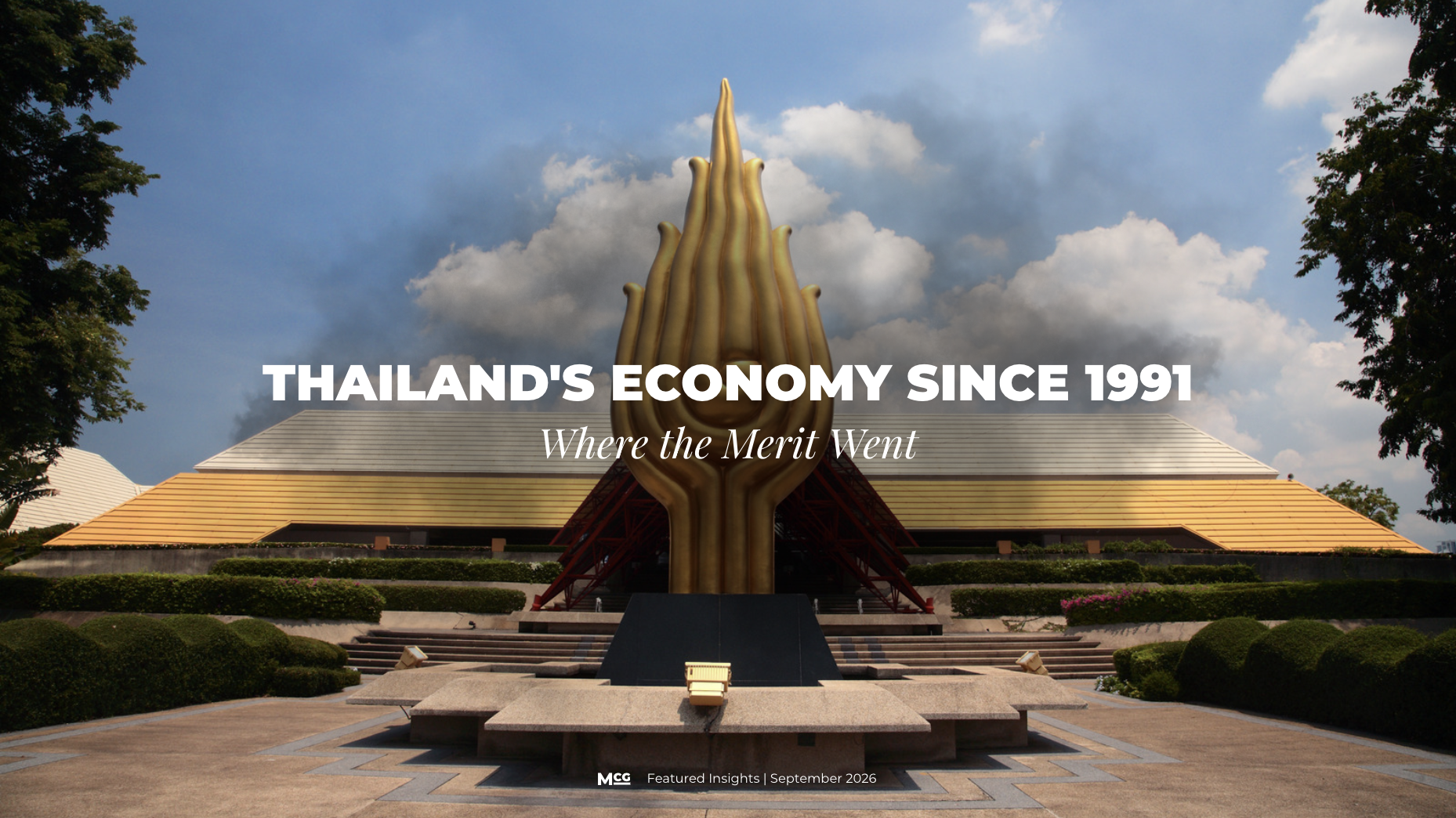
Four works of Thai craftsmanship commissioned for the 1991 meetings, among them the Kalpavriksha Door with its naga handles and the Elephant Pillars with Globe, still stand in the Queen Sirikit National Convention Center and will greet the delegates again in October. What was made then has lasted. The question the series turns to next is what Thailand now proposes to make.
Series note. This is Part I of MCG's series on Thailand's return as host of the IMF-World Bank Annual Meetings, 12 to 18 October 2026. Ben Kiatkwankul's companion essay in Asia Sentinel, "Thailand and a Tale of Two IMF Meetings", examines the 1991 meetings and the road to 1997.
Part II examines what Thailand is now proposing to build: the government's growth and investment agenda, the World Bank's new partnership framework, OECD accession and its wider economic diplomacy, and whether these initiatives amount to a coherent attempt to convert international engagement into greater domestic capability.
Part III turns to the Annual Meetings themselves, what Thailand puts on the agenda, and what survives after the delegates leave.
— Ben Kiatkwankul, Partner & Co-Founder
mcg-asia.com | Bangkok
Ben Kiatkwankul is Co-Founder and Partner at Maverick Consulting Group. He advises businesses and institutions on government relations, public affairs and business diplomacy, with a particular focus on Thailand and policy-driven markets across Southeast Asia.
About Maverick Consulting Group
Maverick Consulting Group (MCG) is a strategic advisory firm specialising in government relations, public affairs and business diplomacy. Based in Bangkok, MCG helps organisations understand how government systems actually work, build defensible positions and operate within the institutional, regulatory and political conditions shaping business outcomes.