
Platform Labour Regulation in Thailand: Four Tracks, and What Southeast Asia Already Chose
In three days in August, Thailand's platform labour question moved from a standing grievance to an active legislative contest.
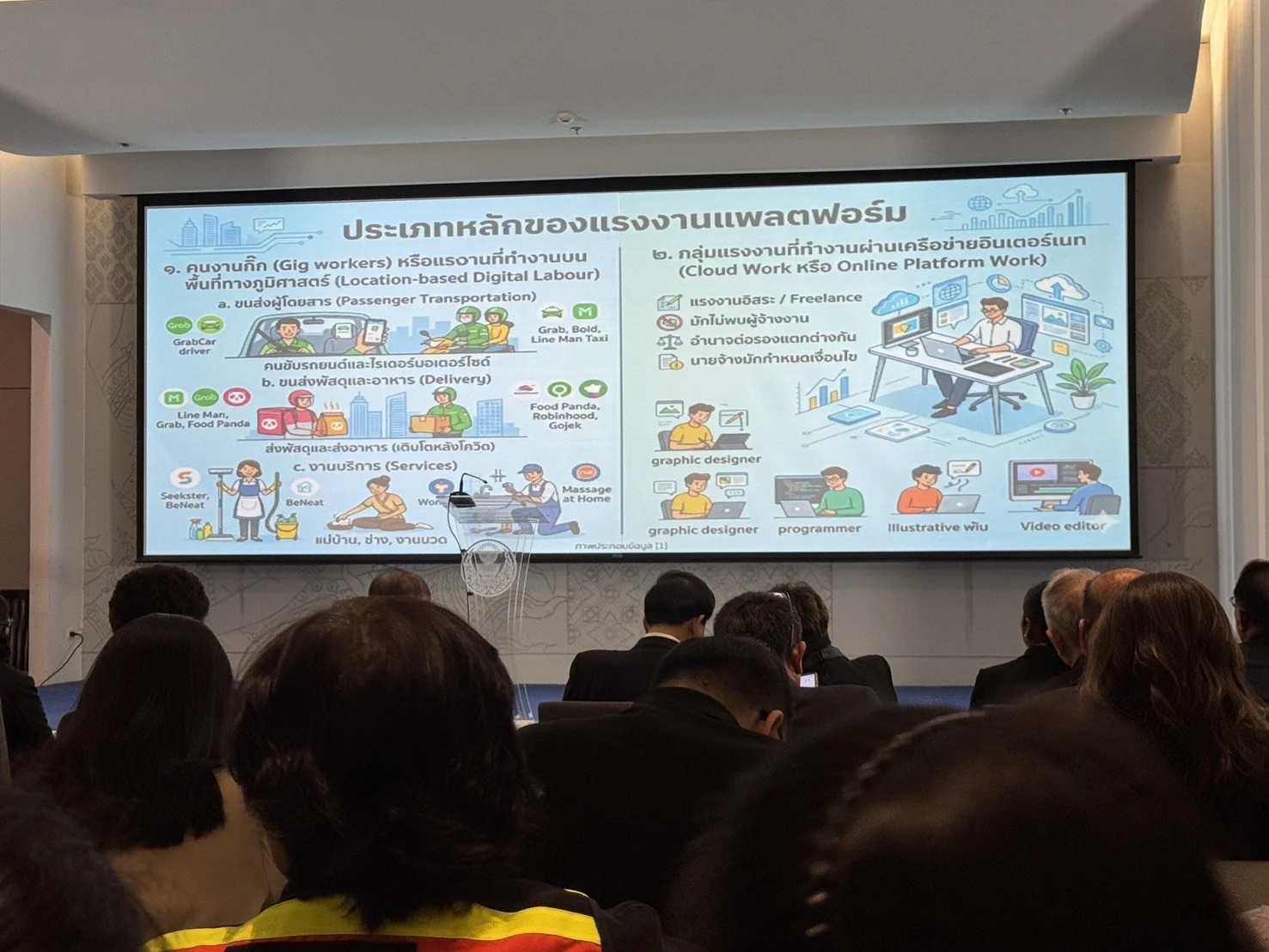
On 18 August the Senate Committee on Labour convened a seminar at Parliament with Friedrich-Ebert-Stiftung Thailand and Thai PBS. The same morning the Trade Competition Commission's ride-hailing subcommittee approved draft service standards for platform operators and opened them for comment.
Also that morning, Lalamove riders delivered a letter to the company over falling rates and then drove to Parliament to hand a second to the House Committee on Labour, which received a separate rider union delegation the same day.
Two days later, five political parties appeared at a public forum where rider unions tabled eleven demands and a drafted ministerial regulation.
The question is no longer whether Thailand regulates platform work. It is which instrument arrives first, and one of them closes for comment on 31 August.
A workforce nobody counts
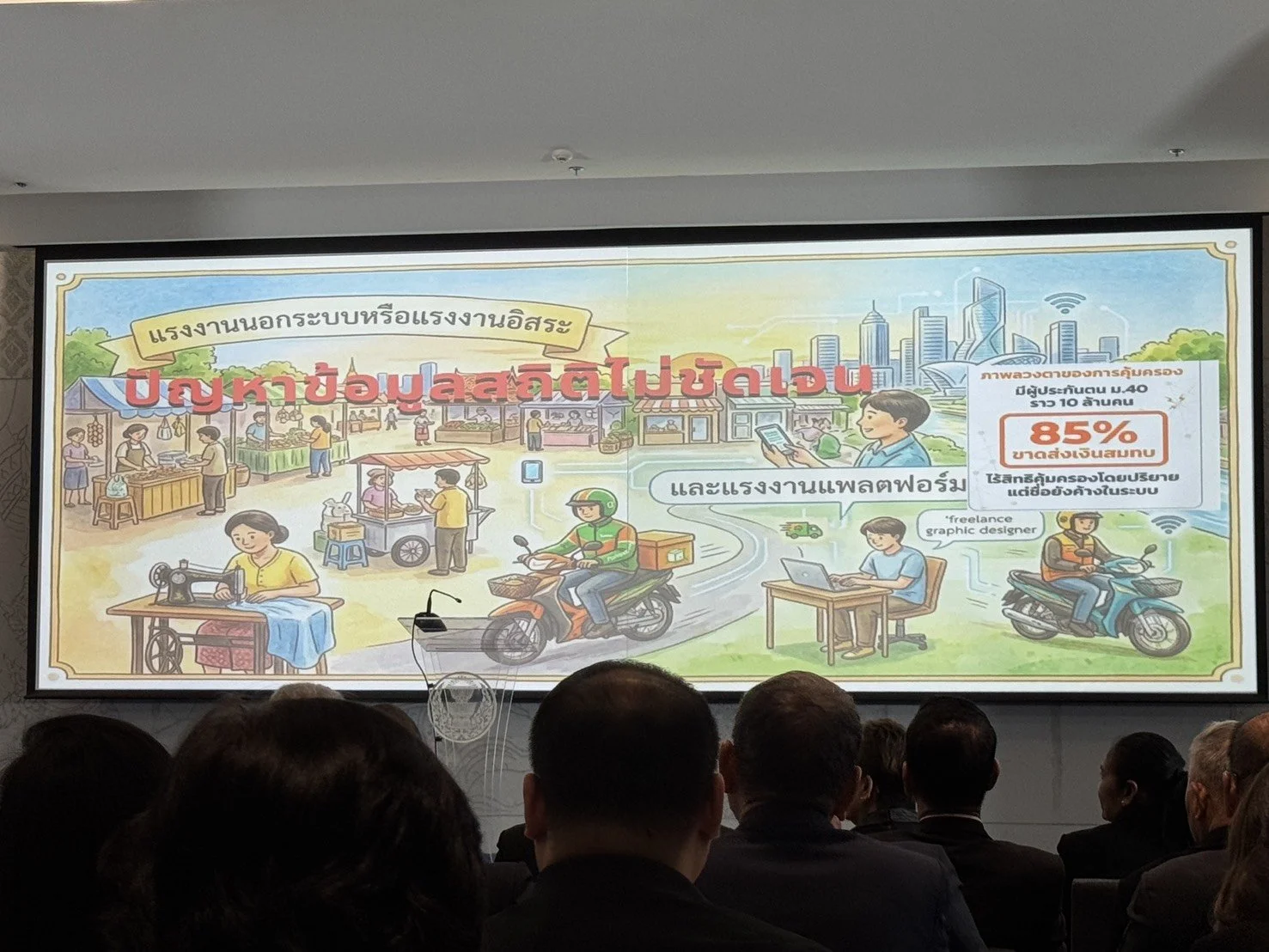
Thailand knows it has 2,056 notified digital platform businesses. It does not know how many people work through them.
The National Statistical Office recorded roughly 39.9 million employed persons in 2025, of whom 20.9 million, or 52.4 per cent, were informal. But it counts by sector and by absence of protection, not by platform mediation.
The available estimates come from different bodies on different bases and do not reconcile: the Trade Competition Commission puts ride-hailing riders above 400,000, the Thai Riders Association puts food delivery riders at 300,000 to 400,000, labour research organisations put the total above one million, and the Ministry of Labour suggested in May it could reach one million within three to five years.
The only hard official count is incidental. Under ETDA's Driver Verify system, as of early March 2026 14,918 vehicles had completed registration with the Department of Land Transport while 36,896 had not, weeks before a compliance deadline.
Value is measured no better. Momentum Works puts food delivery gross merchandise value at US$5.1 billion in 2025, up 22 per cent and the fastest growth in Southeast Asia; the Commission puts ride-hailing at roughly 45 billion baht. Both measure consumer spend, not worker earnings. The gap between them is the commission structure, which is what is now in dispute.
Growth and earnings have separated
The Fairwork Thailand 2025 ratings, covering Grab, LINE MAN, ShopeeFood and Robinhood, found riders routinely working beyond the 48-hour statutory ceiling at hourly earnings below the applicable minimum wage. No platform met the threshold on pay or conditions. Of 113 rider protests recorded between 2019 and 2023, 93 concerned per-trip rates.
The Lalamove action shows the mechanism. Riders told reporters they were paid 3.81 baht per kilometre before a 20 per cent commission. One described an 85 kilometre job that paid over 500 baht in early July and 350 baht three weeks later.
A driver of eight years' standing said the published starting fare fell in stages from 390 to 199 baht before disappearing from the company website, leaving the calculation visible only inside the application. Rate changes arrive as revised terms that must be accepted to keep working.
Platforms are not comfortable either. Grab's Thai entity reported net profit falling sharply in 2025 despite revenue growth, and Foodpanda withdrew in May 2025 after accumulated losses. Competitive intensity is passed down to the per-trip rate and lands on the party with no pricing power.
Part of the 2025 growth came from government co-payment schemes, which places the state on both sides.
Why the law does not reach
Substantive rights are tethered to employee status. Under the Labour Protection Act B.E. 2541 (1998) core protections attach to an employment relationship; riders fall instead under Section 587 of the Civil and Commercial Code, governing hire of work, so minimum wage, hours, leave, overtime and severance do not follow.
Section 22 of the same Act allows ministerial regulations setting different standards for particular categories of work. In June 2565 (2022) the Office of the Council of State, Committee No. 9, advised that this power could be used for platform work without waiting for new primary legislation, where the facts showed genuine managerial control.
That opinion remains on the record. No ministerial regulation has followed.
Organisation rights sit under the Labour Relations Act B.E. 2518 (1975), which does not reach beyond conventional employment; Thailand has ratified neither ILO Convention No. 87 nor No. 98. The Social Security Act B.E. 2533 (1990) covers employees compulsorily under Section 33 and the self-employed voluntarily under Section 40, where some 11 million had enrolled by end-2025. Section 40 is worker-funded, narrower, and creates no employment relationship.
Four tracks, ranked by speed
Competition law is fastest, and carries the largest exposure. On 18 August the Trade Competition Commission's ride-hailing subcommittee approved a principles document on service standards for ride-hailing and on-demand delivery platforms, open for comment to 31 August with publication expected by end-September.
The Commission acts under the Trade Competition Act B.E. 2560 (2017) and has form in this sector, having issued a food delivery guideline in December 2020 and an e-commerce guideline in April 2026, both interpreting Sections 50, 54, 55, 57 and 58.
An administrative fine for breach of Section 57 runs to 10 per cent of revenue in the year of the offence. The draft Independent Workers Bill's proposed operator contribution is up to 3 per cent of service fees. The competition track has both the shorter timetable and the larger downside.
Its stated concerns read like a labour charge sheet: unfair GP structures, batching that adds a second pickup and drop-off while cutting the payment, allocation favouring higher-tier riders, GPS discrepancies, and dark patterns.
Because competition law reaches the platform as a business operator, it need not resolve whether riders are employees. The classification question that has stalled the labour track is not on its critical path.
Digital platform regulation is already operating. The Royal Decree on the Operation of Digital Platform Service Businesses Subject to Prior Notification B.E. 2565 (2022), administered by ETDA, sits behind Driver Verify and the ride-sharing announcement effective 31 March 2026.
A joint committee chaired by the Permanent Secretary for Labour has sent standards to the Ministry of Digital Economy and Society proposing a 35 baht floor for a first job and the first two kilometres, stacked orders at not less than 75 per cent of the primary fare, and mandatory accident cover. When Lalamove riders sought a negotiating venue, the company proposed ETDA.
Social security is under revision. In May the Ministry of Labour indicated it is preparing to amend the Social Security Act, choosing between redefining an existing section and creating a new one. The unresolved question was put directly: who is the employer, given that some jurisdictions have designated the customer placing the order.
The Bill is slowest. The draft Independent Workers Promotion and Protection Act runs to 131 sections across nine chapters, creating independent and semi-independent worker categories, a protection fund drawing 3 per cent of income from semi-independent workers and up to 3 per cent of service fees from operators, a seven-day investigation before suspension and one day's notice before termination.



Four neighbours, four models
Thai parties debating this cite Malaysia and Singapore. Both are reasonable, and neither did the same thing. Four jurisdictions legislated within eighteen months, and no two chose the same instrument.
Singapore created a distinct class that is neither employee nor self-employed.
Its Platform Workers Act 2024, in force January 2025, requires Central Provident Fund contributions rising to 17 per cent by 2029, mandates work injury insurance, and permits platform work associations to bargain. The affected population is small, roughly 70,000 workers or about 3 per cent of the workforce.
The measurement consequence is the striking part: because the Act created the category, 2025 was the first year Singapore could publish platform worker injury data, recording a fatal and major injury rate of 84.6 per 100,000 against 15.7 for all other workers. The ratio was always there. Classification made it visible.
Malaysia created a new category with compulsory contributions.
Its Gig Workers Act 2025 (Act 872), in force 31 March 2026, retains contract for service while mandating social security with personal liability for directors who fail to remit, payment within seven days, a 14-day cap on investigative suspension, and a dedicated tribunal. It legislated for roughly 1.2 million gig workers from an informality rate of 20.65 per cent, less than half Thailand's.
Indonesia went at price rather than status.
Presidential Regulation No. 27 of 2026 caps platform commission at 8 per cent, down from 20 under a 2022 transport decree. Some 2.3 million people remain outside general labour law as mitra, or partners. Of the four this is the closest precedent for where Thailand's competition and digital platform tracks are heading, and the least discussed in Thai debate.
Korea reclassified.
A Labour Standards Act amendment effective 1 May 2026 introduces a presumption of employee status, shifting the burden of proof onto the platform.
Above them sit EU Directive 2024/2831, requiring a rebuttable presumption of employment, algorithmic disclosure and human decision-making on account restriction, with transposition due 2 December 2026; and ILO Convention No. 193, adopted June 2026 with Thailand's support. Scale has not predicted speed: Singapore legislated first with the region's smallest platform workforce, Thailand last with its largest informal one.
What August changed
Until this month the Bill had no obvious sponsor. Labour organisations argued it departed substantially from the consulted version, that its annual membership payment converts protection into purchased membership, and that recognising worker organisations as juristic persons rather than trade unions falls short of ILO Conventions 87 and 98.
Riders were split, with one network petitioning in May for social security coverage and another petitioning against it nine days later over duplicate contributions across platforms.
The 20 August forum shifted that. Five parties, government and opposition, each committed to legislation, citing Malaysia and Singapore. The rider coalition tabled eleven demands including a floor at fuel cost and equipment depreciation, stacked jobs at no less than 75 per cent of the standard rate, a commission cap of 15 per cent deductible only with consent, algorithmic disclosure, a working emergency button, customer registration against national ID, and per-trip weight limits.
One governing-coalition party proposed a social security split of 50 per cent platform, 25 per cent state, 25 per cent rider, alongside a GP ceiling.
The procedural detail matters most. The coalition did not lead with the Act. It tabled a drafted ministerial regulation and asked every party to push it into force as an urgent measure, which is the Section 22 route the Council of State cleared four years ago.
What follows
The instrument determines the cost, and it is not settled. A presumption of employment, a distinct legal class, a commission cap and a bespoke social security section produce materially different obligations for the same business.
Binding rules will arrive before the Bill does. Operators with a view on GP structures, batching, ranking or pricing disclosure have until 31 August to put it to the Trade Competition Commission, with publication expected weeks later. Nothing on the labour track moves on that timescale.
Commission economics are the exposed line. A 15 per cent GP cap, a 50 per cent employer share of contributions and a floor tied to fuel and depreciation are now on the public record as negotiating positions. None is settled. All are materially different from the status quo.
The terms are still being set. On the competition track the window closes this month.
This article reflects publicly available sources as at 25 August 2026. The Trade Competition Commission consultation referred to closes on 31 August 2026.
Sarawut Thiramanit is an Associate Consultant at MCG
Maverick Consulting Group is a Bangkok-based government relations, public affairs and business diplomacy firm working across Thailand, Southeast Asia and the Gulf.