
After the “Sick Man of Asia” Diagnosis: What Thailand’s Election Reveals About Change and Its Limits
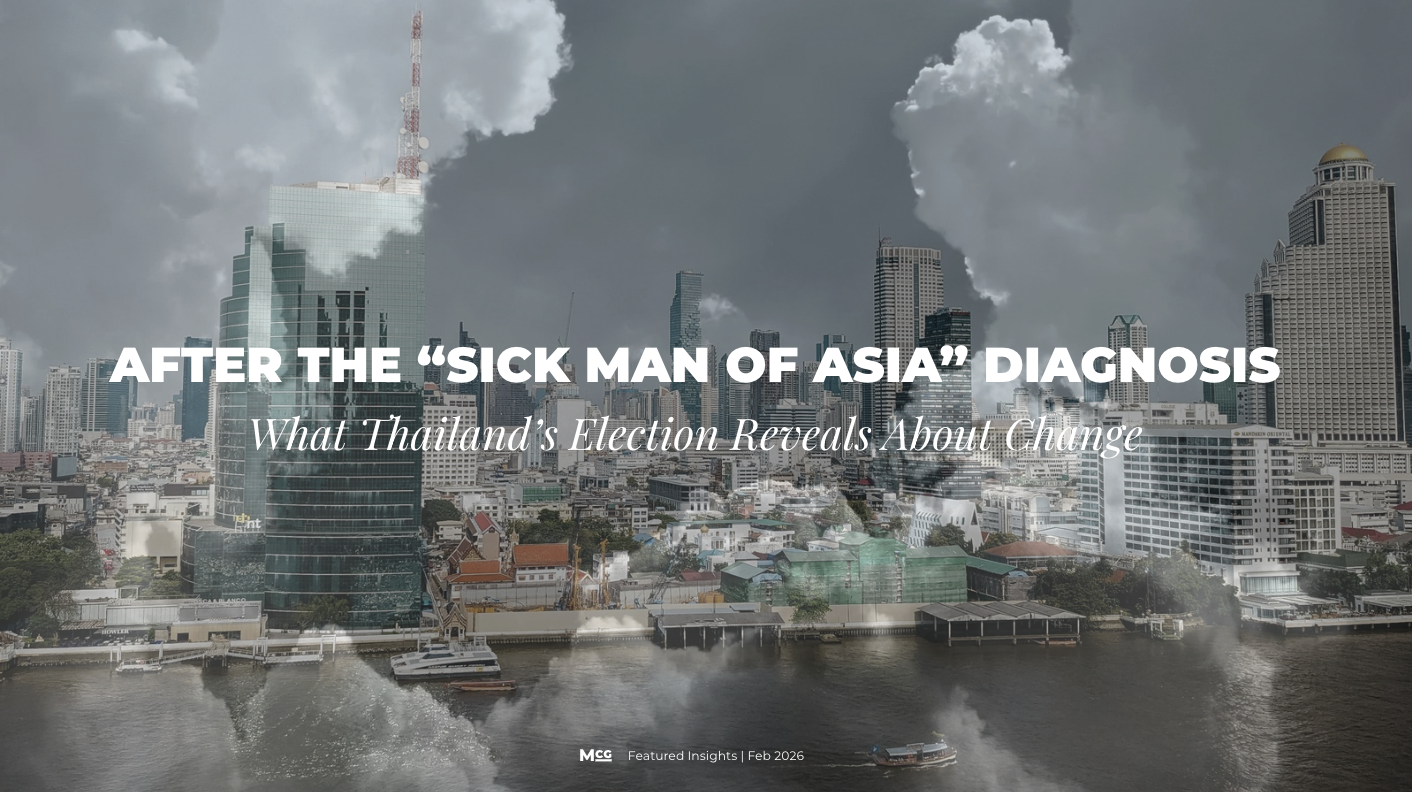
Thailand’s recent portrayal as the “sick man of Asia” sharpened attention on the country’s economic malaise. But as discussions at the Foreign Correspondents’ Club of Thailand (FCCT) made clear this week, the deeper question confronting the February election is not simply how Thailand recovers economically. It is what kind of change the political system is still capable of delivering.
The election arrives against a backdrop of structural slowdown, high household debt, and weakening competitiveness. It is also shaped by unresolved political tensions that have accumulated over nearly two decades. Together, these forces are narrowing the space for decisive reform, even as public demand for change grows louder.
Taken alongside our recent analysis of Thailand’s structural economic slowdown and election-related political risk, the FCCT discussion reinforces a consistent picture. Economic underperformance, electoral uncertainty, and institutional constraints are no longer separate challenges. They are mutually reinforcing.
An Election That Feels Necessary but Unresolved
A recurring theme at the FCCT was the sense that Thailand is returning to the polls not because the system has worked, but because it has failed to resolve the outcome of the previous election.
That sentiment was articulated most starkly by Thitinan Pongsudhirak, professor of political science and international relations, and senior fellow at the Institute of Security and International Studies at Chulalongkorn University, who observed:
“We shouldn’t have to have an election this Sunday. There was one in 2023, and Pita should have been prime minister.”
The remark was less a partisan intervention than a reflection of a broader unease. Thailand is being asked to repeat the electoral process without first achieving political closure. When elections are held under such conditions, they risk becoming procedural resets rather than mechanisms for resolving contested authority.
This unresolved past continues to shape expectations for the current contest. It has created a feeling of repetition rather than renewal. The election feels institutionally necessary, but politically unfinished.
Parties, Power, and the Asymmetry of the System
The FCCT discussion underscored how uneven Thailand’s electoral terrain remains.
Bhumjaithai enters the race with the advantages of incumbency and relatively strong institutional backing. Its resilience reflects a broader pattern in which certain political actors enjoy a degree of insulation from the legal and procedural pressures that have constrained others.
Pheu Thai, meanwhile, draws on a loyal but ageing support base that continues to credit the legacy of Thaksin-era policies. This election is notable for being the first in which Thaksin himself is not publicly involved in shaping the campaign. That shift raises questions about generational renewal and narrative transition.
The People’s Party faces a different set of challenges. Despite strong urban and youth support, it operates under persistent scrutiny and vulnerability. As Thitinan noted, the relative calm surrounding the party should not necessarily be read as reassurance. In Thailand’s political history, the absence of early pressure has often preceded more disruptive interventions later in the cycle.
The result is a contest in which popularity, protection, and institutional tolerance do not align evenly. This reinforces uncertainty about how electoral outcomes will ultimately be interpreted.
These dynamics echo the risks we identified in our earlier assessment of Thailand’s 2026 election and political risk for business, where coalition arithmetic and institutional fragmentation were already narrowing the space for decisive reform.
Foreign Policy as Theatre, Not Strategy
Dr Pongkwan Sawasdipakdi, lecturer in international relations at the faculty of political science at Thammasat University, highlighted another revealing dimension of the campaign. This was the instrumentalisation of foreign policy.
Positions on Thailand–Cambodia relations, and on regional geopolitics more broadly, fluctuate between parties with little consistency. Foreign affairs, in this context, function less as a domain of strategy than as a matter of perception. They are a way of signalling patriotism or managing domestic sentiment.
Thailand’s traditional bamboo diplomacy once served a clear purpose.
In today’s fractured geopolitical environment, it increasingly appears ambiguous and outdated. Yet no party has articulated a coherent alternative that balances strategic clarity with political feasibility.
Historical memory remains powerful, particularly on border and sovereignty issues. Memory alone, however, does not constitute policy. The gap between rhetoric and strategy underscores how constrained the foreign policy space has become within domestic politics.
Fixing the Engine or Becoming the “Forgotten Man”
Burin Adulwattana, Chief Economist at Kasikornbank’s KResearch, added an important economic dimension to the political debate. He described Thai society as divided between those who want to fix the engine, and those who believe the system itself requires deeper structural change.
Crucially, Burin later clarified that his widely cited “sick man” remark was not intended as a diagnosis of terminal weakness. It was a warning about neglect.
In his framing, Thailand risks becoming a “forgotten man”, overlooked by investors and foreign businesses not because of a lack of potential, but because of self-imposed constraints.
Protectionist policies, regulatory accretion, and rising economic nationalism have combined to limit competition and reduce openness. Rather than simplifying the operating environment, repeated regulatory interventions have often produced a guillotine effect. This generates additional layers of compliance and uncertainty.
This matters because growth is not driven by capital alone. It depends on the circulation of knowledge, technology, and managerial practices. When markets are shielded and participation narrowed, opportunities for learning and productivity gains diminish.
These competing diagnoses did not remain confined to expert or academic debate. Within days, they entered Thailand’s electoral arena directly.
From Diagnosis to Debate: How Thailand’s Political Leaders Respond
The “sick man of Asia” diagnosis did not remain confined to international commentary or expert discussion. It entered domestic political debate directly. What emerged was not a lack of ideas, but sharply divergent theories of what has gone wrong and who has the authority to fix it.
On 5 February, just three days before the election, a nationally televised debate organised by Channel 3 brought together prime ministerial candidates and senior economic figures from Thailand’s leading parties.
The discussion engaged explicitly with the Financial Times characterisation and revealed sharply divergent interpretations of both the problem and the cure.
Abhisit Vejjajiva of the Democrat Party framed Thailand’s condition as the result of a state that has shifted from enabler to obstacle. He set a concrete benchmark of restoring GDP growth to 5 percent by the fourth year of government and identified three structural “cancers” deterring investment: corruption, convoluted regulation, and a widening skills gap. His prescription centred on repositioning the state as a facilitator, through regulatory simplification and proactive economic diplomacy, particularly in digital and green sectors.
Representing the People’s Party, Natthaphong Ruengpanyawut advanced a more structural critique. He described Thailand’s malaise as a “triple leak” in which domestic stimulus fails to circulate internally, high-quality foreign investment stays away, and grey money distorts competition by overwhelming legitimate businesses. In his framing, economic reform is inseparable from political reform. Without dismantling monopolies and money politics, policy interventions risk reinforcing existing inequalities rather than reversing decline.
From the governing Bhumjaithai Party, Suphajee Suthumpun, the Minister of Commerce candidate and a prominent technocratic figure, acknowledged that Thailand’s growth has fallen to the bottom tier of ASEAN. She attributed this in part to the inefficiency of the government spending engine, noting that the vast majority of the budget is absorbed by routine expenditure, leaving limited space for productive investment. Her response emphasised professionalisation over ideology, advocating targeted trade expansion into new markets such as the Middle East and Central Asia, and the application of data and artificial intelligence to improve agricultural pricing and export efficiency.
For Pheu Thai, Chayosanant Wongswasdi argued that Thailand requires not merely adjustment but a new economic engine altogether. He framed the country’s predicament as a loss of science and technology sovereignty, with Thailand producing for an obsolete economic model while failing to capture value from its own innovation. His proposal centred on health economics, positioning Thailand as a global hub not only for medical services, but also for high-value manufacturing in medical devices, herbal medicines, and precision medicine.
The most revealing exchange emerged around institutional credibility. Natthaphong directly challenged whether a Bhumjaithai-led government could credibly dismantle energy monopolies that contribute to high electricity costs, given the party’s perceived proximity to incumbent power structures. Suphajee countered that her presence within the party demonstrated a commitment to reform from within, arguing that professional expertise offers a pathway to change even in constrained political environments.
The debate concluded with a symbolic joint commitment by all four participants to reject vote-buying in the final days of the campaign, underscoring a rare point of consensus. Corruption, they agreed, remains the ultimate point of failure for Thailand’s recovery.
Taken together, the debate revealed a striking paradox. Thailand’s political class broadly agrees on the symptoms of economic decline, yet remains divided over the sequence of reform. Some argue that economic fixes can precede political change, while others insist that without restructuring power and institutions first, economic policy will only reproduce existing distortions. This divergence goes a long way toward explaining why reform momentum has repeatedly stalled, regardless of electoral outcomes.
The question, then, is not whether Thailand lacks policy ideas, but whether its institutional design allows any of these visions to be implemented.
Constitutional Constraints as the Binding Layer
Several speakers at the FCCT pointed to a deeper constraint that sits beneath both economic reform and electoral outcomes. This was the constitutional architecture itself.
Anon Chawalawan, program manager at iLaw, argued that meaningful political and economic change will remain elusive without addressing how Thailand’s constitutional framework was designed, and how it continues to function in practice. His focus was not on partisan outcomes, but on process.
He highlighted a constitution shaped through contested drafting processes, combined with an appointed Senate whose role has repeatedly diluted electoral translation and accountability.
Rather than framing this as a question of overt illegitimacy, Anon characterised it as a problem of structural misalignment. When constitutional mechanisms systematically weaken electoral mandates, they reduce incentives for long-term policymaking.
They also reinforce a cycle in which governments govern cautiously, reforms stall, and public trust erodes.
This institutional fragility is reinforced by the long evolution of electoral corruption itself. A recent Thai PBS documentary tracing the history of vote-buying shows that corruption in Thai elections has not disappeared so much as adapted.
From overt ballot manipulation in earlier decades to the rise of canvasser networks (หัวคะแนน) and, more recently, to policy-level and administrative distortions, the mechanisms have become less visible but more embedded within formal institutions.
Former Election Commissioner Somchai Srisutthiyakorn noted that while formal safeguards exist, they are often underutilised, leaving enforcement reactive rather than preventive. The result is a political environment in which electoral integrity is formally upheld, yet substantively fragile.
This has direct economic consequences. Structural reform, whether opening protected sectors, liberalising energy markets, or reducing state involvement in commercial activity, requires political authority that is both durable and credible. Where constitutional design fragments authority, reform capacity diminishes accordingly.
These dynamics build on our earlier analysis of Thailand’s 2026 constitutional referendum debate, which examined how unresolved questions around constitutional design continue to constrain political accountability and policy continuity.
Distortions, Reform, and Political Feasibility
Burin’s policy prescriptions, including liberalising the solar market to reduce electricity costs, opening protected sectors such as agriculture, levelling the playing field for foreign investment, and reducing state involvement in commercial enterprises, are well known within economic policy circles.
What is less discussed is the political coalition required to implement them.
These reforms challenge entrenched interests, redistribute rents, and impose short-term adjustment costs. In a political system already constrained by fragmentation and legitimacy deficits, the appetite for such measures remains limited. The danger is not that reform ideas are absent. It is that reform capacity is insufficient.
What This Election Can and Cannot Deliver
Thailand’s February election will matter.
It will reshape parliamentary arithmetic, reconfigure coalitions, and signal public sentiment. It will not, by itself, resolve the structural constraints weighing on the economy or the political system.
The more difficult task lies ahead. It is the translation of electoral outcomes into credible authority, and authority into reform capacity.
That challenge cannot be met through ballots alone.
It requires institutional trust, policy continuity, and a willingness to confront distortions that have accumulated over time.
As Thailand grapples with its current moment, the question is no longer whether change is desired. It is whether the system can still absorb that desire and turn it into lasting progress.
For a deeper examination of the economic dimension of this challenge, see our earlier Featured Insight on Thailand’s “sick man of Asia” moment and its structural roots.
- Ben Kiatkwankul, Partner & Co-Founder @ MCG
The Channel 3 debate referenced in this article is publicly available online.