
A week of this kind produces a great many things described as outcomes, and they do not carry equivalent weight. A framework published jointly by the IMF and the World Bank, a host country's written reflections, a loan agreement, a tax convention and a ministerial conversation sit at very different points on the scale of institutional force. The question worth asking after Bangkok is which of them acquired an instrument, an owner and a next step.
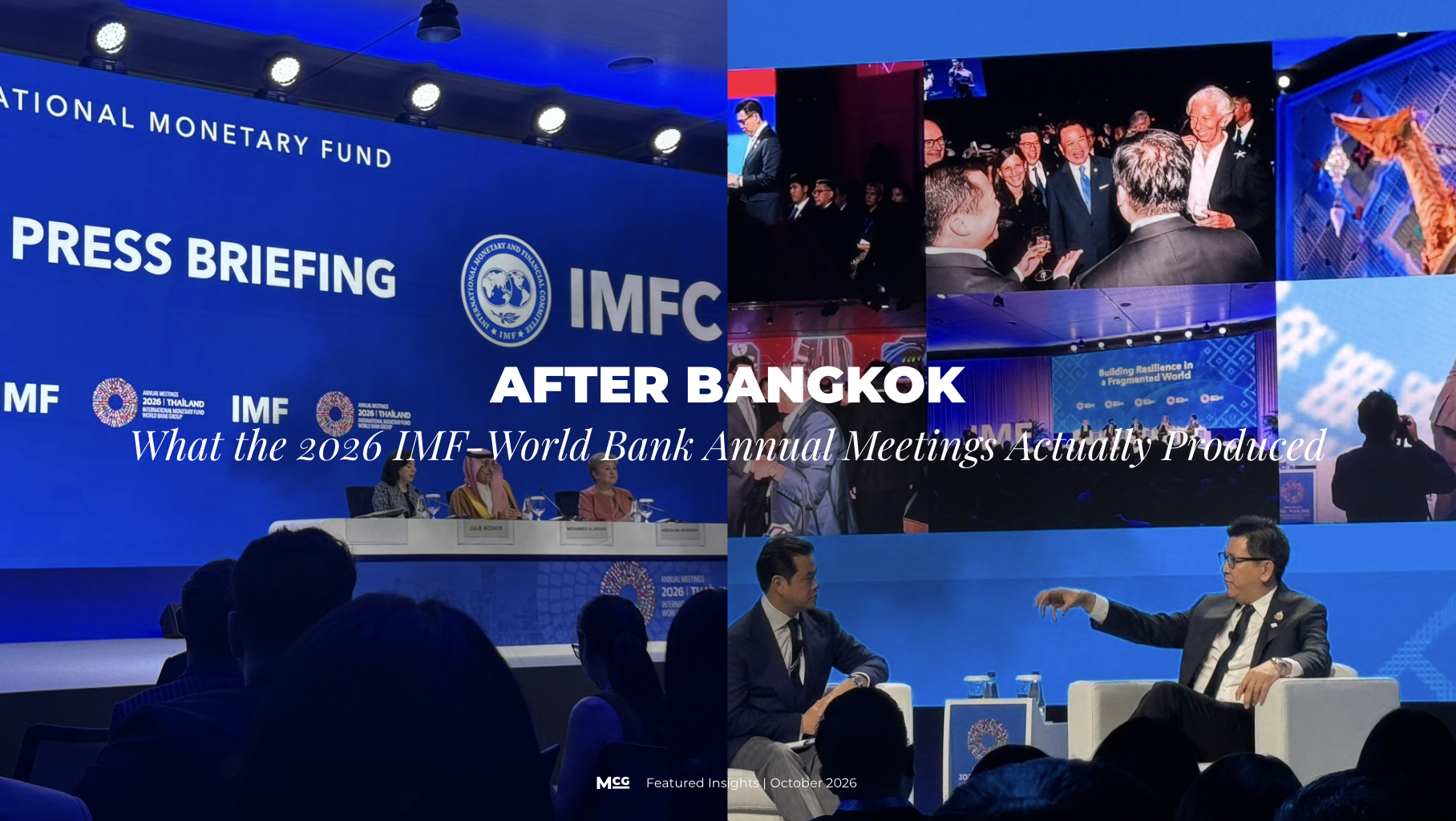
By that measure the 2026 Annual Meetings produced several things of markedly different standing. Some already have documents, names and timetables attached and can be followed from here. Others remain propositions whose significance will depend on the machinery assembled behind them.
The Bangkok Blueprint and its companion paper
The clearest institutional product of the week runs to forty-eight pages. The Bangkok Blueprint for Fraud-Resilient Financial Services sets out twelve key considerations under five pillars, covering legal foundations, the fraud-mitigation cycle, enforcement frameworks, cross-border cooperation and consumer protection. Fourteen IMF and World Bank staff prepared it. Tobias Adrian and Yan Liu authorised it for the Fund, Pablo Saavedra for the Bank. It builds on the Bali Fintech Agenda of 2018.
The document is precise about its own standing. "The blueprint is a nonprescriptive framework, not formal IMF and WBG policy guidance." Its force runs through country dialogue and through the two institutions' contributions to the bodies that write standards, which is why it mattered that Andrew Bailey spoke at the launch in his capacity as Chair of the Financial Stability Board as well as Governor of the Bank of England.
Formal authorship and institutional contribution are not quite the same thing here. The Blueprint lists IMF and World Bank staff as its authors, while the IMF's seminar page describes the twelve considerations as developed with the Fund and the Bank working "in partnership with the Bank of Thailand". Researchers at the Bank of Thailand and the Puey Ungphakorn Institute produced the companion paper, The Bangkok Blueprint in Action, presented at the same launch on 14 October. Sommarat Chantarat, Thammarak Moenjak, Nakarin Amarase, Kanyarat Suwannama and Thiti Tosborvorn wrote it, drawing operational lessons from Hong Kong SAR, Malaysia, Singapore and Thailand.
The distinction matters more than any question of credit. The framework is a joint IMF and World Bank publication. The companion is Thai-authored and regionally comparative, and it exists rather than being promised.
Its findings also explain why this material matters outside financial regulation. The Thai experience it describes shows a shift towards authorised push-payment fraud, in which victims are manipulated into moving the money themselves and the funds pass through mule accounts within minutes, which makes prevention far cheaper than recovery. The paper argues for clear liability allocation, legal protections for good-faith data sharing, and cross-border cooperation that operates as a standing arrangement rather than through treaty processes. The gap it identifies is data sharing with telecoms, e-commerce and social media companies, whose regulators sit elsewhere in government. Governance across institutional boundaries is the constraint running through this series.
From a proposed Bangkok Declaration to the Bangkok Dialogue Notes
On 9 October, three days before the meetings opened, Ekniti Nitithanprapas said Thailand would propose a Bangkok Declaration, with the week's Bangkok Dialogue expected to culminate on the final day as part of it.
What Thailand published on 17 October was the Bangkok Dialogue Notes. The host site is explicit about the character of the exercise. The Dialogue sought "ideas and actions" rather than "negotiated outcomes or formal recommendations", and it "did not seek to produce consensus".
No public explanation of the change exists and it should not be over-read, since documents of this kind are drafted under time pressure and a working title is frequently not the final one. The sequence does establish the standing of what Thailand published: an agenda-setting proposition that still requires political or institutional machinery behind it. Annual Meetings are not designed to produce negotiated settlements, so the test is not whether Bangkok delivered one. It is whether propositions of this kind acquire owners.
The substance has attracted less attention than the phrase attached to it. Five reflections run through the Notes, one of which bears directly on this series: the quality of a connection is measured by what remains locally, and trade, investment, technology and climate finance should be assessed by the skills and the stronger firms they leave behind. Four forward pillars follow, covering trusted digital futures, trade and geoeconomic fragmentation, climate transition and adaptation, and demographic shift and longevity. The proposition Thailand carried into the room is the one Part II found in the domestic reform agenda, that capital arriving is worth less than capability remaining.
Trusted Connector: representation, payments and sequencing
The Notes advance a general proposition, that countries and institutions which build trusted connections can increasingly serve as Trusted Connectors in a fragmented world. Thailand's own communications then place Thailand within that category, the official release describing the country as championing the role.
Connector status becomes durable only when it is anchored in a capability counterparties actually use. A formulation on its own establishes nothing, which makes the relevant question what Thailand already connects.
Two answers are a matter of record, and neither originated in Bangkok. Ekniti chaired the 57th Joint IMF and World Bank Group SEAVG Briefing on 14 October, with Piti Disyatat, Deputy Governor of the Bank of Thailand, among those attending. The following day he delivered Thailand's statement to the 114th Development Committee on behalf of the South East Asia Voting Group, arguing that development finance should generate quality jobs and leave local businesses with a meaningful share of the growth. Representing a regional constituency inside the Bretton Woods institutions is a standing function with its own rules.
The second is infrastructure. The Bank of Thailand is one of the founding partners of Project Nexus, the BIS Innovation Hub work linking domestic instant payment systems. In March 2025 the central banks and payment system operators of India, Malaysia, the Philippines, Singapore and Thailand incorporated Nexus Global Payments in Singapore, a not-for-profit entity, to take the scheme into operation. Indonesia joined as the sixth jurisdiction in February 2026. A PayNet and NETS joint venture was appointed technical operator the same month, and the company is working towards go-live in late 2027.
Nexus is the most literal evidence available for the connector proposition, because it is cross-border infrastructure with an operating entity and a timetable rather than a description. It is also not yet carrying payments. Founding membership of the operating company establishes Thailand's institutional position today. Whether Thai transactions flow across it from 2027 is a separate question, and the one that settles the argument.
Agreements and financing around the meetings
Among the instruments that emerged around the meetings, two were formal agreements and one is a reported commitment. None should be treated as having been created by the meetings themselves. Thailand and the Asian Development Bank exchanged loan agreements for $212 million at the Ministry of Finance on 15 October, covering five public hospitals in Chiang Mai, Nakhon Sawan, Kanchanaburi, Chanthaburi and Nakhon Ratchasima and serving around 14 million people outside Bangkok, within a $302.21 million project carrying $90.30 million of government money. The ADB identifies it as its first loan to the Thai government in the health sector, and Masato Kanda described the exchange as the start of implementation.
Thailand and Norway signed a double taxation convention, with base erosion and profit shifting provisions aligned to OECD and G20 standards. Domestic procedures remain outstanding before it enters into force.
Ekniti further reported securing World Bank funding for a flood and disaster study covering the Chao Phraya and Pa Sak basins, describing it as a direct result of the week's discussions. That rests on his account rather than on a published instrument.
OECD accession: a domestic target on an international process
Thailand's accession is the most measurable process the week touched, and the stages within it are routinely collapsed. Cormann said in Bangkok that twenty-five OECD committees are now reviewing Thailand, while the Thai government works towards its stated objective of accession by 2028.
Committee activity is not the same as a formal committee opinion, and neither is the same as changes to Thai law. The OECD's own description of the process is unambiguous on both the sequence and the timetable. Each committee issues a formal opinion at the end of its review, those opinions inform the Council, and the Council "takes a final and unanimous decision on whether to extend an invitation". On timing it states plainly that "there is no deadline for completion of the accession processes".
So 2028 is a Thai political target set against an international process whose pace Thailand does not control and whose conclusion requires the unanimous agreement of existing members. That makes it a reasonably clean test of domestic reform capacity, which is rare. The preceding article in this series set out why, in a system where political assent is abundant and the instruments meant to follow it frequently are not.
Bangkok created none of that process. What the week supplied was a concentrated run of senior attention to it. Cormann dined with Vice Minister for Foreign Affairs Sarun Charoensuwan on 14 October, where the Thai side reaffirmed its political commitment, met Anutin and Foreign Minister Sihasak Phuangketkeow on 16 October, and met Ekniti again in Hong Kong on 20 October at the APEC Finance Ministers' Meeting, two days after the Bangkok meetings closed.
A related domestic question is harder to observe, and Thailand had begun moving on it well before the meetings. The Dialogue Notes and the Development Committee statement both hold that investment should be assessed by what it leaves behind, and Ekniti applied the same standard publicly to data centres.
The Board of Investment now requires promoted data centre projects to fill at least half their executive and specialist positions with Thai nationals within three years, a condition it ties explicitly to the transfer of technology and knowledge, and it requires proposed training, joint curricula with universities, research and supplier development to be completed before the corporate income tax exemption can be drawn.
The Data Center Business Policy Committee, which met for the first time under the Prime Minister on 4 September 2026, has four subcommittees drafting standards covering project viability, energy and water requirements, siting and environmental performance. The question after Bangkok is whether those separate requirements become a system capable of showing what skills, productivity and domestic capability an investment actually leaves behind.
The ASEAN test: Singapore 2027, Thailand 2028
Nothing regional originated in Bangkok either. The Digital Economy Framework Agreement negotiations concluded earlier in 2026, the ASEAN Power Grid has its own financing architecture, and Nexus has been running since 2022.
What the week supplied was a setting in which those tracks occupied the same conversation as global capital and the multilateral institutions. On 14 October ASEAN met with the IMF, AMRO and the ADB. Ekniti discussed ASEAN connectivity with Indonesian Finance Minister Suahasil Nazara, proposed an ASEAN-Europe finance ministers' meeting, and raised joint work with Singapore ahead of Thailand's 2028 chairmanship.
The IMF advanced the regional argument independently in the same week. Georgieva's foreword to Shaping the Future of Asia holds that deeper regional integration, "particularly through digital connectivity and cross-border financial and payment systems, can provide an important source of future growth and resilience".
Singapore chairs ASEAN in 2027 and Thailand in 2028. A chairmanship sets a theme more reliably than it sets a programme, and no Thai agenda advances unless neighbouring governments find their own interests within it. The two years offer the opportunity to carry a small number of operating mechanisms across consecutive chairmanships instead of introducing a further annual theme.
What to measure
Thailand last hosted these meetings in October 1991. The IMF occasional paper published the month before carried a title worth recalling: Thailand: Adjusting to Success. David Robinson, Ranjit Teja, Yangho Byeon and Wanda Tseng credited an outward-looking economy, a development strategy built around the private sector and cautious financial policies, then turned to the strains that rapid growth was placing on infrastructure, finance and the distribution of the gains. Contemporary reporting also noted that roughly a quarter of the population remained in poverty. Growth itself was generating the policy problem in 1991. In 2026 the shortage of growth is generating it, under demographic and geopolitical conditions considerably less favourable. What is worth comparing is what Thailand proved able to do after each meeting, rather than what either announced during it.
Four things are worth following.
OECD accession. How many of the twenty-five committees issue formal opinions, what changes in Thai law and policy as a result, and how far either advances towards the 2028 target.
The Bangkok Blueprint. Whether the framework and the Bank of Thailand companion begin appearing in supervisory arrangements, liability allocation, cross-sector information sharing or regional enforcement practice.
The Dialogue Notes pillars. Whether any of the four acquires Cabinet authority, a budget line, a regulation or an international mechanism, rather than remaining a ministerial document from a hosting year.
Nexus. Whether implementation holds to its 2027 schedule, and whether Thai transactions subsequently flow through it.
Those tests run through 2027 and 2028, which is appropriate to what Bangkok produced. The significance of the 1991 meeting is clearer in retrospect than it was during the week itself. The same discipline should apply now. By 2028 there should be harder evidence to work from: committee opinions issued, laws amended, mechanisms funded, and a payment system either carrying Thai transactions or not.
Series note. This is Part III and the conclusion of MCG's series on Thailand and the 2026 IMF-World Bank Annual Meetings, 12 to 18 October 2026. Part I examined what happened to Thai investment, capital allocation and productivity after the delegates last left Bangkok in 1991. Part II examined the growth model Thailand is trying to build in their place. An interlude written during the meetings asked what separates political intent from implementation. Ben Kiatkwankul's companion essay in Asia Sentinel, "Thailand and a Tale of Two IMF Meetings", examines the 1991 meetings and the road to 1997.
— Ben Kiatkwankul, Partner & Co-Founder
mcg-asia.com | Bangkok
Ben Kiatkwankul is Co-Founder and Partner at Maverick Consulting Group. He advises businesses and institutions on government relations, public affairs and business diplomacy, with a particular focus on Thailand and policy-driven markets across Southeast Asia.
About Maverick Consulting Group
Maverick Consulting Group (MCG) is a strategic advisory firm specialising in government relations, public affairs and business diplomacy. Based in Bangkok, MCG helps organisations understand how government systems actually work, build defensible positions and operate within the institutional, regulatory and political conditions shaping business outcomes.