
Bangkok Governor Election 2026: What the Next Generation Expects
Bangkok elects its governor on 28 June 2026, and the polling leaves little suspense at the top: across every major survey, incumbent Chadchart Sittipunt leads by a wide margin and looks set to return for a second term. Rather than add to the campaign commentary, we asked two of our interns to step back from the noise and write about the Bangkok they actually want. What follows is what they wrote, lightly edited for accuracy and kept in their own voice.
Let’s hear it from our bright junior members, Pitthayut Suradee and Akarawin Rimcharone.
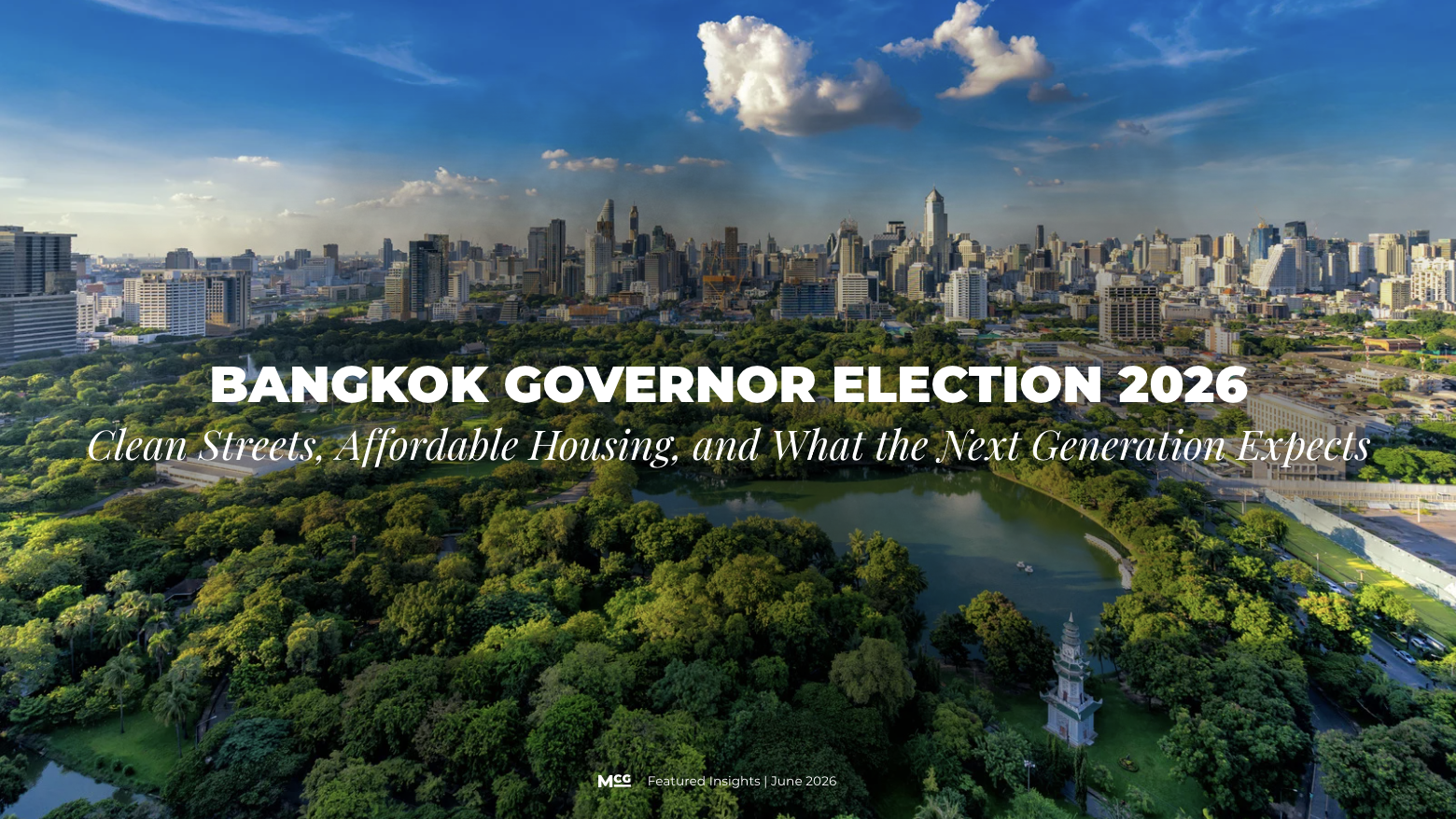
As Bangkok prepares for its gubernatorial election on 28 June 2026, two front-running candidates are proposing sharply different visions for the city. Dr. Chadchart Sittipunt, the incumbent known for steady administration, faces Dr. Chaiwat Sathawornwichit ("Dr. Joe") of the People's Party, a challenger promising bold urban reform.
Polling data reveals that Bangkok residents, especially younger generations, are most concerned about two interrelated issues, namely urban cleanliness and waste management, and housing affordability. The city generates approximately 9,000–10,000 tonnes of solid waste daily, its canal communities face persistent flooding and pollution, and its housing market remains structurally inaccessible to first-time buyers burdened by post-pandemic household debt.
The next governor will inherit a city navigating a complex intersection of ageing infrastructure, rapid urbanisation, and rising citizen expectations. The two leading candidates offer distinct approaches, one prioritising feasibility and continuity, the other betting on structural reform. Although early polling has placed Chadchart well ahead, the outcome of this election will shape Bangkok's urban trajectory for at least four years.
What the Next Generation Expects
Survey data from Dusit Poll indicates that Bangkok voters aged 18–35 rank urban cleanliness, public safety, and housing affordability among their top three priorities when evaluating candidates for governor.
This generation has grown up navigating flooded streets, competing in a mortgage market that routinely rejects first-time buyers, and living in neighbourhoods where waste disposal infrastructure has deteriorated for decades. Their expectations are include fewer overflowing bins, cleaner canals, and a credible pathway to home ownership.
The following two sections examine Bangkok's most pressing urban challenges in detail, followed by a comparative evaluation of each candidate's policy response.
Urban Cleanliness and Waste Management
1. Current Problems
Street Litter and Inadequate Public Bins. Bangkok's streets suffer from a visible and chronic litter problem. Overflowing trash bags pile up on sidewalks and around tree bases, while residents are frequently left with no nearby disposal point, carrying waste long distances.
The absence of public bins is not accidental. Following the 2006 New Year's Eve bombings, in which explosives were placed inside street bins, the BMA removed large numbers of receptacles from the city as an emergency security measure. While the response was a proportionate reaction to a genuine threat, it left Bangkok's waste disposal infrastructure in a state it has never fully recovered from.
Drainage Blockage and Urban Flooding. Official BMA data shows that during the heavy rain season, street litter regularly clogs drainage systems, directly contributing to the city's chronic urban flooding. The BMA's own Greener Bangkok campaign acknowledges that unmanaged solid waste is one of the primary, preventable causes of drainage failure.
Canal Dumping in Waterway Communities. Residents along Bangkok's klong (canal) communities have been flagged for disposing of household waste directly into the waterways. Critically, this behaviour is not primarily a cultural failing but a structural consequence of inadequate local garbage collection access.
Community Organization Development Institute (Public Organisation - CODI) research into Bangkok's canal housing communities confirms that many residents in waterway-adjacent settlements lack regular, accessible waste pickup services. Without local alternatives, canal disposal becomes a rational, if harmful, default.
2. Root Causes
Bangkok's waste management failures can be traced to four interrelated structural causes:
The post-2006 removal of public street bins, which created a lasting gap in disposal infrastructure that was never systematically replaced.
Weak and fragmented waste collection infrastructure, particularly in lower-density and canal-adjacent residential areas.
Decade-long reliance on reactive measures such as additional garbage trucks and volunteer canal dredging campaigns, which treat symptoms rather than systemic gaps.
The absence of a comprehensive zoning-based approach to waste infrastructure, meaning disposal points are not matched to population density or community access needs.
Bangkok currently generates between 9,000 and 10,000 tonnes of waste per day, of which food waste alone accounts for close to half, and only an estimated 4,000 tonnes are recovered or reused at the source.
3. International Benchmarks
Germany: Pole-Mounted Micro-Bins. Germany offers the most directly transferable model for Bangkok's street-level disposal problem. Across German cities, small bins are mounted on utility poles at nearly every transit stop and major pedestrian intersection. Their frequency makes littering a choice rather than a necessity.
Adapting this model to Bangkok would require revised procurement and a mapping exercise to identify high-footfall corridors, but the infrastructure cost per unit is modest and the behavioural impact has been substantial.
Underground Concrete Silo Systems. Several Northern and Central European cities (including those in Germany, Sweden, and the Netherlands) have adopted underground waste silo systems for high-density residential areas.
These systems store waste in underground concrete chambers, with small surface-level inlet points. They offer significantly higher capacity than conventional street bins, prevent odour and animal interference, require less frequent collection, and occupy minimal pavement space.
For Bangkok's klong communities, underground silos installed within walking distance of canal-adjacent residences would provide a permanent, hygienic alternative to waterway disposal, addressing the root access problem directly rather than continuing to punish residents for a gap in services.
Housing Affordability in Bangkok
1. The Current Housing Crisis
Household Debt and Mortgage Rejection. Thailand's housing affordability problem is primarily a financing problem, not a supply problem. During the COVID-19 pandemic, millions of Thai households took on emergency short-term loans to replace collapsed income, and those liabilities did not remain short-term.
Household debt as a share of GDP surged to among the highest levels in the region, peaking at around 95.5 percent in early 2021; although it has eased since to roughly 86–87 percent, it remains structurally elevated, and non-performing loans (NPLs) on household credit have continued to climb, with foreclosures of lower-priced homes rising sharply.
The consequence is a mortgage market that routinely rejects first-time buyers who, on paper, should be able to afford a home. Many are left with no option but to purchase outright in cash, an effective exclusion from home ownership for most working-age Bangkokians.
Declining Purchasing Power. Rising construction costs, stagnant wage growth, and elevated household debt obligations have collectively reduced the real purchasing power of Bangkok's working population. Despite the nominal availability of housing units at various price points, the financing environment has made formal home ownership increasingly inaccessible to median-income earners.
2. Structural Problems in the Housing Market
Housing Oversupply in Low-Demand Locations. Following post-pandemic infrastructure investment in Bangkok's skytrain network, private housing developers responded with a wave of speculative construction, primarily in suburban corridors along new transit lines. The result is a large and growing inventory of unsold units in areas where actual housing demand is limited, a misallocation that ties up capital and depresses developer confidence without meaningfully addressing Bangkok's affordable housing deficit.
Transit-Oriented Speculation. The government's infrastructure investment, intended as a recovery stimulus, produced an unintended market distortion. Land values along new transit corridors rose rapidly, attracting speculative development rather than demand-driven residential construction. The housing produced was primarily mid-to-high-end condominium product, not the affordable units the market actually needs.
Land Hoarding in High-Demand Areas. In densely populated central Bangkok, a significant share of vacant or underutilised land is held by owners who face minimal carrying costs due to a widely exploited tax classification loophole.
Under the Land and Buildings Tax Act, land used for agriculture is taxed at very low progressive rates, as little as 0.01 percent and capped at 0.15 percent, and is exempt entirely for individual owners below a 50-million-baht threshold, whereas vacant or unused land is taxed from 0.3 percent, rising by 0.3 percentage points every three years up to a 3 percent ceiling.
The gap is wide enough that owners plant bananas, limes, or papaya on prime plots along roads such as Ratchadaphisek, Rama IX, and Ekkamai to reclassify them as agricultural, effectively subsidising land hoarding in areas where housing development is most urgently needed.
Hidden Cost of Housing. Housing affordability in Bangkok is not solely determined by the price of a home. For many households, the true cost of housing also includes the cost of commuting. As property prices in central Bangkok continue to rise, many families are increasingly pushed toward suburban districts where housing is more affordable. However, these savings are often offset by higher transportation expenses and significantly longer travel times.
As a result, many Bangkok residents face a difficult trade-off: live closer to employment centres and pay substantially higher housing costs, or move to more affordable suburban areas and bear the burden of expensive and time-consuming daily commutes. In some cases, lower housing prices are accompanied by transportation costs that significantly reduce the financial benefit of living farther from the city centre.
The BMA's Role: Limits and Levers
It is important to acknowledge what the BMA cannot do. Most of the structural drivers of Bangkok's housing crisis (household debt management, mortgage regulation, national land use law, and macroprudential policy) fall under the jurisdiction of the national government. The BMA cannot reduce household NPL rates, reform the Land and Buildings Tax Act, or direct the Bank of Thailand's mortgage lending guidelines.
What the BMA Can Do
Revise and enforce zoning regulations to restrict the agricultural land classification loophole in urban areas, closing the tax arbitrage, using the power given by the Ministerial Regulation on the Bangkok Comprehensive Plan.
Use its urban planning authority to designate strategic mixed-use zones in underutilised inner-city areas, making developable land available for affordable housing projects.
Apply eminent domain selectively in cases of prolonged land vacancy in high-need corridors, enabling public or social housing development.
Leverage BMA-controlled land assets as sites for subsidised housing, reducing dependence on private market supply where affordability is most acute, as the BMA is a legal entity created by the Bangkok Metropolitan Administration Act.
The BMA's most effective tool may be zoning reform. Creating more restrictive zoning maps for strategic inner-city parcels would reduce the economic incentive to hoard land while making space available for housing at scale.
Fiscal Reality and Budget Constraints
Bangkok's next governor will inherit a budget that looks large at first glance, but the fiscal room for new policy is narrower than it appears. The FY2026 city budget totals approximately 93 billion baht, yet only about one quarter of Bangkok's recurring revenue is collected by the city itself, while the rest comes through taxes and fees collected by other state agencies.
The city also carries large inherited obligations: official budget documents record roughly 90 billion baht in multi-year commitments, and recent cash-flow statements show Bangkok drawing more than 23 billion baht from accumulated funds to settle Green Line debt. In other words, the BMA has money, but not unlimited discretionary money.
This matters for both housing and waste policy. Every baht devoted to new housing stock, rental support, or waste infrastructure is money not being spent on flood control, roads, district services, hospitals, or environmental management. By contrast, Bangkok's directly identifiable housing machinery remains extremely small. That means serious housing reform will require more than mayoral intent: it will require reprioritisation within the budget, new partnership capital, or support from the central government, especially on housing finance and transit integration.
Candidate Policy Comparison
The policy comparison focuses on Dr. Chadchart Sittipunt and Dr. Chaiwat Sathawornwichit, as their campaign platforms offer the most comprehensive responses to the key issues shaping this election, particularly urban cleanliness, waste management, and housing affordability. As the two frontrunners, their proposals provide valuable insight into the competing visions for Bangkok's future development. They are not the only candidates in the field. The Democrat Party's Anucha Burapachaisri and others are also contesting, but these two frame the central choice most clearly.
1. Dr Chadchart Sittipunt (Independent)
Housing: Lease-to-Save Model. Dr. Chadchart's flagship housing proposal is a "Lease-to-Save" model, which converts rental lease payments over a three-to-five-year period into savings that accumulate toward future home ownership. The policy is designed to help households with impaired credit histories rebuild financial standing while securing stable housing tenure.
The model's strength is institutional compatibility: it works within existing BMA administrative structures and avoids large capital outlays. Its limitation is scope: it is a financial bridge, not a supply-side solution. Critics argue it defers, rather than resolves, the access problem, particularly for households whose debt burden precludes any lease arrangement.
Waste Management Approach. Dr. Chadchart's administration launched the "No Mixed Waste" initiative. From October 2025, the standard monthly collection fee for an ordinary household rose to 60 baht, but households that register through the BKK Waste Pay application and separate their waste pay a reduced rate of 20 baht. This represents a relatively low-cost, scalable behavioural incentive, but it does not address the structural absence of disposal infrastructure in underserved areas.
2. Dr Chaiwat Sathawornwichit (People's Party)
Housing: Public Investment in Long-Term Affordable Housing. Dr. Chaiwat's housing platform commits to substantial public investment in long-term affordable housing for low-income households. The approach draws on the models of Vienna and Singapore, both of which demonstrate that the government, acting as a direct housing provider rather than a market regulator, can deliver meaningful affordability at scale.
The policy is structurally ambitious. Evidence from Vienna's social housing programme and Singapore's HDB model confirms that public construction at sufficient scale can durably depress market rents and expand ownership access. The central challenge is that Bangkok's budget may not provide adequate headroom for capital investment at the scale required to replicate these models.
Waste Management Approach. Dr. Chaiwat's waste policy focuses on improving efficiency, transparency, and accessibility throughout Bangkok's collection system. He has named the On Nut waste-treatment plant, whose odour pollution he says affects more than 400,000 residents, as his first immediate priority, arguing it falls squarely within the governor's direct authority, and has signalled a broader overhaul of the On Nut waste-management system alongside expanded private-sector participation. Notably, the incumbent administration had itself already begun moving to privatise collection and management at the On Nut and Nong Khaem sites, so the contrast between the two candidates here is one of emphasis and execution more than of fundamental direction.
A Note from MCG
A brief word on where this lands. The result itself is not in much doubt: Chadchart is the clear favourite for a second term. Behind him the field is crowded but distant, with the People's Party's Chaiwat Sathawornwichit second, independents such as Mallika Boonmeetrakul Mahasook and former city councillor Komsan Panwichartkul in the mix, and the Democrats' Anucha Burapachaisri further back. That last name is its own quiet story.
Bangkok was for years a Democrat heartland: the party won four straight governor races between 2004 and 2013, with Apirak Kosayodhin and MR Sukhumbhand Paribatra holding City Hall until 2016, before collapsing to zero Bangkok seats in the 2019 general election and then watching the People's Party sweep all 33 of the capital's constituencies this February. Anucha's run is an attempt to claw back onto that old ground, though the early polling suggests the revival is still some way off.
The more telling contest is the 50-seat Metropolitan Council, voted on the same day, where the People's Party leads and looks set to become the largest organised opposition. The likeliest picture on 28 June is a returned independent governor facing a more assertive, reform-minded council. For anyone operating in Bangkok, that means continuity with sharper oversight, and it keeps alive the deeper question the challenger raised whether a Bangkok governor holds enough authority to deliver what voters now expect.
What stayed with us about our interns' piece is where their analysis arrives, a point we return to often in our own work: the binding constraint in public life is rarely a shortage of good ideas. It is execution, the distance between what is announced and what is delivered. Bangkok's waste and housing challenges are, as they note, well understood and largely solvable. What has been missing is follow-through, and that is the standard the next administration will be measured against.
There is something instructive, too, in the lens itself. Those who will live longest with the consequences judge a city by whether it works, by clear streets, drainage that holds, and a realistic path to a home, rather than by the vocabulary of any campaign. It is a plain test, and a demanding one. We think it is the right one to hold the next four years to, and we are glad to have given two thoughtful young Bangkokians the room to set it down.
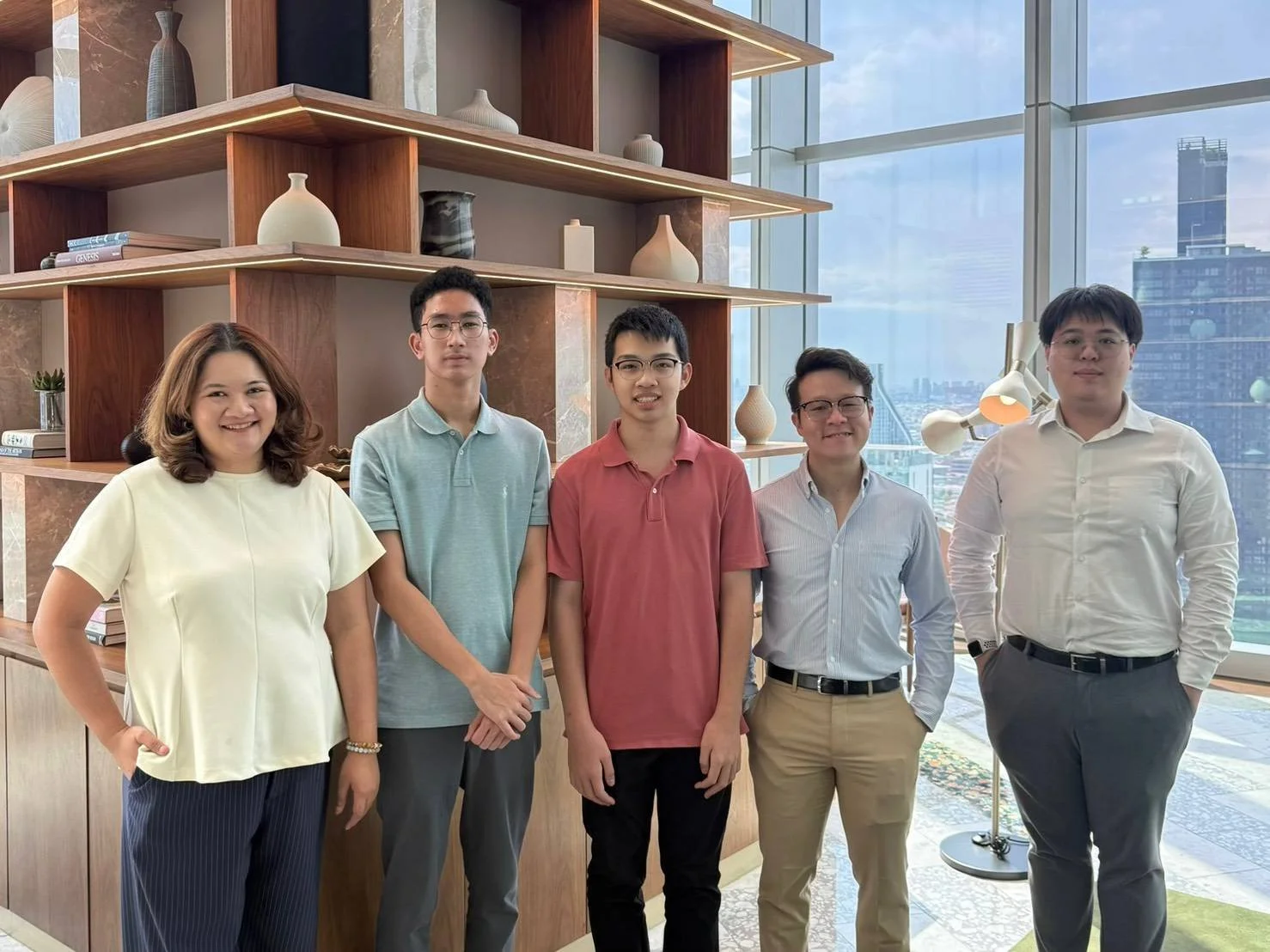
Maverick Consulting Group interns Pitthayut Suradee and Akarawin Rimcharone
Pitthayut Suradee and Akarawin Rimcharone are students at Suankularb Wittayalai School who joined Maverick Consulting Group as interns in May 2026. This piece grew out of a simple brief: to step back from the campaign noise and write about the Bangkok they want to see.
Parts of this article is also featured on Asia Sentinel.