
Thailand is preparing to give five million citizens a year of free access to premium AI tools through a 1,621-million-baht programme called the TH-AI Passport, now one of the most debated technology policies in the country.
This analysis is built from the tender document itself, the e-bidding announcement and the full terms of reference, together with government statements, parliamentary records and Thai press reporting. It explains what the programme is, how it came to be, how it works and why it is contested, then sets it against the national AI programmes of Malta, the UAE, Singapore, Estonia, Vietnam, India and Sweden to ask what separates the programmes that build lasting capability from those that mostly spend.
The essentials
The TH-AI Passport is a programme of Thailand's Ministry of Digital Economy and Society, implemented by the Office of the National Digital Economy and Society Commission. It offers five million Thais aged 15 and over free access to premium generative-AI tools for one year.
The contract is worth 1,621 million baht, funded by the Digital Economy and Society Development Fund rather than the annual budget. The tender, e-bidding number 6/2569, was announced on 24 December 2025 with bids due on 27 January 2026, and was won by the TH Consortium of Turnkey Communication Services PCL and Human Intelligence Co., Ltd. The terms of reference require a minimum of eight Pro or Premium AI products, at least two of them ranked in the global top five on recognised benchmarks.
Public registration was planned for June 2026 and the programme is now under ministerial review following parliamentary and public criticism.
What the TH-AI Passport is
The TH-AI Passport is a national AI access programme run by Thailand's Ministry of Digital Economy and Society, with the Office of the National Digital Economy and Society Commission (ONDE) as implementing agency. The state has procured a central platform that bundles leading generative-AI models and will open it to five million Thais aged 15 and over for one year at no charge.
Public statements on the scope have varied, around twelve models including ChatGPT Plus, Gemini Advanced and Claude Pro in the government's announcement, and fourteen providers totalling twenty-four models including Grok and the Thai-developed Typhoon in the minister's account to parliament. The tender document itself sets a contractual floor of at least eight Pro or Premium tier products, at least two of them ranked among the global top five on recognised international benchmarks, so the larger figures describe delivery above an eight-brand minimum.
The cost works out to roughly 324 baht per person per year, about 27 baht a month, against retail prices of several hundred baht a month, and the access is wrapped in a skills platform called Learn to Earn carrying AI courses, prompting instruction and certification developed with global technology firms.
How it came to be
The ministry frames the programme as the answer to two structural problems. Thailand is becoming a super-aged society with a shrinking workforce, and Thai AI adoption is low, an AI diffusion rate of 10.7 percent against 60.9 percent in Singapore, 23.5 percent in Vietnam and a global benchmark around 16.3 percent. The target is to lift adoption to roughly 20 percent or more by 2027. A one-month pilot with Google's Gemini that drew about 300,000 sign-ups is cited as evidence of demand.
The procurement moved quickly. Inter-agency work began on 17 November 2025, a public hearing on the draft terms of reference ran from 15 to 22 December, and the tender was announced on 24 December 2025 with bids due in a single morning window on 27 January 2026, giving bidders 34 days over the holiday period.
Three groups bid, and the winner was the TH Consortium, a joint venture of Turnkey Communication Services PCL and Human Intelligence Co., Ltd., at 1,621 million baht, about 1.5 percent below the tender's 1,645.69-million-baht reference price and about 1.76 percent below its 1,650-million-baht budget ceiling, which reconciles the two discount figures quoted in public debate.
Registration was planned for June 2026. On 2 June the minister said he was compiling feedback and was open to adjustments, including to the terms of reference, without confirming the original schedule.
How it will work
Thais aged 15 and over register and verify identity through state systems, which the ministry says serves only to confirm eligibility and prevent duplicate rights. Users access the bundled models through the state-procured platform rather than each provider's own app, with usage managed through token allocation, reserved cloud computing capacity, or a hybrid, under user tiers with differentiated credit quotas.
Around the tools sits a delivery layer the minister described to parliament, training for the operators of 2,222 community digital centres, regional boot camps for 4,000 participants, AI competitions, publicity across social media and television, and the now-contested requirement for advertising on digital screens in convenience stores.
Who governs it and who pays
Policy ownership sits with the DE Ministry under Minister Chaichanok Chidchob, implementation with ONDE, and delivery with the winning contractor, with the AI developers positioned as sub-suppliers rather than direct counterparties of the state.
The money comes not from the annual budget but from the Digital Economy and Society Development Fund, a statutory fund under Thailand's 2017 digital development law financed largely from telecommunications-sector revenues, which means the spending follows the fund's own approval machinery rather than the parliamentary budget process.
Former finance minister Korn Chatikavanij has criticised the structure as operating expenditure rather than investment, a one-year rental after which the country holds no technology assets.
What happens to the data
The ministry's position is that the AI providers cannot use Thai users' data or prompts to train their models, that data is stored on cloud infrastructure inside Thailand, accessible only in anonymised form, with identity data withheld from the model owners, all framed within the Personal Data Protection Act.
The data also has a declared second life. Anonymised usage data is to feed ThaiLLM, a Thai-language AI project intended to move the country toward sovereign AI, making the corpus of Thai interactions itself a national asset the programme is designed to accumulate.
Critics counter that foreign-owned software and model weights mean in-country servers are not data sovereignty, and that queries to foreign models are processed through the providers' systems regardless of where logs sit.
The debate, in brief
The contested elements cluster into three groups, each pairing a criticism with a ministry response.
The first concerns how the numbers were made.
Opposition MP Pawoot Pongvitayapanu says ONDE officials told a committee the five-million target came from dividing the available fund money by an assumed cost of about 300 baht per head rather than from measured demand, while the minister says it derives from adoption benchmarking and the Gemini pilot. The 34-day holiday-season bid window, reportedly the fastest in the fund's history, raised the question of whether any bidder without advance knowledge could compete, against the minister's reply that the full process ran more than five months and followed the law throughout.
Pawoot also states that the group involved in setting the reference price ended up winning the tender, which the minister answers by welcoming any investigation where there is evidence.
The second concerns what is being bought.
The terms of reference require advertising on screens in 1,500 convenience-store branches, and critics note a single media group is reported to hold those rights and to sit inside the winning consortium, while the minister replies that the media component is two pages of a 33-page document.
A technical estimate by Dome Charoenyost of Tokenine reads the specification as supporting about 140 concurrent users per second, implying a true cost far below the contract price in the absence of token guarantees, and commentator Arm Thananont notes the document requires neither live web search nor user API access. The ministry says the specification is outcome-based by design.
The third concerns the structure itself.
Critics ask why Thailand did not contract the AI developers directly, citing OpenAI's direct agreement with Singapore worth around 300 million Singapore dollars.
The minister says provider policy and Thai law prevented it. The tender's own eligibility rules are part of the explanation, since they required bidders to be juristic persons established under Thai law with a completed single contract worth at least 400 million baht, terms that excluded foreign developers from bidding directly by design.
Demands have been lodged for review by the State Audit Office and the National Anti-Corruption Commission, and the House law committee has received complaints and signalled it will summon those involved.
How Thailand compares, country by country
Thailand is not acting in isolation. Governments worldwide are moving to put advanced AI into citizens' hands, at different layers of the same system, some buying access to finished tools, some building skills, some funding the compute and models underneath.
The cases are not strictly like-for-like, but read together they reveal a pattern.
Malta
Malta has gone furthest on universal access.
Under a partnership with OpenAI described as the company's first with a national government, every citizen and resident, about 574,000 people, can receive a free year of ChatGPT Plus, with Maltese launch reporting indicating Microsoft Copilot as an alternative option, but only after completing a literacy course developed by the University of Malta and verifying identity through the national eID, with the Malta Digital Innovation Authority managing distribution. Premium AI is treated as a public benefit earned through learning, delivered through a direct developer partnership, with the official portal run by the MDIA.
Set against the Passport, Malta pairs the two things Thailand's design is most criticised for lacking, a capability gate on access and a direct contract with the developers.
United Arab Emirates
The UAE became, by OpenAI's account, the first country to enable ChatGPT nationwide under the OpenAI for Countries programme, and that access sits on top of Stargate UAE, a one-gigawatt compute cluster built with G42, Oracle, Nvidia, Cisco and SoftBank.
The state dealt directly with the developer through its national AI champion, and citizen access is the visible tip of a sovereign infrastructure investment few middle-income economies could replicate.
What Thailand rents for a year, the UAE is building underneath, which makes it a structural reference rather than a template.
Singapore
Singapore, the benchmark Thai officials cite, is built around fluency.
From late 2026, citizens 25 and over who enrol in selected AI courses receive six months of free premium AI access delivered through SkillsFuture, and the state has signed a national partnership with Google and a first agreement with OpenAI that includes roughly 300 million Singapore dollars and an applied AI lab. Beneath sits more than a billion Singapore dollars of public AI research, a national supercomputer and AI training for all public officers.
Singapore is the comparison Thai critics reach for most often, shorter access tied to courses, contracts held directly with the developers, and a research base accumulating underneath.
Estonia
Estonia's AI Leap programme gives students and teachers free access to leading AI tools, and the sequencing is the point.
Teachers are trained before students gain access, the rollout is phased from 20,000 senior-secondary students and 3,000 teachers outward, and the programme runs through a public-private foundation on direct partnerships with developers including OpenAI and Anthropic, consciously echoing the 1990s Tiger Leap that seeded Estonia's digital economy.
The contrast with the Passport is sequencing, since Estonia builds the teaching capacity before it opens the tools.
Vietnam
Vietnam, Thailand's closest peer and declared benchmark, has tilted toward domestic capability.
Its updated national AI strategy frames AI as national infrastructure, it passed the region's first dedicated AI Law effective March 2026 before scaling, its innovation fund directs at least 40 percent of its budget to AI with vouchers steering small firms toward locally built solutions, and Vietnamese groups have signed a sovereign AI infrastructure framework with Abu Dhabi's G42.
Where Thailand is moving access-first with no AI statute yet in force, Vietnam built the legal frame first and points its money at domestic builders.
India
India invests at the foundation.
The IndiaAI Mission, funded at roughly 1.2 billion US dollars, provisions tens of thousands of GPUs at subsidised rates through multiple empanelled cloud providers and funds indigenous models including a trillion-parameter consortium effort, with builders rather than end users as the audience and reduced foreign dependence as the stated aim.
India's is the capital-investment path that Thai critics such as Korn Chatikavanij propose for the Passport budget, assets and builders rather than a year of rented seats.
Sweden
Sweden offers an instructive middle path.
Its AI Reform gives 2.3 million Swedes, civil servants, teachers, students 13 and over, researchers and non-profits, free AI access for two years through a domestically owned platform that acts as a secure layer over frontier models from OpenAI, Google and Anthropic, a deliberate governance choice with largely private funding. It is an intermediary model, but a domestic, multi-model, governance-led one, with the programme's own platform page setting out the terms.
That makes it the instructive contrast with Thailand's intermediary, which is a single contractor selected by tender rather than a domestic governance layer.
Others, in brief
Iceland has given teachers access to Anthropic's Claude, Greece has brought OpenAI's tools into schools, the United Kingdom has an agreement with Anthropic on public services, and the United States has added OpenAI, Google and Anthropic to a government-wide purchasing schedule so agencies can buy directly from any provider.
Why these design choices matter
The stakes are more than rhetorical. A much-studied working paper by Brett Hemenway Falk and Gerry Tsoukalas, The AI Layoff Trap, argues that competing firms are driven to automate jobs away faster than is collectively wise, harming workers and firm owners alike, and that faster reabsorption of displaced workers into better roles, through retraining and new work, directly reduces the damage.
Whatever one makes of its contested remedy, a tax on automation, the distinction it sharpens matters here. AI that augments workers and AI that replaces them pull an economy in opposite directions, and a national programme that builds genuine capability is a bet on the augmentation path. That is the deeper case for tying public money to skills rather than to access alone.
What separates the programmes that last
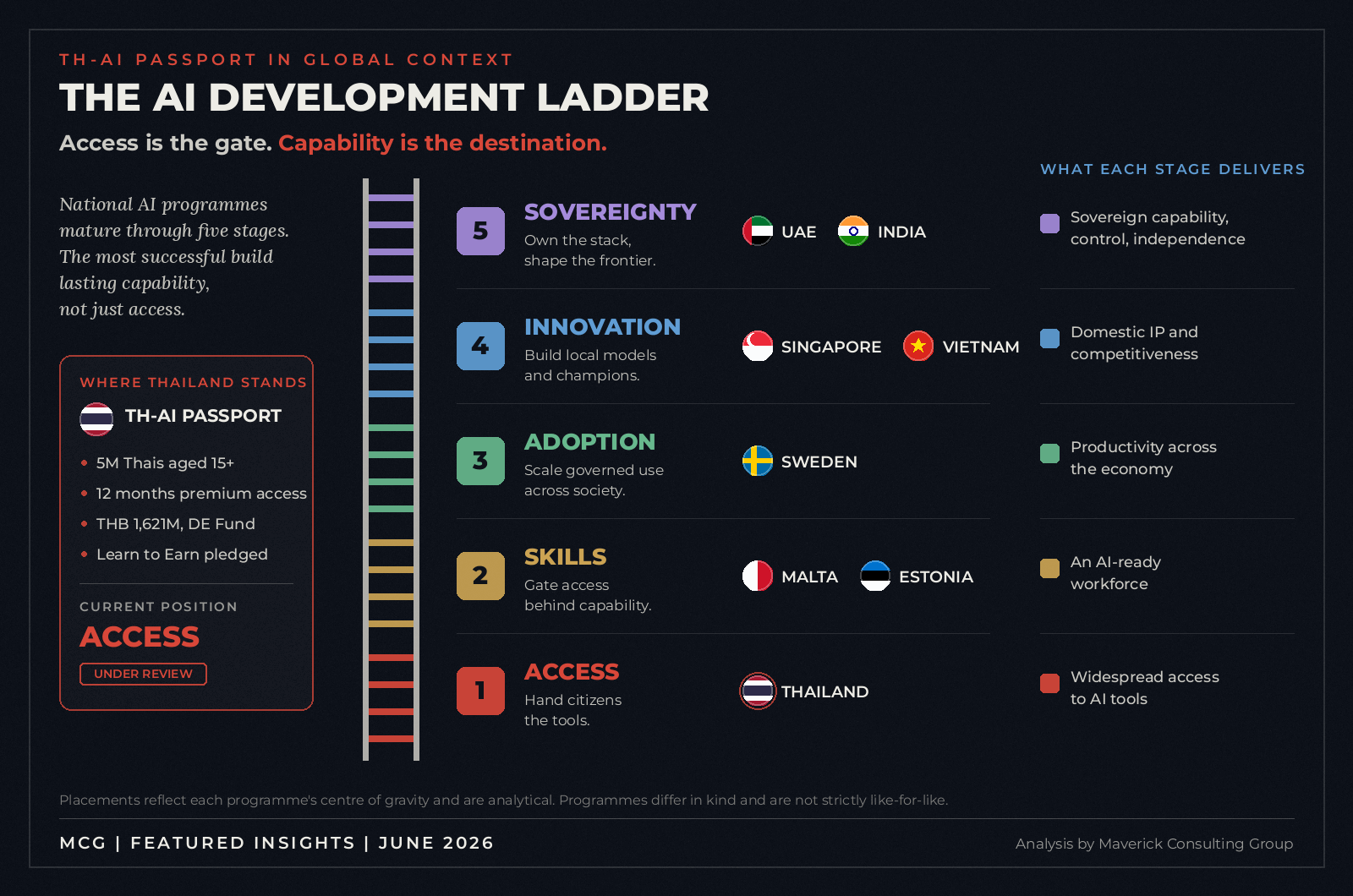
Where eight national AI programmes sit on the path from access to capability, as of June 2026. Placements are analytical.
The stages describe each programme's centre of gravity rather than a strict ranking, and Thailand's position reflects the programme as it stands today, with the terms of reference still open to amendment.
Read across these cases, five design choices recur among the programmes widely regarded as effective.
The first is that spending is tied to capability, not just access. Singapore links subscriptions to courses, Estonia trains teachers first, Malta gates access behind a literacy course, and Vietnam steers funds toward locally built solutions. The money buys competence, not just a login.
The second is that the access is specified richly enough to be useful, with live search, document handling, developer access and generous limits. This is one of the questions raised about Thailand's terms of reference, which require neither web search nor user API access, a reminder that in national AI procurement the technical detail is not a footnote.
The third is that the strongest programmes build something durable underneath. The UAE pairs access with sovereign compute, India funds compute and indigenous models, Vietnam is building its own cloud capacity. A year of rented tools leaves little behind, while compute, models and data endure. Thailand's ThaiLLM data ambition gestures in this direction, and whether it materialises is one of the programme's most important open questions.
The fourth concerns how a government holds its relationship with the companies that make the AI, and it is where Thailand differs most. The UAE, Singapore, Malta and Estonia contract the developers directly, India runs an open multi-vendor marketplace, the United States lets agencies buy from any provider, and even Sweden's intermediary is domestically owned, multi-model and built for governance. The common thread is that the relationship is kept direct, openly competitive or domestically controlled and accountable.
Thailand's single private platform selected by tender, with the developers as sub-suppliers, sits apart from that pattern, and the view that global developers will not contract directly with governments is not supported by the Malta, UAE, Singapore and United States examples.
The fifth is that effective programmes measure outcomes rather than sign-ups. Adoption rates count access. They say little about whether people use AI regularly, capably and to real economic effect, which is harder to count and is the thing that matters.
What it means for Thailand
Few programmes do all five of these well, and the right balance depends on resources and starting point. The Gulf can build compute at a scale a middle-income economy cannot, a small state can move faster than a large one, and Thailand's instinct to move quickly and widen access is sound. One advantage of moving slightly later than others is that their playbooks are now visible.
The TH-AI Passport reaches for access as the fastest route to capability, and it is currently paused between defence and review, with the minister gathering feedback and the terms of reference open to amendment. The experience of its peers suggests that access is a strong beginning and rarely the finish, and that the programmes which endure are the ones that turn access into skill, build something of their own underneath, and keep a direct or accountable hand on the relationships that matter most.
Whether Thailand's version makes that turn is the question worth watching, and the prize for making it is a workforce that AI augments rather than one it merely displaces. It is the same question every government now faces.
Where this analysis comes from:
This analysis was prepared independently by Maverick Consulting Group from public documents and reporting. The primary sources are the ONDE e-bidding announcement and the full terms of reference for the project, the Government Public Relations Department's official statement, and the minister's account to parliament as reported by Matichon, supplemented by The Momentum, Naewna and international reporting linked inline, and a 2026 working paper by Brett Hemenway Falk and Gerry Tsoukalas.
Contested claims are attributed to those who made them and paired with the ministry's responses. Figures reflect public statements that have in some cases varied between announcements, and country figures describe different types of programme and are not strictly like-for-like. The programme is under ministerial review and this page will be updated as it develops, with material changes noted at the top.
This article is for general information and policy discussion and does not constitute legal, financial or investment advice. Questions and corrections are welcome through our contact page.
— Ben Kiatkwankul, Partner & Co-Founder
mcg-asia.com | Bangkok
Maverick Consulting Group provides strategic advisory, government relations, and public affairs counsel across Thailand, Southeast Asia, and the Gulf. MCG advises international clients on regulatory strategy, market entry, stakeholder navigation, and political economy analysis in complex operating environments.