
featured insights
Stay tuned for what you need to know.
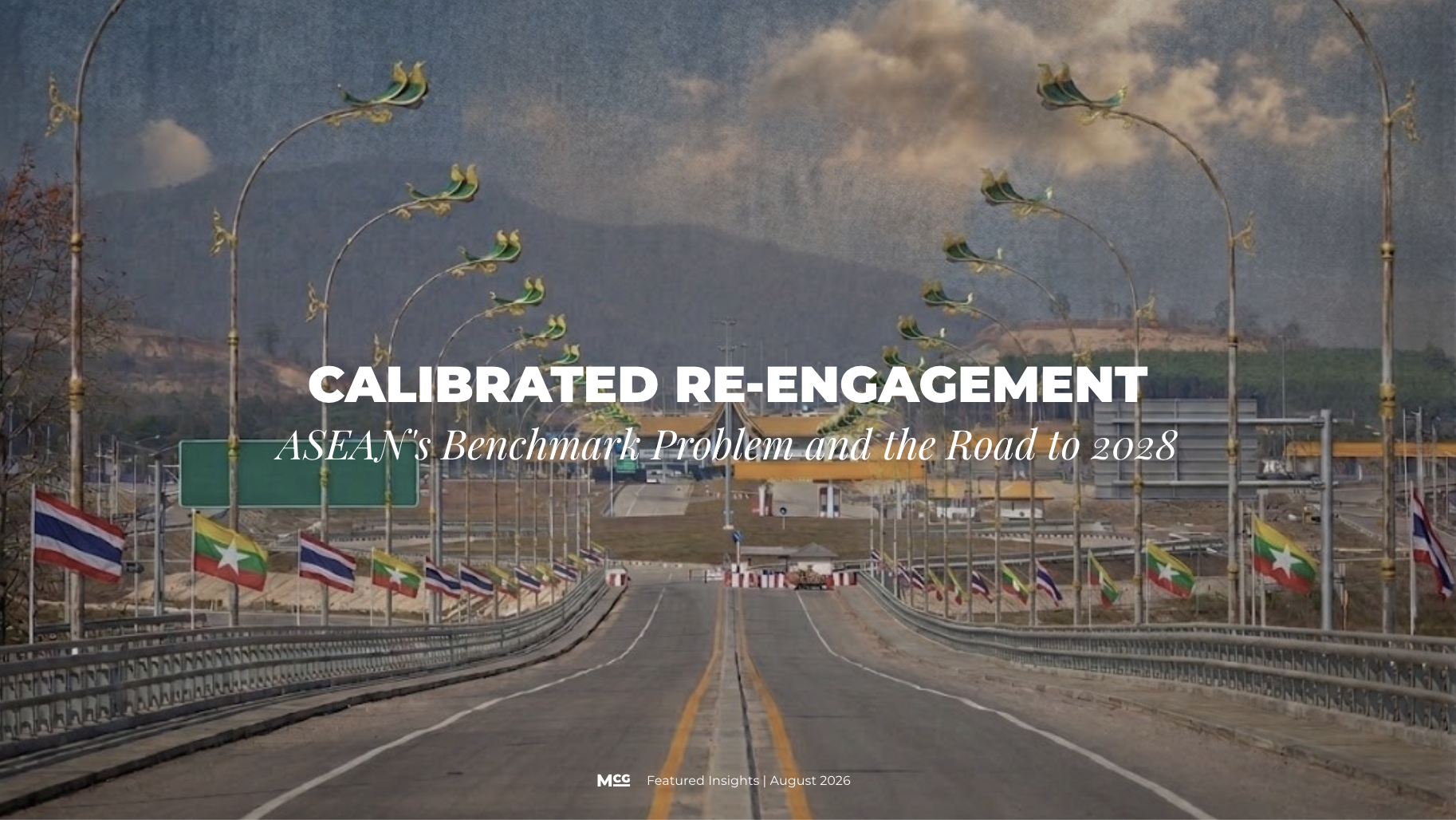
Calibrated Re-engagement: ASEAN's Benchmark Problem and the Road to 2028
Thailand has given its Myanmar policy a name, calibrated re-engagement, and a set of benchmarks to go with it. Its own foreign minister has since confirmed that no commitment was secured. MCG examines the framework ASEAN is quietly building in place of the Five-Point Consensus, why the bloc remains divided over it, and what the road to Thailand's 2028 chairmanship means for business across the border.
Thailand's TH-AI Passport, Explained, and How It Compares with National AI Programmes Worldwide
Five million Thais, twelve months of free premium AI, and 1,621 million baht drawn from a fund that sits outside the annual budget. Thailand's TH-AI Passport is the government's flagship AI initiative and its most contested. MCG read the full tender document, the e-bidding announcement and the 33-page terms of reference, then set the programme against the national AI initiatives of Malta, Singapore, the UAE, Estonia, Vietnam, India and Sweden, to ask the question that will actually decide whether the money is well spent. Not who won the tender, but whether access converts into capability.

Concrete Is Not Connectivity: What Thailand's Aviation Build-Out Actually Decides
Thailand is building its most ambitious airport expansion in a generation. But its future as an aviation hub will be decided in the institutional layer: its carriers, its MRO and cargo ecosystem, and the partnerships now forming in Paris, not in terminal capacity. A strategic read for 2026.
Thailand's Fever Test: What the Energy Crisis Reveals About the Limits of Political Stability
Thailand's new government inherited a structural illness. The Iran conflict did not create the crisis — it ran the diagnostic test. Six weeks into the Bhumjaithai mandate, a 35-billion-baht Oil Fund deficit, a minister who admitted on air that GPS tracking of oil trucks was never operational, and farmers in the ruling party's own heartland saying they cannot take it anymore. MCG examines what the energy crisis of March 2026 reveals about the structural limits of Thailand's political stability — and what it means for investors in the region.
Resilience Over Efficiency: How Geopolitical Risk Is Redrawing Asia's Digital Infrastructure Map
As subsea cable investment accelerates across Asia-Pacific, the logic driving it has shifted from efficiency to resilience. The cables being laid today are not just infrastructure — they are a map of how capital, governments, and great powers expect the next decade to unfold. MCG examines what this means for investors and multinationals operating in the region.

Thailand’s Data Centre Moment in a Shifting Global Landscape
As AI demand accelerates and geopolitical risks reshape global infrastructure, Thailand is emerging as a strategic location for data centre investment in Southeast Asia.
Thailand Election 2026: Coalition Power, Political Stability, and the Limits of Reform
Thailand’s 2026 election delivers stability through coalition arithmetic, but whether it can unlock meaningful reform remains uncertain. A post-election political economy analysis.

Thailand’s “Sick Man of Asia” Moment: The Structural Limits of an Electoral Reset
A political economy analysis of Thailand’s slowdown following FT’s “sick man of Asia” moment — and why the election alone cannot reset structural constraints.