
Thailand's Fever Test: What the Energy Crisis Reveals About the Limits of Political Stability
Thailand's new government inherited a structural illness. The Iran conflict did not create the crisis — it ran the diagnostic test. The patient failed.
On 13 February 2026, five days after winning Thailand's general election, Prime Minister Anutin Charnvirakul addressed foreign media and dismissed a Financial Times analysis that had described Thailand as the "sick man" of Asia. The label, he said, applied to previous administrations, not his. He cited Fitch Ratings maintaining Thailand's sovereign credit rating at BBB+ as evidence that the country was on sound footing. He was confident, forward-looking, and specific in his rebuttal.
On 28 March 2026 — six weeks later — he rejected the same label again. This time he was speaking to foreign media at Government House, insisting the country remained stable despite the energy crisis and saying a new government would be ready the following week. He was doing so with Thailand's Oil Fund carrying a 35-billion-baht deficit, diesel queues stretching through the night in provinces across the country, and a new cabinet still not yet formally constituted.
A political leader does not address a diagnosis twice unless it is gaining ground. The denial does not disprove the thesis. It confirms that the thesis has reach.
This article does not argue that Thailand is broken. It argues that the energy crisis of March 2026 has revealed the structural conditions under which the Bhumjaithai government is operating, conditions that were present before the Iran shock arrived, and that the shock has now made visible to the international investor community in ways that political analysis alone could not.
Brent crude, which opened 2026 near the historical norm of $60 per barrel, has surged past $90 following the effective closure of the Strait of Hormuz, a chokepoint through which roughly 20 million barrels of oil and refined products pass every day.
Bank of America has revised its 2026 Brent average forecast to $77.50 per barrel, with extended disruption scenarios pointing toward $130 or higher. Goldman Sachs has described the supply shock as the largest in the history of the global crude market. The Strait cannot reopen quickly even after a ceasefire, sea mines require clearance, damaged extraction infrastructure requires rebuilding, and shipping insurance confidence requires its own independent recovery timeline.
Thailand imports the majority of its refined energy needs. Its Oil Fund — the mechanism that has historically buffered domestic prices from global volatility — was burning through 2.59 billion baht per day by late March, with the fund's accumulated deficit reaching 35 billion baht.
This is approximately 80 billion baht per month in subsidy exposure, in a fiscal environment where Thailand's public debt ratio is already approaching the statutory ceiling of 70 percent of GDP.
This is the context in which Anutin is forming his government. The election result, the coalition arithmetic, and the governance failures of late March all read differently once the external pressure is understood to be structural and of at least two years' duration.
The Diagnostic Event: What the Midnight Hike Revealed
On the night of 25 March 2026, the caretaker government announced a 6-baht per litre increase across all fuel types at 10pm, immediately after Parliament adjourned following its first substantive session on the energy crisis.
Not a single cabinet minister had attended the debate to respond. Citizens who were awake rushed to petrol stations. Those who were not discovered the increase the following morning. Farmers queued through the night. Some waited two days.
The midnight timing was the communication failure that converted a necessary structural adjustment into a political crisis. The absence of accompanying relief measures was the governance failure that confirmed a deeper institutional problem.
The cabinet approved seven emergency measures only the following day, including a review of excise tax reductions and a 100-baht top-up to state welfare cards after the damage to public confidence had already been done.
Political economist Sirote Klampaiboon framed the arithmetic precisely: a 6-baht increase translates to a 10 percent rise in transport costs, a 20 percent rise in basic consumer goods prices, and a 6 percent erosion of real purchasing power overnight. For workers on Thailand's frozen minimum wage of 380 baht per day, this is not an inconvenience. It is, in his words, a disaster.
The supply chain data makes the governance failure concrete. Normal daily diesel consumption runs at approximately 72 million litres. During the crisis, Anutin himself confirmed consumption had surged to 87 million litres per day. The standard explanation was panic buying. The reality was more structural.
People's Party MP Woraphop Wiriyarojn identified two distinct groups driving the volume surge beyond genuine consumer demand. The first stockpiled fuel ahead of anticipated price increases. The second exploited the gap between Thailand's subsidised domestic price and the unsubsidised price in neighbouring Myanmar and Laos, where diesel was running at approximately 50 baht per litre.
As long as the Thai price was held artificially low, the incentive to divert supply across the border was structural, not incidental.
What made this traceable only in retrospect was a specific institutional failure, one confirmed on air by the minister overseeing the crisis response. Thailand's oil transport trucks carry GPS devices, a fact the government had cited as evidence of supply chain oversight.
What Deputy Prime Minister Phiphat Ratchakitprakarn acknowledged in a live television interview is that the ministry's GPS system had only ever been used to monitor driving speed. Real-time tracking of where trucks were actually going was not operational, including their destinations, their routes, and their final offtake points.

Screenshot: Channel 3, กรรมกรข่าว คุยนอกจอ, 28 March 2026
The decision to implement destination monitoring was made the day before his interview, weeks into the crisis. Reporting requirements for oil traders, daily disclosure of inventory and movement, were only mandated at the same late stage.
The government cannot follow oil through the final mile of its supply chain. It cannot verify whether elevated demand reflects consumption, stockpiling by end users, or systematic diversion by intermediaries. Thailand's six refineries were operating at full capacity throughout the crisis. Oil supply was not the problem. The problem was an institutional architecture with a documented and costly blind spot exactly where the pressure was highest, and a minister who confirmed it himself.
The Political Architecture: A License, Not a Mandate
Bhumjaithai won 193 of 500 House seats on 8 February 2026. Prime Minister Anutin Charnvirakul secured the premiership with institutional backing from Thailand's bureaucratic, military, and business establishment, what analyst Suranand Vejjajiva describes as a "license to govern."
This concept is analytically distinct from electoral legitimacy and from mass popular support. It is conditional, revocable, and performance-contingent.
The East Asia Forum has characterised the post-election settlement as reflecting fragile stability grounded in elite accommodation and provincial patronage rather than ideological consolidation. A separate analysis noted that the Bhumjaithai victory gives the green light for "grey capital" — the patronage networks and crony relationships that structural reform must ultimately dismantle.
The government's strength lies not in ideology or mass legitimacy but in its capacity to mobilise local political machines and entrenched provincial networks.
The energy crisis has sharpened a question that analysts have been asking since the election: whether the Bhumjaithai government has the political will to act against the energy sector interests embedded within its own coalition.
The cabinet includes figures with direct connections to Thailand's oil and energy industry, among them Deputy Prime Minister Phiphat Ratchakitprakarn, who oversees the crisis response, holds a stake in PTG Energy, the parent company of PT petrol stations, and whose brother serves in a senior executive role at the company.
The government that presided over the crisis is, in part, constituted by people who understand the price architecture better than any opposition MP. Woraphop Wiriyarojn's observation in Parliament that a government containing former PTT executives and oil sector figures should have been the best-positioned administration in Thai history to anticipate and manage an energy shock, is a question about political will, not technical capacity.
As MCG analysed in our post-election assessment, the result is a government strong enough to govern but not necessarily strong enough to transform the system that produced it. The energy crisis has made that gap concrete. The cabinet was assembled through the logic of factional accommodation rather than crisis capability.
The "empty chair" strategy, one position deliberately left vacant to maintain leverage over coalition partners, signals political management sophistication. It does not produce decisive executive action when an energy emergency requires it.
The public reaction in Bhumjaithai's own heartland was documented in real time. Farmers in Buriram province wearing Bhumjaithai shirts told reporters directly: the government is rich enough, share some with the people, we cannot take this anymore. In Kamphaeng Phet, farmers described selling tractors and returning to buffalo-drawn ploughs because diesel was no longer affordable.
When Anutin appeared at Government House on March 25 showing reporters his new BYD electric vehicle while petrol stations across the country hung "out of fuel" signs, the empathy gap became a political image that no communications strategy fully repairs.
Suranand Vejjajiva has identified a 30-day window in which the administration must demonstrate tangible economic relief or risk the revocation of elite institutional support.
Dr Olarn Thinbangtieo placed this in longer historical perspective. Every significant political rupture in Thailand's modern history has been preceded by the convergence of two conditions: hunger and perceived injustice. The rice queues before October 1973. The energy crisis that ended the Kriangsak government. The economic collapse that preceded May 1992.
Both conditions are now present simultaneously.
The deeper question is one of legitimacy. Thai academic, foreign policy advisor, and social entrepreneur, Fuadi Pitsuwan has argued that for Thailand to function as an effective actor in the current global environment, it must possess at least one form of credible legitimacy, political, economic, or military. The energy crisis has put all three under simultaneous pressure.
A government that cannot manage a supply chain it controls, cannot protect its own citizens from a price shock it saw coming, and cannot convene a full cabinet when the crisis requires it is a government whose legitimacy is being tested on every dimension at once.
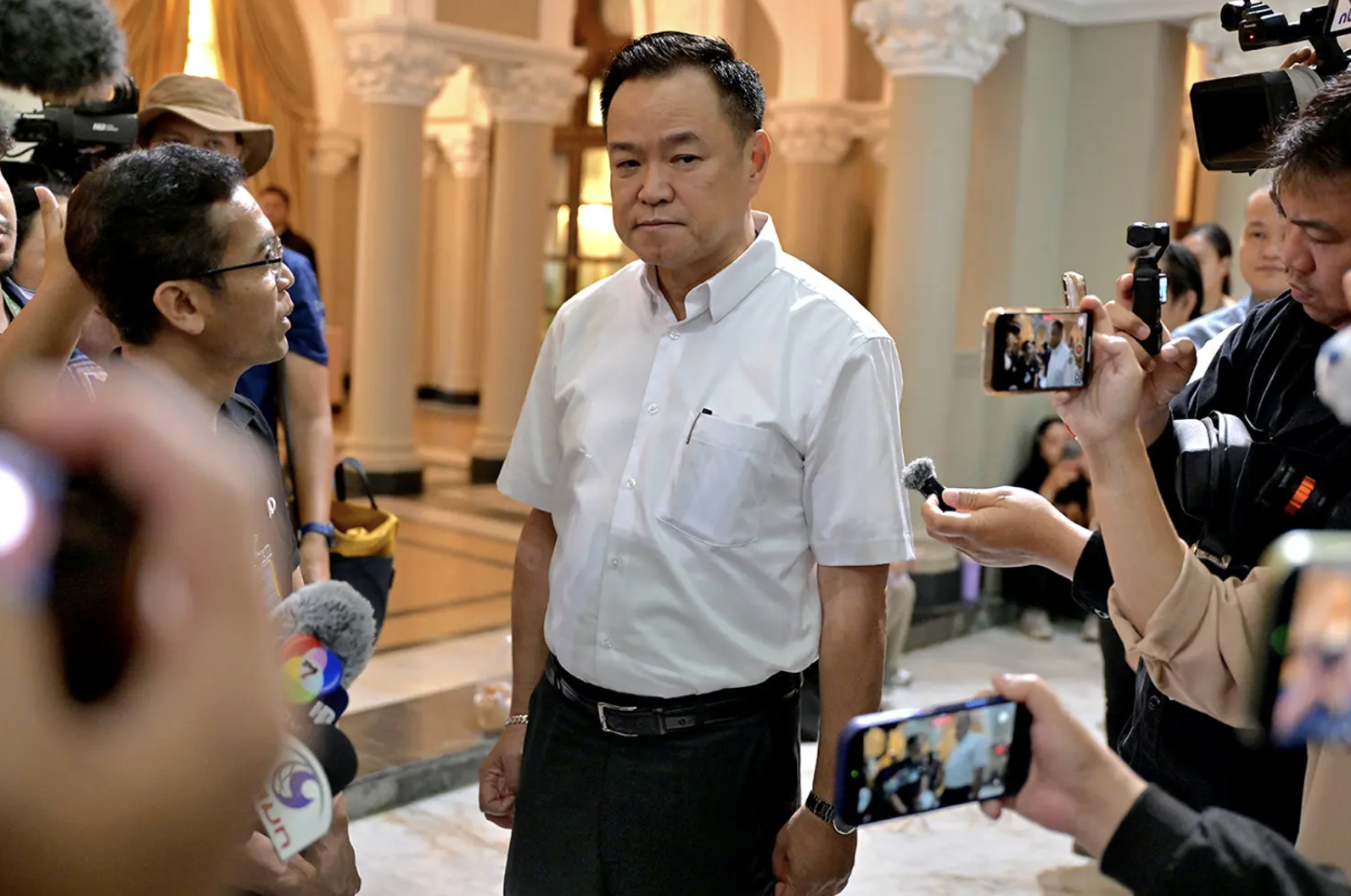
Photo Credit: spacebar.th
The Price Architecture: Where the Burden Falls
Understanding what is structurally possible requires understanding how Thai fuel prices are constructed.
There are five layers between refinery output and the retail pump: the Singapore reference price, which embeds shipping and insurance costs that Thailand does not actually incur because it refines domestically; the excise tax; the Oil Fund contribution or subsidy; the market margin paid to retailers; and the retail price the consumer pays.
Each layer is an intervention point. Democrat Party deputy leader Korn Chatikavanij has proposed two levers within immediate executive authority: suspending the excise tax — currently set at 6.90 baht per litre for biodiesel to deliver direct per-litre relief, and imposing a windfall levy on refineries to channel proceeds back into the Oil Fund. The windfall case is supported by data: Thailand's refinery margins, which run at approximately 2 baht per litre under normal conditions, had risen to 6 baht per litre during the crisis, which is three times their baseline.
Woraphop Wiriyarojn in Parliament described this as energy sector capital extracting crisis profits from a subsidy mechanism funded by the state. Neither intervention requires new legislation. Both require political will to act against entrenched interests.
The Malaysia price benchmark gives investors the most important forward-looking signal. Before the crisis, a net oil producer like Malaysia, priced diesel approximately 10 baht below Thailand. That gap has now reversed. Malaysia raised its diesel price to 39.54 baht per litre in March. Thailand's post-hike price sits at 38.94 baht. The arithmetic implies further upward pressure as global prices remain elevated and the Oil Fund continues to draw down.
The fiscal risk transmission is the element most underweighted in current market analysis. If the government is forced to issue sovereign guarantees for Oil Fund borrowing, necessary once the Fund exhausts its own credit capacity, the accumulated deficit converts to public debt.
Thailand's public debt ratio is projected at approximately 68 percent of GDP for fiscal year 2026, approaching the statutory ceiling of 70 percent. The OECD has noted that this ceiling may already be uncomfortably close to the country's actual debt limit, with IMF modelling suggesting explosive debt trajectories above approximately 80 percent of GDP.
The conversion of Oil Fund liabilities would constrain fiscal space for the FY2027 budget, infrastructure investment, and any counter-cyclical support to SMEs already operating on post-COVID margins. The energy crisis is not only an inflation story. It is a sovereign balance sheet story.
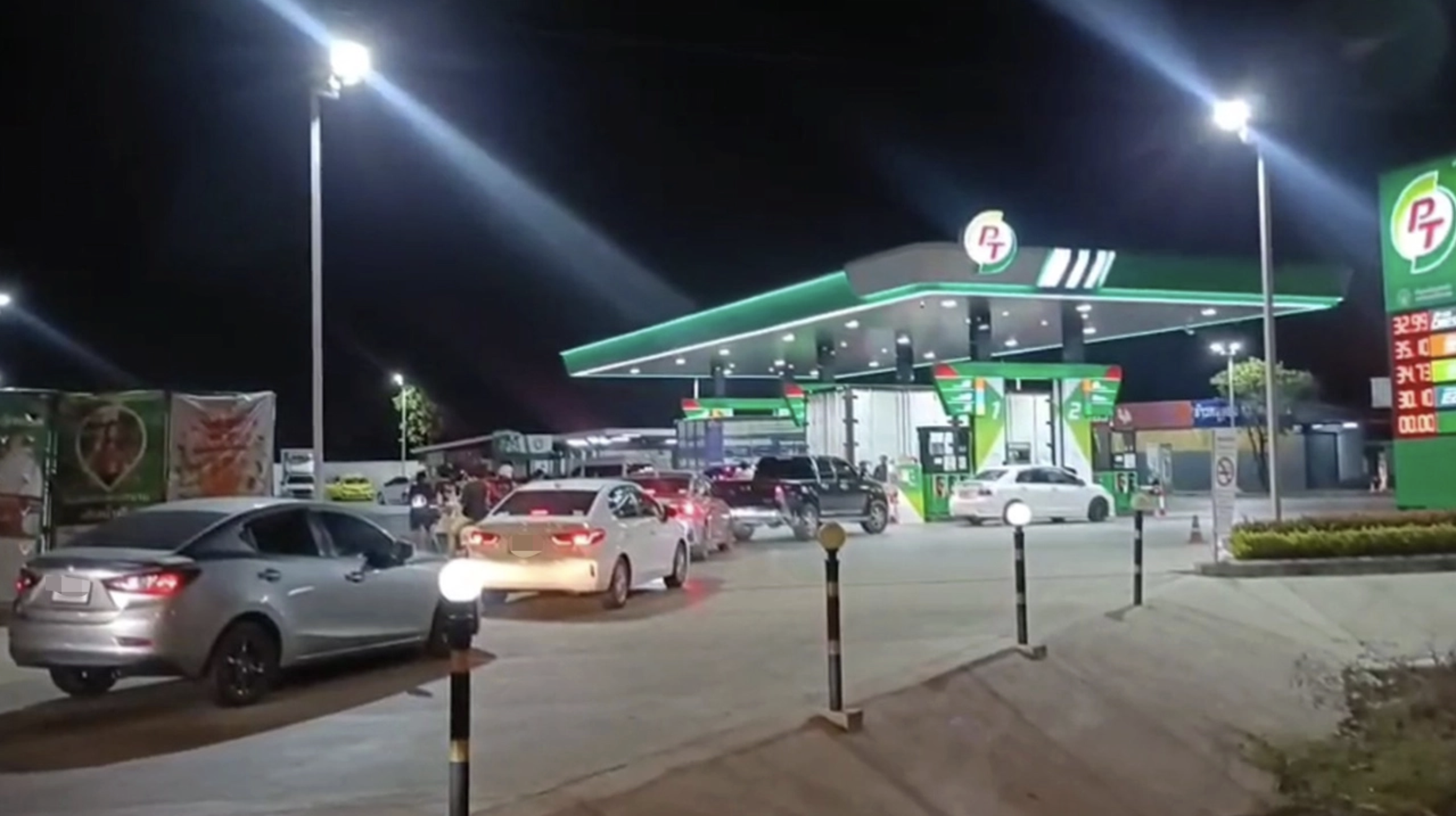
Source: Thairath Online
The Regional Context: Standing Still While Others Move
The IMF's February 2026 Article IV conclusion projects GDP growth of 1.6 percent for Thailand in 2026. The World Bank's Thailand Economic Monitor carries the same figure. The Bank of Thailand and OECD have issued matching assessments. This convergence describes what analysts have called the weakest growth in three decades excluding crisis years and that was the baseline before the energy shock arrived.
Vietnam continues to capture manufacturing foreign direct investment through China+1 supply chain diversification. Indonesia has leveraged its critical minerals base into downstream processing while sustaining domestic demand growth.
Malaysia has renewed its emphasis on technology investment and semiconductor supply chains. None of these trajectories require Thailand to fail. They require only that Thailand stand still while the region moves.
Thailand retains genuine industrial strengths in automotive manufacturing, agriculture, and tourism. What it lacks is a policy programme capable of repositioning those strengths at the pace the competitive environment demands. The energy crisis compounds the regional positioning problem in a sector the government has explicitly prioritised.
Announced as a strategic priority for attracting technology capital, data centre investment requires reliable and competitively priced energy. A two-year period of elevated energy costs and policy uncertainty is the worst possible environment in which to make that investment case to international operators.
The signal the crisis sends is not about energy prices alone. It is about institutional capacity to manage structural transitions.

Watch Full Programme: https://youtu.be/DuSxlMMLgYY?si=3sD70fV5haAzDBHa
The point was made directly by analysts at the Topp Table this week. While the world is debating artificial intelligence, cloud infrastructure, and sovereign technology strategy at the level of Davos, Thailand's policy apparatus is managing the immediate politics of fuel queues and Oil Fund solvency. There is no cognitive space for future-proofing when the present is consuming all available bandwidth.
This is not a criticism unique to the current administration — it reflects a structural pattern in which each crisis forces a reactive response that crowds out strategic planning. But the pattern is cumulative. Each cycle of reaction leaves less capacity for transformation.
Strategic Implications for Investors in Thailand
For companies with existing Thailand exposure, the near-term operating environment is manageable but under pressure across multiple dimensions. Energy costs will remain elevated for at least two years by credible external assessment. The Oil Fund's fiscal trajectory will tighten monetary and fiscal space over coming quarters. The political coalition's stability is real but conditional — investors should assess whether the 30-day window identified by Thai analysts produces structural policy action or symptom management.
For companies evaluating market entry or significant capital commitment, the risk calculus has shifted. Thailand's institutional fundamentals, the BOI investment promotion framework, infrastructure quality, and supply chain depth, remain credible. What has changed is the confidence interval around policy continuity and crisis management capability.
A government that entered office during the most severe energy shock in a generation, with a cabinet structured around political accommodation rather than technical capacity, is a government operating with narrowing margins for error at exactly the moment when error is most costly.
The deeper risk is not political instability in the conventional sense. Thailand's system has demonstrated a consistent capacity to absorb significant political turbulence without disrupting the basic operating environment for business.
The deeper risk is what Thai analysts have begun to describe as the "Paracetamol trap": a government stable enough to persist but not ambitious enough to matter, offering targeted relief measures, welfare card top-ups, soft loans, fuel coupons, that address symptoms without touching the structural conditions that produce them. Paracetamol manages pain. It does not treat the underlying condition.
Two questions will define Thailand's investment climate for this government's term.
First, whether the energy crisis generates the political pressure necessary for genuine structural reform, of the price architecture, of the supply chain data infrastructure, and of the relationship between energy sector capital and cabinet formation that has persisted across every Thai government since the 1980s.
Second, whether the constitutional reform referendum — in which approximately 59 percent of voters endorsed beginning the process of replacing the junta-era 2017 constitution, produces meaningful institutional change or is quietly absorbed by a government that owes its majority partly to that constitution's architecture.
If structural reform follows, Thailand 2026 is a disruption-driven entry point. If symptom management prevails, it is confirmation that the diagnosis the Prime Minister has now twice rejected remains unresolved.
Conclusion: The Fever Test
The Financial Times identified the structural illness. Anutin rejected the diagnosis. Twice. The energy crisis ran the test.
What the results show: an institutional architecture whose oil trucks had GPS but whose ministry, by the minister's own admission, had never used it to track where the oil was actually going.
A price framework carrying phantom logistics costs from a $60-per-barrel era into a $90-and-rising world. An Oil Fund carrying a 35-billion-baht deficit and burning 2.59 billion baht per day.
A cabinet assembled for political stability rather than crisis response, including the minister overseeing the crisis whose family has commercial interests in the sector he is regulating. A Prime Minister presenting his new electric vehicle to journalists while his party's own farmers said they were selling their tractors.
Analysts placed the current moment precisely: external shocks have exposed deep internal structural failures. The risk, as they described it, is that continued reliance on handouts and targeted relief, on Paracetamol rather than surgery, pushes Thailand toward a state failure threshold where public trust is not temporarily damaged but permanently lost.
The illness was always structural. The shock confirmed the diagnosis. The question for investors and policymakers is not whether the patient is sick and it is notable that the Prime Minister feels compelled to say so again today.
The question is whether the new government, once it takes full authority, has the political will to prescribe structural treatment, and whether this crisis, in the way that crises sometimes do, creates the conditions that ordinary governance cannot.
That question will determine Thailand's investment climate, its competitive positioning within ASEAN, and the durability of the current political settlement for the duration of this government's term.
— Ben Kiatkwankul, Partner & Co-Founder
mcg-asia.com | Bangkok
Maverick Consulting Group provides strategic advisory, government relations, and public affairs counsel across Thailand, Southeast Asia, and the Gulf. MCG advises international clients on market entry, stakeholder navigation, and political economy analysis in complex operating environments.
Parts of this article is also featured in Asia Sentinel.