
Thailand's Data Centre Rules in 2026: The Bar for Approval Has Risen
Between 3 and 10 August 2026, the terms on which Thailand accepts data centre investment changed. The Governor of the Bank of Thailand put a number on what the country gets. Cabinet created a national committee. The Board of Investment published a screening framework that answers the Governor almost point by point.
What follows is not a tightening of rules at the margin. It is a higher bar, applied through five separate gateways, and reaching backwards into projects already approved.
Update: the regulation is now in force
Added on 15 August 2026
This section supersedes references below to a draft regulation awaiting publication.
The Prime Minister signed the Regulation on the Data Centre Business Policy Committee B.E. 2569 on 11 August. It was published in the Royal Gazette on 13 August at Volume 143, Special Part 192 Ngor, page 5, and took effect the following day, under section 11(8) of the State Administration Act B.E. 2534. The full text is on the Royal Gazette site.
Four things in the published text were not in the cabinet announcement.
The secretariat sits with NESDC. Its Secretary-General is committee member and secretary, and the committee's costs come from its budget. The ministry that promotes digital investment chairs nothing here. The body holding the pen is the one that adjudicates whether projects are worth what they cost, and which in July concluded that Thailand's largest transport project was not.
The telecommunications regulator sits on it, alongside twelve other ex officio members spanning finance, energy, water, industry, commerce, environment and investment. The ownership reclassification discussed below is no longer a parallel track.
There is a standing compliance loop. The committee proposes to cabinet, but once cabinet resolves, agencies must implement and report progress every three months. That is stronger than an advisory body implies.
The scope has a carve-out. A data centre is defined as a facility serving persons other than affiliated companies, which on its face leaves captive capacity outside the regime, though the committee may redefine the term. The mandate also names national data sovereignty twice.
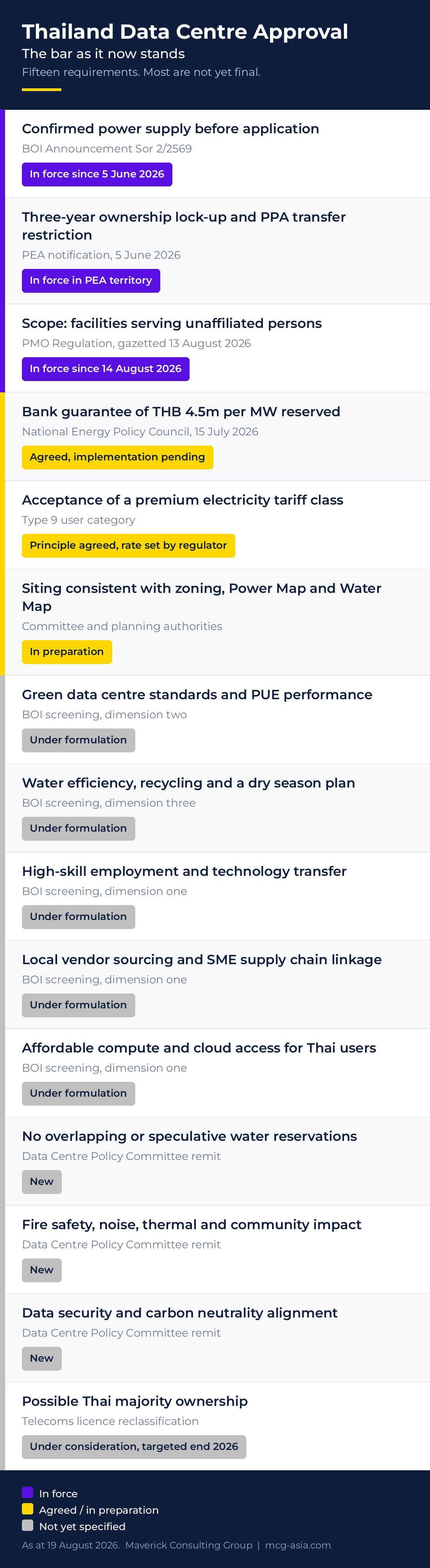
Fifteen requirements now stand across the five gateways, of which three are in force.
Update: the incentives themselves are being rewritten
Added 19 August 2026
Deputy Prime Minister and Finance Minister Ekniti Nitithanprapas, who also chaired the committee that stopped the Land Bridge, has described the incentive review as a complete overhaul, with the value to the country's economic system as the starting point. Support will be tied to measurable benefit rather than to investment value. The amount of capital a project brings is no longer the qualifying test.
Ekniti has also named the gap the new regulation is meant to close. Operators can establish businesses in Thailand without applying for BOI promotion at all, which leaves the state unable to manage resource use across the sector. BOI conditions bind only BOI applicants; a Prime Minister's Office Regulation setting policy for every permitting agency reaches the rest. That also suggests the affiliate carve-out noted above will not survive in its current form.
Three figures are now confirmed. The power guarantee is THB 4.5 million per megawatt of reserved capacity, half returned at 50 per cent utilisation and the remainder at 70. Around 70 per cent of approved investment sits in the Eastern Economic Corridor. And of the 42 approved projects, only 16 have confirmation that electricity can be supplied. Fewer than half the approved projects have confirmed power.
Where Thailand sits. Thailand is often described as a late entrant to a restriction cycle. Measured against current international practice, that reads wrong. New York has a one-year moratorium on facilities above 50 megawatts, Texas has paused grid interconnection approvals, Pennsylvania requires local community consent, Monterey Park has banned data centres outright, and Amsterdam is closed to new capacity until 2030.
Thailand has imposed no moratorium, no ban and no pause. It sits mid-pack and has chosen the least restrictive instrument available. The global baseline has moved; Thai terms remain comparatively accommodating.
Last Updated: 19 August 2026
Key facts
On 3 August 2026, Bank of Thailand Governor Vitai Ratanakorn told the Bank's Northeastern Region annual seminar in Khon Kaen that foreign direct investment is expanding while generating relatively limited employment, with local content of only around 30 per cent.
In the same published remarks, Vitai said Thai export growth of 14 per cent is concentrated in electronics and technology, where 105 major producers account for the growth and 87 of them are foreign companies with high imported input content and low employment, while most other exports grew around 2 per cent.
Thai media reporting of the occasion additionally attributed to the Governor a figure of 30 to 40 staff per hyperscale data centre and a 70 per cent local content benchmark for conventional industry. Neither figure, nor the term data centre, appears in the Bank of Thailand's published summary of the speech.
On 5 August 2026, the Thai cabinet approved a draft Prime Minister's Office Regulation establishing the Data Centre Business Policy Committee, proposed by Deputy Prime Minister Pakorn Nilprapunt.
The Board of Investment approved 42 data centre projects between 2024 and 2026, totalling 3,400 MW of IT load and THB 750 billion of investment.
Tracing projects to their ultimate controlling parent, 15 are Thai, 10 Chinese, 5 American, 4 Emirati, 2 Japanese, 1 Malaysian and Hong Kong, and 5 from other jurisdictions.
No new data centre investment promotion application has been filed with the Board of Investment since April 2026.
The National Energy Policy Council agreed on 15 July 2026 to create a separate electricity user class for data centres, priced above other categories, with a guarantee required before a power application is accepted.
The Nation reported on 5 August 2026 that some Eastern Economic Corridor investors signed overlapping water reservation agreements with East Water, Wong Siam Construction and the Provincial Waterworks Authority simultaneously, inflating recorded water demand.
The planned regime covers three categories: existing operators face audits, approved projects under construction face additional conditions, and new applicants face the full requirements.
The week the terms changed
Three events, in eight days, in this order.
On 3 August the Governor of the Bank of Thailand spoke at a regional development seminar in Khon Kaen. On 5 August cabinet created a national data centre committee. On 6 August the Board of Investment set out a new four-dimension screening framework.
Read in that order, the sequence is not coincidental, and the framework is not a neutral technical document.
What the Governor said
Vitai Ratanakorn did not argue against data centres. He did not mention them. What he delivered, at the Bank's Northeastern Region annual seminar, was a structural argument about the quality of Thailand's inbound investment, and it landed on the sector because the sector is the largest current instance of the pattern he described.
The published summary of the remarks sets out a K-shaped economy. Exports grew 14 per cent, but the growth is concentrated in electronics and technology, where export value rose around 45 per cent on the back of 105 major producers, 87 of them foreign companies with high imported input content and limited hiring.
Most other exports grew about 2 per cent. Foreign direct investment is expanding well but generating relatively limited employment and using few domestic inputs, with local content at only around 30 per cent. Money entering the country, in his framing, is not circulating within it.
Thai media coverage of the same occasion carried two further figures widely quoted since: that a hyperscale facility employs 30 to 40 people, and that 30 per cent local content compares with roughly 70 per cent for conventional business.
Neither appears in the published text. They are attributed remarks rather than prepared ones, and the distinction is worth preserving, because the 30 to 40 figure has since become the shorthand for the entire debate.
The setting carried as much information as the content. This was said at an Isaan development forum, about growth not reaching the Northeast, by the head of an institution that does not ordinarily comment on industrial policy. The Governor supplied the frame. The public supplied the subject.
The framework answers him
Within days, the Governor's structural argument had been translated into four specific charges against the sector: too few jobs, too little local sourcing, too little benefit reaching Thai firms, and too much resource consumption. Set those against the Board of Investment's four dimensions, published on 6 August, and the mapping is close to exact.
Against low direct employment, the first dimension requires high-skill hiring, technology transfer, and engineering curricula built with Thai universities. Against 30 per cent local content, it requires local vendor sourcing and SME supply chain linkage, with a stated push to buy Thai-made drives, servers, optics and cooling systems domestically rather than exporting components for assembly abroad and reimporting them.
Against benefits not reaching Thais, it requires operators to open affordable compute and cloud access to Thai startups, universities and SMEs. Against resource burden, the remaining three dimensions cover energy readiness, water management, and environment and town planning.
Four charges, four answers, in sequence. Secretary-General Narit Therdsteerasukdi framed the position as neither refusing all data centre investment nor accepting every project unconditionally, but deciding what kind of data centre Thailand wants.
This matters for how the framework will be enforced. Criteria written as political answers are applied hardest when political pressure is highest and relax when it lifts. That is a different risk profile from criteria written as engineering standards, and it changes what a sponsor should prepare.
The requirement is no longer to satisfy a checklist. It is to be able to put a defensible national benefit case in front of a committee that was created because the previous answer failed in public.
The five gateways
Thailand is not writing a single data centre code, and is unlikely to. As Formichella and Sritawat put it, the country is regulating through intersecting gateways. Five are now live, each held by a different institution, each with its own timetable.
Investment promotion. Three Board of Investment announcements were published in the Royal Gazette on 5 June 2026: Sor 9/2568 revising promoted activity categories and technical conditions, Por 3/2569 prescribing criteria for the Thailand Benefit Enhancement Plan, and Sor 2/2569 introducing a pre-application requirement for power supply confirmation. The third inverts the old order. A sponsor must now demonstrate it can be powered before it can apply to be promoted.
Electricity. The National Energy Policy Council agreed on 15 July to separate data centres into their own user class priced to reflect the true cost of network expansion, and to require a guarantee before a power application is accepted. Reporting ahead of that meeting described the Energy Ministry expanding user categories from eight to ten, with data centres as a Type 9 user at five to six baht per unit.
The political economy of that decision is its most durable feature, and we set out the mechanics in One Shot, Many Targets. The same Council meeting cut the first 200 residential units to three baht and stripped public lighting costs out of household bills. Cheaper household electricity has been made publicly contingent on large users paying their own way. Note also that the draft PDP 2026 targets an average tariff across the plan period of no more than four baht per unit, a figure the Energy Policy and Planning Office has set to protect national competitiveness. A data centre class priced at five to six sits deliberately above that average, and the gap is the point rather than an anomaly. Sponsors modelling the premium as an opening position are mispricing it.
Ownership. Two instruments, one instinct. A Provincial Electricity Authority notification published in the Royal Gazette on 4 June 2026 and effective from 5 June imposes a three-year lock-up running from the actual date of electricity use, during which original shareholders must retain more than 50 per cent of shares following any transfer, alongside tighter criteria for novating the power purchase agreement itself. It applies to data centre operators and other large, energy-intensive industrial users.
Running behind it, and materially larger, the telecommunications regulator has been considering reclassifying data centre services from a Type 1 telecommunications business, where foreign majority ownership is permitted, to Type 3, which requires Thai majority ownership. The proposal was signalled by the Acting Secretary-General in late March 2026, is targeted to take effect by the end of 2026, and is subject to public consultation before finalisation. It remains preliminary.
If that lands as drafted, it reprices every foreign-controlled asset in the pipeline. It is the largest single item on the board and the least discussed.
Water. The operational detail that explains the timing sits in the Nation's 5 August report. Some EEC investors signed overlapping water reservation agreements with East Water, Wong Siam Construction and the Provincial Waterworks Authority at the same time, to guarantee cooling supply. Aggregate demand figures were inflated above real need, and allocation planning became impossible. The trigger was not scarcity alone. It was the state discovering it could not see the true demand curve because the market had rationally double-booked it.
The same report notes there was no single licence and no centralised permission, with applications running variously through the telecoms regulator, the Board of Investment, or direct agreements with water authorities. It also records that some operators bought former entertainment venues in the Rama 9 area and converted them, because the existing infrastructure suited.
Siting. Zoning is being prepared on the back of a Power Map and a Water Map now under compilation, described by the deputy government spokesperson on 10 August as the basis for determining where data centres may appropriately be located. The Nation reports that new capacity may be pushed away from the EEC, with the Mae Moh area of Lampang under consideration because reservoirs built for power generation already exist there, and the state prepared to fund high-speed fibre if it becomes a hub.
Read that alongside where the Governor was standing. He made the low-benefit argument at an Isaan forum. The state's answer to the resource problem points north. What is forming is not only a resource allocation policy but a distributional one, in which the location of digital infrastructure becomes a regional equity question in a country where regional equity is a permanent fault line.
The bar, as it now stands
Consolidating across the five gateways, a sponsor coming to Thailand today must be able to show the following before an application is credible.
Two features of that table matter more than its length.
First, most of the demanding items are not yet final. The bar is rising while the specification is still being written, which is precisely the condition under which sponsors stop filing.
Second, it is not only forward-looking. The planned regime treats existing operators, projects under construction, and new applicants as three separate categories, with audits for the first and additional conditions for the second. The approved cohort is not insulated. A promotion certificate secured in 2025 does not fix the terms of operation in 2027.
That is a familiar shape. We described the same dynamic in CP Group's move to exit the Three-Airport Line: a signed concession is not an asset when the conditions around it are renegotiable. Forty-two certificates against 3,400 MW of IT load now sit in the same position.
The tell
One line in the Board of Investment briefing carries more information than the rest of it. No new data centre promotion application has been filed since April 2026, following a first quarter in which data centres drove record applications above one trillion baht.
Four months of silence is not incidental, and the committee did not arrive before it. Sponsors stopped filing when the rules stopped being knowable, and the state responded by trying to make them knowable again. The committee is simultaneously a response to the pause and a confirmation that the pause was rational.
The commercial reframing follows. The scarce asset is no longer the promotion certificate. It is the grid connection, the water allocation and the zoning designation, and value will accrue to whoever holds firm power and water rather than to whoever holds a card.
The question the framework does not answer
The most interesting intervention in the debate came from neither the regulator nor the industry. Saroj Athiwitwat of Wisible argued that headcount is the wrong metric, and that the question is what the compute is used for. Processing power directed at Thai AI development, pharmaceutical research or industrial upgrading creates value. Processing power directed at content consumption creates considerably less.
The framework mandates access to compute. It says nothing about use. Nobody in Thai policy has a mechanism for the second, because almost nobody anywhere does. We examined the same problem in a different programme in our analysis of the TH-AI Passport, where the question was whether five million subscriptions convert into national capability rather than national consumption. Mandating access to a resource is the easy half. The second round of Thai data centre policy will be about the other half.
Who is arguing, and who is not
The public defence of the sector has been led by Jareeporn Jarukornsakul of WHA, arguing that a data centre is infrastructure rather than a factory, comparable to a power plant that employs 50 to 80 people while enabling activity across banking, manufacturing, government, education and commerce. She supported state regulation of the sector and asked for both sides of the data to be put before the public.
The argument is sound. The position is also not disinterested: WHA is the industrial estate landlord whose land sales have been driven by this demand.
What is more striking is the absence. The hyperscalers, the Chinese operators and the Gulf platforms have said nothing in public. The defence of a THB 750 billion investment programme is being conducted by a Thai landlord and a Thai software founder while the beneficiaries stay silent. Rational for each of them individually. Collectively, it leaves the Governor's numbers standing unanswered in the only forum that matters. A Prachachat column in early July had already warned that a backlash was forming. It has now arrived, and the industry has not turned up to it.
What to watch
The telecommunications licence reclassification. Binary and ownership-determinative, targeted for end 2026, with public consultation first. Consultation is an intervention point, not a notification.
The electricity regulator's implementation of the Type 9 tariff. The Council set the principle. The number is set at regulator level, and that is where the five to six baht range either holds or moves.
The three discretionary appointments to the new committee. Ministers and permanent secretaries are fixed by office. The Prime Minister appoints up to three qualified members, and they are the only variable in the composition. They will indicate whether the committee's centre of gravity is industrial, environmental or security-facing.
Publication of the Power Map, Water Map and zoning framework. Land repricing follows directly, in both directions.
Whether the Metropolitan Electricity Authority follows the Provincial Electricity Authority on the ownership lock-up. It has not yet. Hyperscale load sits in provincial territory, so the gap is tolerable. Convergence would tighten project finance structures considerably, because a control lock-up sits badly with step-in rights and share security.
The audit programme for existing operators. The first tier of the three-tier regime is the one nobody is modelling, and it applies to assets already drawing power.
The wider frame
Thailand is late to a restriction cycle that Singapore, Johor and Jakarta entered earlier, and is applying it after approving the capacity rather than before. That sequencing creates an unusual problem. The question facing most sponsors is not how to secure approval. It is how to convert an approval already held into a connection, an allocation and a site that survives zoning.
It is worth noting how quickly this test has generalised. On 3 August the central bank governor asked what the country actually retains from investment of this kind. On 9 August the Prime Minister said the Land Bridge is not yet worth what it costs and shelved a trillion-baht corridor. A contested jobs figure and a deferred megaproject are the same argument reaching two very different institutions in the same week.
Thailand has not decided it does not want data centres. It has decided that installed megawatts are not the same thing as national capability, and it is now writing that distinction into the conditions of entry.
Frequently Asked Questions
-
No.
There is no moratorium. Cabinet created a Data Centre Business Policy Committee on 5 August 2026 to set policy, standards and approval frameworks for the agencies that grant permissions.
No new investment promotion application has been filed since April 2026, but that reflects sponsor caution rather than a formal suspension.
-
A proposed separate electricity user category for data centres, priced above other classes so that tariffs reflect the true cost of expanding the network.
The National Energy Policy Council agreed the principle on 15 July 2026. Reporting has indicated a range of five to six baht per unit. The final rate is set by the energy regulator and had not been confirmed at the time of writing.
-
It is under consideration.
The telecommunications regulator has been examining a reclassification of data centre services from a Type 1 to a Type 3 telecommunications business, which would require Thai majority ownership. The change is targeted to take effect by the end of 2026 and is subject to public consultation before finalisation. It is not yet law.
-
Yes, in part.
The planned regime distinguishes three categories. Existing operators face audits and assessment covering water use, thermal management and noise. Projects approved and under construction face additional conditions. New applicants face the full set of requirements.
-
Zoning is being prepared on the basis of a Power Map and a Water Map now under compilation. New capacity may be directed away from the Eastern Economic Corridor, where water is contested between industry, agriculture and households. The Mae Moh area of Lampang has been raised as a candidate location because reservoirs built for power generation already exist there.
-
The Board of Investment approved 42 projects between 2024 and 2026, totalling 3,400 MW of IT load and THB 750 billion.
By ultimate controlling parent, 15 are Thai, 10 Chinese, 5 American, 4 Emirati, 2 Japanese, 1 Malaysian and Hong Kong, and 5 from other jurisdictions.
Maverick Consulting Group is a public affairs, government relations and business diplomacy consultancy headquartered in Bangkok, working across Thailand, Southeast Asia and the Middle East.