
Thailand's Lemon Law Is Coming: What the Liability for Defective Goods Act Means for Business
Thailand's "Lemon Law", the draft Liability for Defective Goods Act, is now moving. Passage is settled. The commercial terms are not. The law will reverse the burden of proof for product defects, impose statutory repair and replacement deadlines, and force a repricing of after-sales risk across automotive, electronics and consumer retail. What it will actually cost, and whom, is being decided now, in committee and in subordinate regulations that most affected businesses are not yet watching.
Current status: House special committee stage. The bill passed its first reading 420 to 0 on 24 June 2026. A 24-member special committee is scrutinising the text; the 15-day amendment window closes on or around 9 July 2026. Second and third readings, Senate passage and Royal Gazette publication remain.
Last updated 7 July 2026. This analysis is maintained as a living document: facts are updated within hours of every legislative milestone and logged in the changelog below; judgments are revised openly when events test them.

Key takeaways
The bill cleared first reading unanimously on 24 June 2026. No serious actor is contesting the principle; the contest has moved to definitions, thresholds and scope.
The structural change is evidentiary. Defects appearing within six months (general goods, electronics, motorcycles) or one year / 10,000 km (cars) are presumed to have existed at delivery. The seller disproves it or pays.
The compliance cost lives in the numbers: 60-day and 90-day repair clocks, 7-day and 14-day replacement rights, and instalment suspension during repair. These convert service capacity and documentation into legal exposure.
Coverage of B2B, hire-purchase and credit-financed sales makes this broader than Singapore's law and most peer regimes. Second-hand goods and peer-to-peer sales are out.
The comparative record is unambiguous: lemon laws fail in the forum, not the statute. Thailand has copied a strong design; it has not yet built the machinery that made Singapore's version work. That is the open variable, and the one worth influencing.
What is Thailand's Lemon Law?
Thailand's Lemon Law is the draft Liability for Defective Goods Act B.E. 2569 (2026), in Thai พ.ร.บ. ความรับผิดเพื่อความชำรุดบกพร่องของสินค้า. It gives buyers of defective new goods statutory rights to repair, replacement, price reduction or refund, and shifts the burden of proving a defect from buyer to seller. It was developed by the Office of the Consumer Protection Board (OCPB) to close a gap Section 472 of the Civil and Commercial Code never resolved: under current law, the buyer must prove the defect existed at the time of sale, which is close to impossible for latent faults in complex products.
The origin story explains the design. Drafting began after a vehicle-defect case in which OCPB testing confirmed the fault but the company repurchased only 3 of 12 affected cars, forcing the rest into litigation; a co-sponsor of the current bill cited owners who spent thirteen years pursuing compensation for defective vehicles. The statute is engineered so that the seller, not the buyer, absorbs the cost of proving what happened.
The legislative timeline
The bill is in committee after a unanimous first reading, with second and third readings, Senate consideration and Royal Gazette publication ahead.
November 2022.Cabinet approves the draft in principle; Council of State review follows
May to June 2024. OCPB holds a public hearing on the vetted draft, which sets commencement at 180 days after Royal Gazette publication
2024. A citizens' draft backed by 21,111 signatures, organised by the Thailand Consumer Council, is submitted to Parliament; it keeps the bill alive through the subsequent dissolution.
12 May 2026. The new Cabinet resolves to return the draft to Parliament
2 June 2026. The OCPB holds a refreshed public hearing at ministerial direction
16 June 2026. Cabinet approves the draft Act, the government's first bill to Parliament
24 June 2026. The House passes the first reading 420 to 0, consolidating six drafts; a 24-member special committee is appointed with a 15-day amendment window
On or around 9 July 2026 (expected). Amendment window closes.
Q3 2026 (estimated). Committee report; second and third readings.
Q3 to Q4 2026 (estimated). Senate consideration.
Date TBC. Royal Gazette publication; commencement 180 days later per the earlier vetted draft, to be confirmed in the final text
Read the calendar as a commitment, not a coincidence. A new government wants this banked; the Consumer Council, having watched a dissolution nearly kill the bill once, wants it beyond reach of the next political disruption. Anyone seeking changes is therefore working against the clock as much as the text. If passage completes in 2026, obligations plausibly go live in the second half of 2027.
For any organisation that must rebuild warranty terms, dealer contracts and service capacity, that is a short runway dressed up as a long one.
The core mechanics, and where the cost sits
The Act's commercial weight is in a handful of hard numbers, not its principles. As passed at first reading, and subject to committee amendment:
Presumption of defect. Defects appearing within 6 months for general goods and electronics, 1 year or 10,000 km for cars, or 6 months or 5,000 km for motorcycles are presumed to have existed at delivery; the seller must prove otherwise.
Repair deadlines. Sellers must complete repairs within 60 days for general goods and motorcycles and 90 days for cars; failure opens price reduction, termination and damages.
Replacement rights. Buyers may demand replacement within 7 days for general goods and 14 days for electronics with severe defects, and a car with an unrepairable safety defect must be replaced with a new vehicle of the same model.
Coverage. The Act extends to B2C and B2B sales, hire-purchase, credit-financed sales and exchange contracts, with strict liability for cars and motorcycles.
Exclusions. Second-hand goods, live animals and peer-to-peer sales sit outside the Act.
Hire-purchase. Instalments may be suspended while goods are under repair.
Limitation. Claims run for two years from discovery of the defect for vehicles and electronics.
Seller-side mechanics. A usage-based depreciation deduction applies to refunds, termination must be exercised in writing within 6 months of the right arising, and the Act does not apply to contracts predating it.
Scope by decree. Further product categories arrive by Royal Decree, with exclusions set by Ministerial Regulation.
Each number reallocates a specific risk. The presumption windows turn handover documentation into the seller's only defence.
The 90-day car-repair clock is a direct test of parts logistics, and it will bite hardest on newer import-dependent brands whose spare-parts chains are thin, a live issue as EV complaint volumes rise and the Consumer Council pushes for refunds and a sales suspension over one model's battery-fire risk. Instalment suspension quietly moves cash-flow risk onto finance companies and captive lenders, which have so far said little in public. And the B2B extension, with strict liability for vehicles and a limitation period running from discovery rather than delivery, makes the exposure longer and wider than most boards currently assume.
The comparative lesson: lemon laws fail in the forum, not the statute
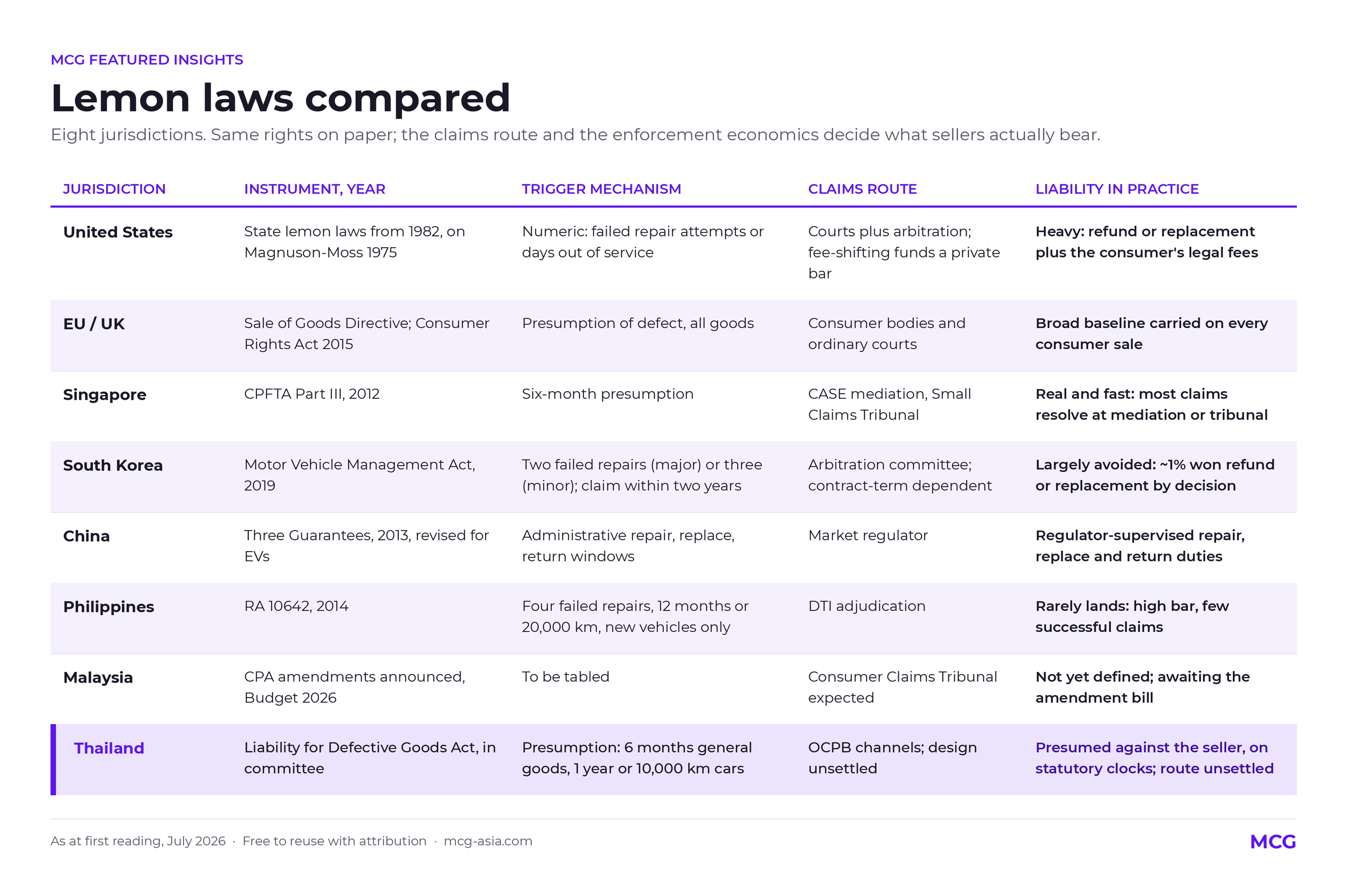
Thailand has combined the two strongest available designs: a Singapore/EU-style general presumption with East Asian vehicle-specific strictness. On paper it is more ambitious than anything else in ASEAN. The paper is not the question.
Singapore's lemon law, Part III of the Consumer Protection (Fair Trading) Act since September 2012, works because the six-month presumption is enforced through cheap, fast mediation and a small-claims tribunal.
The Philippine Lemon Law of 2014 has near-identical intent and is a dead letter: vehicle-only scope, high thresholds, administrative adjudication, so few successful claims that the Supreme Court had to confirm buyers may simply use the general Consumer Act instead.
South Korea's 2019 regime, allowing refund or replacement for two major or three repaired minor defects within two years, routed relief through mediation dependent on contract terms, handing manufacturers a gatekeeping role that blunted it.
The United States, where the first state lemon law passed in Connecticut in 1982 on the base of the 1975 Magnuson-Moss Warranty Act, is effective for the opposite reason: fee-shifting created a private enforcement bar that needs no regulator.
Same rights, opposite outcomes, and the difference is always the forum and the enforcement economics.
Thailand has written the Singapore statute without yet building the Singapore tribunal. Whether OCPB channels function like CASE mediation or like Philippine DTI adjudication is the single largest determinant of what this law will cost business in practice, and it will be settled in implementation design, not in Parliament.
Meanwhile Malaysia announced lemon law amendments in Budget 2026 but had yet to table them as of mid-2026, leaving Thailand set to become ASEAN's second comprehensive regime, ahead of its largest regional peer.
The politics: read the unanimity correctly
A 420 to 0 vote does not mean there is no fight. It means the fight moved rooms. The draft stalled for years after its 2022 cabinet approval and nearly died with the dissolution of Parliament, surviving because the Consumer Council's citizens' version kept it procedurally alive.
The incoming government then chose it as its first bill: pre-drafted, universally popular, zero fiscal cost, an immediate fairness deliverable. With six drafts sponsored across government, opposition and civil society, every party owns a piece, so the competition is over credit, not content.
The law also does quiet industrial-policy work: it raises the cost of selling poorly made goods into Thailand without naming any country of origin, at a moment of low-cost import influx and rising EV quality complaints.
Consumer politics and industrial interest point the same way, which is why open business opposition is absent. The nearest thing on record is a Federation of Thai Industries representative warning, at a Consumer Council forum, that the law could disrupt promotional and discounted goods and raise producer costs unnecessarily. That silence is not consent; it is relocation. Industry input has moved to the committee, where the amendment window is the last public leverage point, and after that to Royal Decrees and Ministerial Regulations, where the law's real perimeter gets drawn once the cameras have left.
What we are watching: loose ends ranked by commercial consequence
Definitions. The Section 472 regime failed precisely because "defect" was never defined and buyer rights stayed ambiguous. Whether "severe defect" acquires objective criteria or stays interpretive will decide the volume of disputes more than any other clause.
Forum design. Whether claims flow through fast, low-cost OCPB channels or slower administrative adjudication will determine the law's real-world weight; the comparative record above says this single choice outweighs everything in the text.
Seller-side mechanics already embedded. The depreciation deduction from refunds, the six-month written-termination requirement, and non-application to pre-existing contracts are material seller wins hiding in procedural language; expect consumer-side amendments to target the first, and expect the refund calculus to be litigated either way.
Software defects. The modern defect is increasingly a software defect. A widely cited case of phone screens failing after a software update, with liability refused as out-of-warranty, poses the question the draft does not answer: whether an over-the-air fault "existed at delivery". For EVs and connected devices this is not an edge case; it is the main case.
Scope by decree, and the sequel. Product categories and exclusions sit in subordinate legislation to be issued later. Policy critics add a structural gap: the draft fixes the remedy while leaving the repair ecosystem, parts access, warranty barriers and parts-pairing practices untouched, and the Consumer Council's own EV research argues for preventive standards rather than remedy-only design. Right-to-repair is the plausible next bill; price that in now.
What businesses should expect
The exposure map is concentrated: automotive first, especially newer EV entrants with thin service networks; electronics and appliance importers on the 14-day replacement right; hire-purchase and captive finance on instalment suspension; and promotional and online retail, where "no exchange, no return" sale terms, currently widespread, become unenforceable.
The Act converts three ordinary business functions into legal positions. Paperwork becomes defence: under a presumption regime, inspection logs, serial-number records and handover documentation are the means of rebutting liability, and advisers are already telling manufacturers, importers, distributors and retailers not to wait for enactment.
Service capacity becomes compliance: parts inventory, workshop throughput and loaner arrangements now sit against statutory clocks. And contract chains become risk-allocation battlegrounds: dealer agreements, importer recourse to overseas principals, warranty terms and financing documentation will all be renegotiated around who holds the liability the statute creates.
For organisations with a material stake in how "defect", severity, or product scope are defined, the committee stage and the subordinate-regulation process are the two moments when precise, technical input is still receivable.
The viable posture is the one the record rewards: alignment on the principle, which cannot be contested anywhere it has been tried, and precision on the detail, which is where every real outcome in this field has ever been decided. Singapore's market adapted early and engaged on implementation; the Philippines' assumed the details would take care of themselves. The details never do.
Frequently asked questions
What is Thailand's Lemon Law? It is the draft Liability for Defective Goods Act B.E. 2569 (2026), which gives buyers of defective new goods statutory rights to repair, replacement, price reduction or refund, and presumes that defects appearing within a set period existed at delivery, shifting the burden of proof to the seller.
When will Thailand's Lemon Law take effect? It passed its first reading on 24 June 2026 and is in committee. It still requires second and third readings, Senate passage and Royal Gazette publication. An earlier vetted draft provided a 180-day runway after publication, pointing to obligations plausibly going live in the second half of 2027 if passage completes in 2026.
What products does it cover? General consumer goods, electrical appliances and electronics, cars and motorcycles, with further categories addable by Royal Decree. Second-hand goods, live animals and peer-to-peer sales are excluded.
Does it apply to business-to-business transactions? Yes. Unusually by international standards, the draft covers B2B sales as well as B2C, hire-purchase, credit-financed sales and exchange contracts. How B2B enforcement will work in practice is an open question for committee and subordinate regulation.
How does it compare with Singapore's Lemon Law? Both use a presumption of defect: six months in Singapore, six to twelve months in Thailand depending on product. Singapore's regime is effective largely because claims run through fast, low-cost mediation and tribunal channels. The equivalent forum design in Thailand is still to be settled, and it will determine the law's real-world weight.
What should businesses in Thailand do now? Strengthen handover and inspection documentation, stress-test after-sales capacity against the 60-day and 90-day repair deadlines, review dealer, warranty and financing agreements for risk allocation, and monitor or engage with the committee stage and forthcoming subordinate regulations that will define defect severity and product scope.
Changelog
7 July 2026. Article published. Status: House special committee stage; amendment window open until on or around 9 July 2026.
MCG advises international and regional organisations on government and regulatory affairs, market entry, and policy positioning across Thailand, Southeast Asia and the Gulf. This is a living analysis: facts are updated as they occur and logged in the changelog; judgments are revised openly when events test them. It is general analysis, not legal advice.