
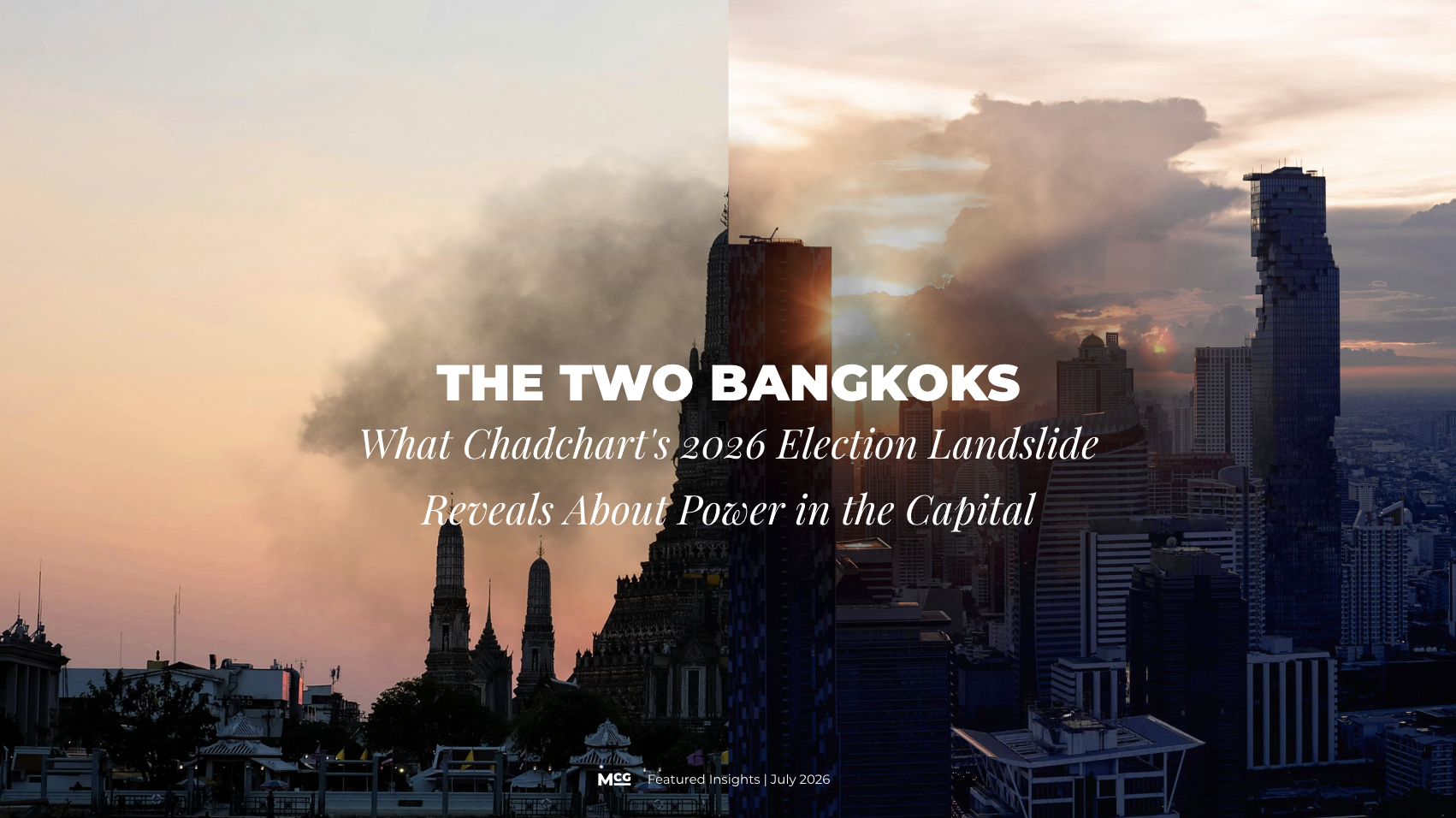
The Two Bangkoks: What Chadchart's 2026 Election Landslide Reveals About Power in the Capital
An MCG reading of the 2026 Bangkok governor election, beyond Chadchart Sittipunt's record landslide, to the fluid vote, the national and local split ballot, the Bangkok Metropolitan Council contest, and what four more years of City Hall mean for business in Thailand.
Key takeaways
Chadchart Sittipunt won a second term in the 2026 Bangkok governor election with a record 1.44 million votes (about 65.6%), sweeping all 50 districts.
Turnout fell to roughly 50%, from 60.7% in 2022, yet his raw vote rose. That is the clearest sign of a competence-led, depoliticised governing model that dominates low-turnout races.
The opposition People's Party swept Bangkok in February's general election, but its gubernatorial candidate finished third, behind conservative-leaning independent Mallika Boonmeetrakool Mahasook.
The People's Party holds 22 of 50 Bangkok Metropolitan Council seats, the largest bloc but short of a majority. The council speakership and the 120-billion-baht city budget are where the real contest sits.
For business, the result signals continuity and low political drama at City Hall, with flooding, the BTS Green Line debt, procurement transparency, and succession as the files to watch.
On 28 June 2026, Chadchart Sittipunt was returned as Governor of Bangkok, winning the 2026 Bangkok governor election with roughly 1.44 million votes, around 65.6% of those cast. It was a record for the office and a second consecutive sweep of all 50 districts. For anyone with commercial or institutional exposure to the capital, that is the operative headline: four more years of a managerial, data-led, low-drama City Hall. Continuity is now the baseline assumption.
The more useful intelligence sits beneath the result. A recent discussion on Matichon TV's The Politics, featuring political scientist Assoc. Prof. Pich Pongsawat and former MP Pannika Wanich, unpacked the mechanics of the vote in a way that repays close reading, not for its verdict on any party, but for what it exposes about how power in Bangkok is actually organised.
A brief orientation helps, because Bangkok's governance is often misread. The Governor of Bangkok is the only directly elected provincial executive in Thailand, leading the Bangkok Metropolitan Administration (BMA). Alongside sits the 50-member Bangkok Metropolitan Council (BMC), which approves the city's ordinances and its annual budget of roughly 120 billion baht, larger than most national ministries. The governor holds executive authority; the council decides whether it is funded.
Competence as a constituency: the Chadchart leadership style
Begin with the winner. Turnout fell sharply, from just under 61% in 2022 to roughly 50%, and yet Chadchart did not merely hold his position. He grew it, lifting his raw vote from about 1.39 million to 1.44 million and his share from roughly half the ballots to around two-thirds. Fewer people voted, and more of them voted for him. A candidate who expands his absolute support while the electorate contracts has demonstrated something rare: a base that turns out even when the wider public does not.
That is the clearest available verdict on his governing style. Chadchart's method is managerial before it is political, an engineer's preference for systems, data and incremental problem-solving over grand gestures, paired with a studied refusal to be anyone's partisan. He runs as an independent, avoids picking fights, and keeps the emphasis on delivery and presence. The result is a candidate few feel much friction in backing: trusted for competence, tolerated for his lack of threat, familiar enough to be the default.
This is what the analysts meant in calling him a rainbow candidate: a figure who draws support from every colour and faction without any of them feeling they have conceded something. He runs as an independent, is willing to bend and blend, and never defines himself against anyone. The contrast with the People's Party carries the real weight. Where the opposition is read by the establishment as a challenge to the existing order, and treated accordingly, Chadchart presents no such threat: competent without being disruptive, reformist in tone without being systemic in ambition.
For a conservative voter left without a candidate of their own, and for the institutions that shape the environment around City Hall, that is what makes him not merely acceptable but preferable. The quality that wins him votes across the spectrum is the same one that lets him govern with the system rather than against it.
In a low-salience contest, that combination compounds. When the mobilising energy of a general election is absent and there is no compelling alternative, the voters who show up gravitate to the known and the capable. The deeper achievement is strategic rather than accidental.
Chadchart has effectively depoliticised the governorship, reframing it as a technical office rather than an ideological battleground. He does not need the city excited; he needs it reassured. One qualification keeps the reading honest: the commanding lead itself likely suppressed opposition turnout, so the headline share flatters what is, in raw terms, a solid rather than seismic increase.
A fluid vote, not a tribal one
Where those extra votes came from complicates the easy story. The instinctive read, progressive consolidation, is only part of the picture. A meaningful portion of the conservative vote appears to have migrated to Chadchart, largely because the conservative field this cycle was thin and its candidates weak.
With no standard-bearer of their own worth turning out for, many conservatives found the incumbent an unobjectionable choice. The same cross-spectrum reach that makes him hard to beat also makes him the natural home for an orphaned vote. The corollary matters for anyone reading Thai politics from the outside: in Bangkok, the conservative and progressive binary explains less than it is assumed to, and competence concentrates the vote more reliably than ideology.
Two cities, two ballots
The most strategically significant pattern is the gap between how Bangkok votes nationally and how it votes locally. In February's general election the People's Party took the capital's constituency seats decisively. Weeks later, its gubernatorial candidate finished third and its council slate underperformed relative to that national base. Voters separate big-picture politics from who fixes my street, and do so deliberately.
The lesson is durable. A strong national brand does not convert automatically into local authority. Where the People's Party won council seats, it did so through candidates who had spent years building presence in specific communities, condominium juristic persons, markets, motorcycle-taxi ranks, with the brand as amplifier rather than substitute. Legitimacy at the city level is earned locally and over time. It is not conferred from the top, and it does not travel on reputation alone.
The Mallika signal: a party that sweeps, a candidate that stalls
The single most instructive data point of the cycle is the distance between two results four months apart. In February, the People's Party won every one of Bangkok's constituency seats. In June, its gubernatorial candidate, Chaiwat Sathawornwichit, finished third on roughly 8% (about 177,000 votes), behind Mallika Boonmeetrakool Mahasook, a conservative-leaning independent who took second on around 13% (some 288,000 votes). A party that had just dominated Bangkok at the ballot box could not place its own candidate second in the city's only elected executive contest.
Two forces explain the reversal. The first is structural. The Bangkok governorship is the only directly elected executive office in Thailand, which makes it uniquely candidate-centric. Voters are choosing a person to run the city, not endorsing a movement. It is precisely the arena in which a party built on brand is most exposed, because the label does not stand in for a candidate the electorate can picture in the chair.
The second is representational. Mallika's second place was not simply conservative arithmetic; the larger share of that vote in fact flowed to Chadchart. What she captured was a specific, emotionally engaged segment of the city, the market traders, street vendors and working households for whom she spoke in a plain, unhedged idiom that read as authentic representation rather than administration. The People's Party ran the most policy-dense campaign in the field and still could not convert that volume into affinity for its candidate.
Elections turn on who voters like and trust, and on that axis a vivid individual outperformed a well-built manifesto. Until the party produces, for the executive office, an individual the city wants to lead it, its ceiling in a governor's race will sit well below its national vote.
Bangkok is not "big-house" country
A recurring error among outside observers is to map provincial machine politics, the baan yai or big-house model, onto the capital. The corrective is worth internalising. Bangkok's political texture is a dense lattice of urban-community networks, including its poorer and more precarious populations, and these networks carry real, revocable bargaining power. A community leader can withdraw support publicly and immediately, in a way that has no clean provincial equivalent.
The work that binds these relationships is granular: eviction disputes, flooding, waste collection, everyday services. For any organisation doing genuine stakeholder work in the city, the relevant gatekeepers are local, numerous, and conditional. Their consent is not secured once; it is maintained.
The council and the fight for the speakership
The governor holds the mandate; the council determines whether it can be executed. The People's Party is the single largest bloc at 22 of 50 seats but short of a majority, while the remaining seats are fragmented across roughly half a dozen groupings likely to coordinate, at minimum, to deny the party the council speakership. The animating logic is less ideological than it appears. The BMA commands an annual budget in the order of 120 billion baht, and district-level budget flows are what most council members are ultimately protecting.
This is the arena that shapes procurement, infrastructure spend, and the pace of regulatory movement. A divided council has stalled City Hall initiatives before, and an ambitious second term will need to be negotiated seat by seat rather than assumed from the governor's mandate. The contest also largely dissolves if the governor signals openness to working across all blocs, which makes the speakership as much a question of posture as of arithmetic.
The second-term watch-list
Several files carry direct commercial and reputational weight. A useful lens: many of the capital's most visible problems are not the governor's to solve alone, a recurring feature of an office whose political exposure exceeds its formal authority.
Flooding and climate exposure. Monsoon flooding is the most politically unforgiving problem City Hall owns outright, compounded by land subsidence and ageing drainage. By the city's own account, only about half the canal network had been dredged going into this term.
Infrastructure failures and the jurisdiction trap. The September 2025 Samsen Road sinkhole and the fatal collapses along the Rama II corridor have hardened anxiety about construction safety and Thailand's engineering reliability. Yet most sit outside BMA control, arising from a national subway contract and Department of Highways works. The governor absorbs the blame for assets City Hall neither builds nor maintains.
The Green Line and the city's balance sheet. The BTS Green Line is the term's largest financial decision. The BMA drew on reserves to settle roughly 32 billion baht in arrears in late 2025, with total exposure estimated near 98 billion baht. Fare policy and the 2029 concession expiry, a decision shared with central government, carry direct weight for infrastructure investors and prospective bidders.
Procurement transparency. Late-campaign allegations of an informal network influencing appointments and contracting, denied by those named, crystallised a durable question separable from the governor's personal standing: the opacity of City Hall's internal machinery, set against a 120-billion-baht budget.
The informal economy and outer-Bangkok pressure. The street-vendor question is a live flashpoint, and districts such as Bang Na, where zoning change and capital inflows meet established communities, are where development friction will concentrate.
Succession. Deputy Governor Tavida is already discussed as a potential heir, a sign that the Chadchart model, not only the individual, is being institutionalised.
What the result means for business
For international companies and investors, the headline reads well. A competent, non-ideological administration is a stable and legible counterparty, and the low drama of the office reduces the kind of headline risk that complicates market entry and capital deployment. The discipline is to read the limits of the office as carefully as its mandate.
The governor's authority is real but bounded, with major infrastructure, national rail, and much of the regulatory frame sitting with central government or the council. Attributing outcomes, or risks, to City Hall without mapping that split leads to misjudged exposure. The medium-term variable is political rather than administrative, which makes succession the question to track, read against national-level volatility.
The through-line
Bangkok rewards competence, continuity, and locally earned legitimacy over ideology and brand. For organisations navigating the capital, outcomes are unlocked at the intersection of three things: the formal authority of the governor and the BMA, the coalitional power of the council and its budget, and the conditional consent of community-level networks. The formal map tells you who holds office. The informal one tells you what will actually move, and it is the second that tends to decide.
Sources: 2026 Bangkok gubernatorial and Metropolitan Council results as reported 28 to 29 June 2026 (Bangkok Post, The Nation, Thai PBS), alongside contemporaneous coverage and the Matichon TV "The Politics" discussion with Assoc. Prof. Pich Pongsawat and Pannika Wanich. Vote figures are unofficial pending Election Commission certification.