
Thailand's Anti-Corruption Push and the OECD Clock: Reading the JSCCIB May 2026 Survey
A 401-respondent survey. Ten state agencies named. A CPI score of 33, Thailand's lowest in 19 years. An OECD technical review opening across 25 committees. And a Prime Minister who calls it a "stigma." A strategic reading of the 15 May 2026 anti-corruption submission as the OECD clock tightens.
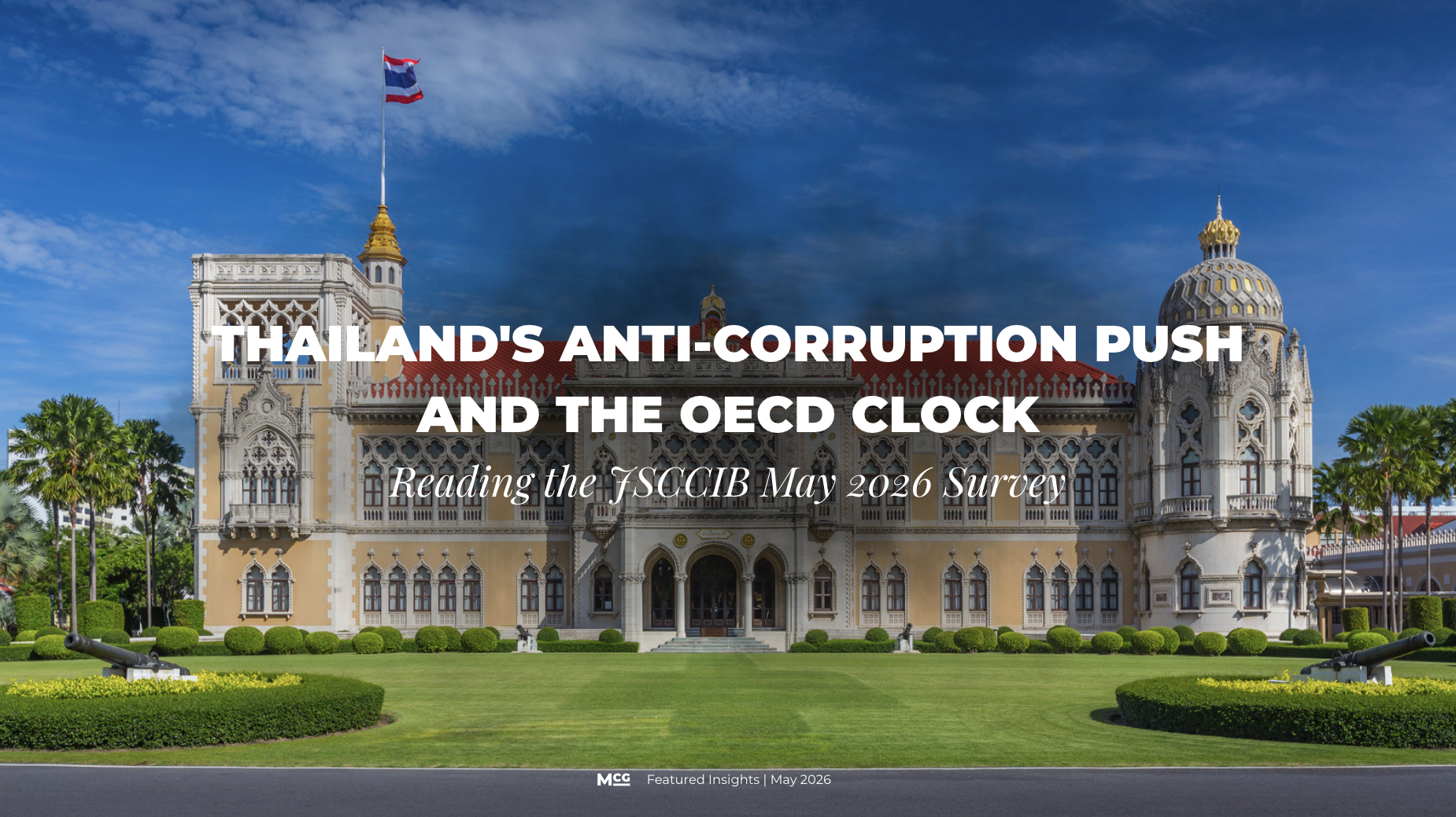
On 15 May 2026, Thailand's private sector delivered its anti-corruption case to the Anutin Cabinet.
A 401-respondent JSCCIB survey, released the previous day, named the country's ten highest alleged bribery-risk state agencies for the first time.
The Corruption Perceptions Index 2025 has placed Thailand at 33 of 100, ranked 116th globally — the lowest in 19 years. The OECD Anti-Bribery Convention technical review opens across 25 committees in 2026, with accession targeted before 2030.
The Prime Minister, on the morning of the submission, called the problem a "stigma."
The Joint Standing Committee on Commerce, Industry and Banking (JSCCIB) and its civil society partner network "Puean Mai Thon" (“Friends Won't Tolerate It") delivered anti-corruption proposals to the Cabinet at Government House. Prime Minister Anutin Charnvirakul received the delegation but assigned Deputy Prime Minister Pakorn Nilprapunt to take and process the submission.
Later the same day, he personally hosted a separate forum titled "Entrepreneurs Speak, Government Listens", with roughly 35 senior executives from Charoen Pokphand Group, Thai Beverage, Gulf Development, Bangchak, Central Group, Betagro and Saha Pathanapibul, each given three minutes.
The headlines covered both events. The interesting story is in the gap between them, in who took which room, and in the language the Prime Minister chose to describe the problem.
What Was Actually Submitted
The JSCCIB survey covered 401 business executives across the country between 26 March and 10 April 2026. The headline numbers are familiar in shape but materially more pointed than previous iterations: 89.1% of respondents called corruption a moderate to very serious obstacle to doing business, 51.2% said it had worsened over three years, 60.9% reported direct or implied requests for inducements on their most recent permit application, and 45.9% admitted paying.
What made this iteration different was the first-ever release of agency-level alleged bribery-risk data. The ranking used two indicators — alleged inducement rate per contact and alleged average bribe value per transaction.
JSCCIB 2026: Top Ten Thai State Agencies by Alleged Bribery Risk
By alleged inducement rate per contact:
Highway and traffic police — 100%
Justice process (excluding courts) — 94.4%
Subdistrict administrative organisations — 91.7%
Marine Department — 90.0%
Department of Highways — 82.0%
Department of Public Works and Town & Country Planning — 78.9%
Local police — 77.7%
Department of Intellectual Property — 76.0%
Revenue Department — 71.0%
Department of Land Transport — 69.4%
By alleged average bribe value per transaction:
Pollution Control Department — THB 102,160
Marine Department — THB 100,000
Excise Department — THB 94,667
Revenue Department — THB 89,498
Justice process (excluding courts) — THB 88,750
Department of Highways — THB 70,167
Department of Public Works and Town & Country Planning — THB 70,000
Source: JSCCIB / Thai Chamber of Commerce, "Survey of Private-Sector Opinion on Transparency in Public-Sector Administration," released 14 May 2026 (n=401 business executives, fieldwork 26 March–10 April 2026).
Thai PBS framed the same dataset more sharply for domestic readers: "Public-sector corruption drags business costs up by 58%." The Thai-language coverage uses ส่วย (suay), the regularised, recurring informal payment that flows in established bureaucratic relationships, distinct from สินบน (sinbon), one-off bribery. The distinction matters. The survey is not describing isolated incidents. It is describing a structural channel.
The OECD Clock
The framing the private sector chose for the submission was not ethics. It was Organisation for Economic Co-operation and Development accession.
This is a deliberate lever. On 8 December 2025, Anutin personally submitted Thailand's Initial Memorandum to OECD Deputy Secretary-General František Ružička. The same day, the National Anti-Corruption Commission submitted a Letter of Intent to accede to the OECD Anti-Bribery Convention. The Convention is a required prior accession for OECD membership.
Thailand became, on that date, an Accession Candidate Country within the OECD Working Group on Bribery. In 2026, Thailand enters technical review with 25 OECD committees, with the stated target of OECD membership before 2030.
The Convention is not about perception. It requires criminal liability of legal persons for foreign bribery, prosecution of bribery of foreign public officials in international business transactions, the non-tax-deductibility of bribes, asset disclosure for politically exposed persons, whistleblower protection, and effective independent enforcement.
The OECD's 2024 review of Thailand's legal and policy framework specifically flagged the need to amend Thai law on bribery of foreign public officials, to ensure liability of legal entities is detailed and enforceable, and to introduce clear prohibitions on the tax deduction of bribes.
This is what allows the JSCCIB framing to work. OECD accession depoliticises the anti-corruption ask. It transforms what could be read as a partisan critique into a national competitiveness imperative. It externalises the timeline. And it gives officials inside the bureaucracy who would otherwise need to make a difficult domestic case the cover of an international standard.
This is how serious advocacy operates in this environment: not by naming, but by reframing.
"Stigma" — Anutin's Own Choice of Word
The morning the JSCCIB delivered its submission, Anutin spoke to reporters. Thairath captured the framing precisely: he described Thailand's CPI standing as a deeply ingrained "perception" that acts like a "stigma," and added that "despite intensified governance and independent oversight in recent years, resulting in many offenders being punished, this stain must be removed."
He referenced the "digital footprint" of the modern age as the reason perception had calcified. He summoned the Director-General of the Department of Public Works and Town & Country Planning, who is an agency under his own Interior portfolio, for questioning.
The vocabulary is not accidental. Read against Anutin's February 2026 statement, "this is considered low. Simply put, it's a fail". The through-line is consistent. The government accepts the indicator damage and the OECD timeline, but positions the response as one of communications correction, digital-government acceleration, and regulatory streamlining rather than enforcement against insiders.
The internal architecture of the response reinforces this.
The substantive legal-reform track is run by DPM Borwornsak Uwanno, a respected constitutional law scholar, with Bhumivisan Kasemsook, Secretary-General of the Public Sector Anti-Corruption Commission. Borwornsak's brief, confirmed in February 2026, is to amend or repeal laws and regulations across the Ministries of Interior, Commerce, Public Health, and Agriculture, targeting discretionary approval powers.
The May 15 JSCCIB submission, by contrast, was routed not to Borwornsak but to Pakorn. The split tells you which file is being treated as substance and which as relations.
Stigmas are washed off. Structures are dismantled. The OECD will eventually require the second; the Prime Minister, on the morning of the submission, chose the first.
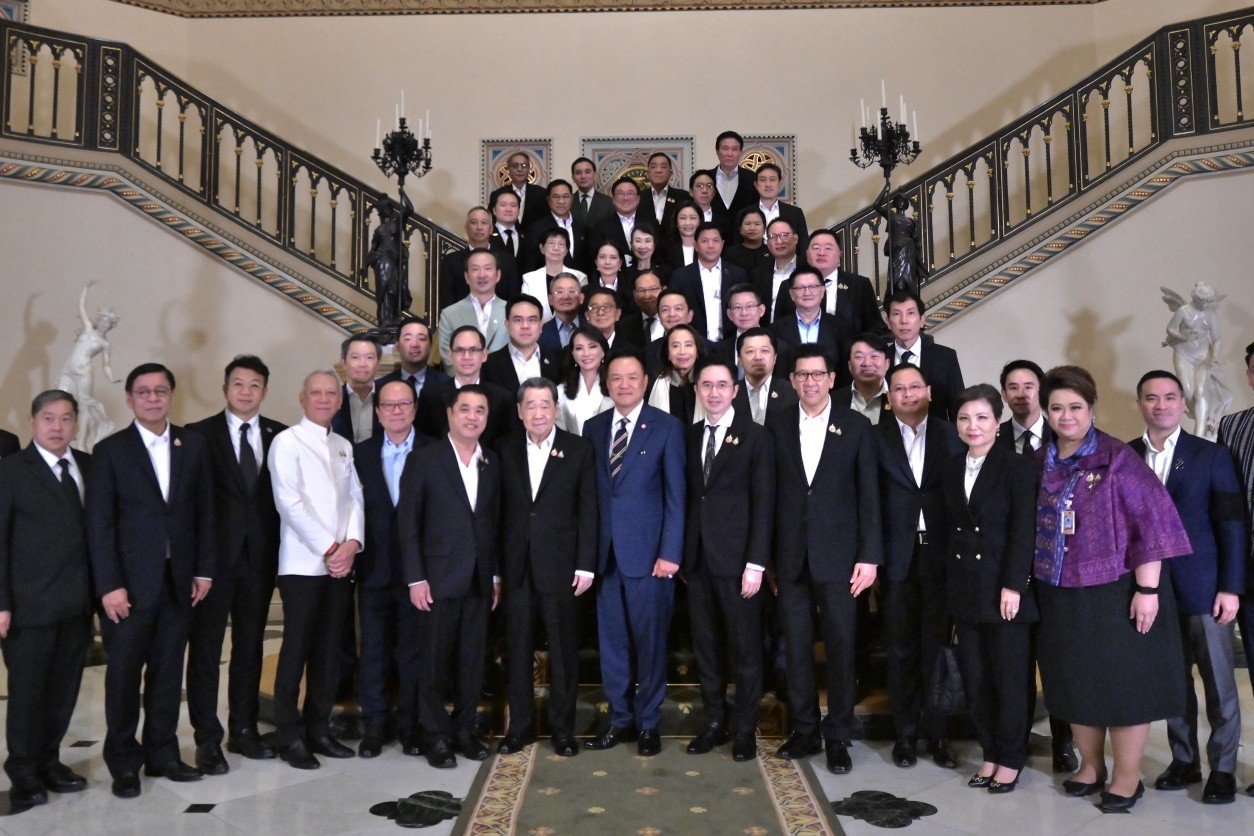
Prime Minister Anutin Charnvirakul and Cabinet ministers with senior executives from Thailand's major business groups at the "Entrepreneurs Speak, Government Listens" forum, Thai Khu Fah Building, Government House, 15 May 2026
Source: Komchadluek (คมชัดลึก)
The Feedback Loop No One Names
The conventional reading is that civil society and the OECD are pressuring a reluctant government toward reform. The more accurate reading is that a tightly coupled feedback loop exists between Thailand's private sector, the international perception indices that score the country on corruption, and the government's own published KPIs, and the same private-sector community is sitting on every side of it.
Transparency International's own decomposition of Thailand's 2025 CPI slide is the key data point.
The biggest declines were concentrated in indices linked to investor and private-sector perception, particularly the IMD World Competitiveness Yearbook. By contrast, assessments of Thailand on the political and legal-structure dimension showed improvement in most areas. The arithmetic: it is the business class itself that is revising Thailand downward.
The government has stated benchmark targets across three indices beyond the CPI, the IMD World Competitiveness Ranking (Thailand at 30th, down from 25th), the World Justice Project Rule of Law Index (77th of 142), and the World Bank Worldwide Governance Indicators.
The JSCCIB comprising the Thai Chamber of Commerce, the Federation of Thai Industries, and the Thai Bankers' Association, represents the executive community whose perception responses populate those indices. The OECD accession process Thailand entered in December 2025 is also heavily weighted toward governance perception and legal-framework alignment.
Mapping these corners shows a closed loop where one constituency supplies the data, articulates the political demand, defines what reform success looks like, and benefits from the resulting reforms. This is neither scandal nor conspiracy. It is how political economies behave when private capital becomes the most coherent voice in the room. But it does shape what reform looks like.
The "Zero Corruption" agenda is administrative reform: digital government, open contract data, regulatory guillotine, discretion reduction. It is the part of the corruption agenda the chamber community can credibly drive.
What does not appear in the JSCCIB rankings or the submission is also instructive: defence procurement, party financing, political-level corruption, judicial corruption (courts conspicuously excluded from the justice-process category).
The Anti-Corruption Organisation of Thailand and its chairman Dr Mana Nimitmongkol, who has consistently argued that "major corruption involving huge losses always requires political involvement", is operationally adjacent to this push, not central to it.
Who Pushed Back, and Why It Matters
Within hours of the agency-level data appearing in print, named agencies began responding. The pattern of response is the next data layer.
The Marine Department issued a same-day denial, citing 287,427 service transactions handled in fiscal year 2025 through e-Service licence-application and e-payment systems, and pointing to its 1199 hotline and website complaint channels. The defence is bureaucratic and predictable: digitalisation removes face-to-face contact, therefore removes the channel for bribery.
The Pollution Control Department response was substantively different. Director-General Surin Worakijthamrong held a press conference, mobilised his executives in a crossed-arms public gesture, and made a methodological argument.
He challenged the survey's sampling design, the respondent selection, and the agency identification. He observed that the alleged average bribe value (THB 102,160) exceeds the statutory maximum fine under the relevant pollution legislation (approximately THB 60,000), making the implied economic logic incoherent.
He noted that the PCD has no permit-issuing authority, only inspection, which removes a primary channel for soliciting bribes. He gave the JSCCIB a seven-day deadline to provide source data and methodology. This is the most credible institutional pushback the survey has received, and it is a model other named agencies are likely to copy.
Deputy Prime Minister and Transport Minister Phiphat Ratchakitprakarn, whose ministry contains three of the agencies on the ranking (Marine, Highways, Land Transport), ordered a ministerial probe of his own agencies.
Phiphat is the same minister publicly questioned in late April over alleged financial ties to the oil trader known as "Sia Tue." A probe by a minister into his own agencies, where the minister's own integrity has been raised on the public record, is procedurally responsive but structurally weak. Under OECD-grade governance norms it would not satisfy independence requirements.
Anutin's own response, summoning the DG of Public Works and Town Planning, which sits under his Interior portfolio, followed the same pattern: minister-led, ministry-internal, contained.
The signal is consistent. Agency-level disclosure will produce probes; probes will be agency-internal or minister-led on agencies the minister already controls. Independent investigation is not in the response architecture.
Where This Connects to the Bigger Diagnosis
The administrative-bribery story is not separable from the broader question of why Thailand's economy is growing at 1.6–2.2% when its regional peers are growing faster.
As we set out in our February analysis of Thailand's structural slowdown, the country is drifting into a structural low-growth equilibrium shaped by debt, demography, eroding competitiveness and prolonged political fragmentation. The corruption file is the regulatory-friction layer of that diagnosis.
Rattakrai Limsiritrakul of FTI put the cost number on the record on 15 May: prices of goods and services could fall by 20–30% if corruption were seriously addressed.
The Anti-Corruption Organisation of Thailand has estimated the total annual cost at THB 500 billion across procurement kickbacks, illegal-economy protection payments, and intra-bureaucratic patronage flows.
The FTI's previous estimate was that Thailand loses approximately 2% of GDP to corruption annually — meaning the country's growth potential of roughly 4% is being halved by the regulatory friction the JSCCIB survey now quantifies.
For multinationals already operating under FCPA, UK Bribery Act and Sapin II constraints, the OECD process represents alignment with internal compliance practice they have already absorbed, net positive, low marginal cost, and a useful signal to global headquarters.
For Thai conglomerates participating in the chamber-led model, the strategy is rational: collective voice on administrative reform through the chambers preserves individual deniability on anything closer to the political-economy core.
For foreign investors trying to read whether the Anutin window will produce durable change, the honest answer is that the parts of reform inside the feedback loop will move and the parts outside will not, until the political cost of inaction crosses a threshold.
What to Watch in the Next Eighteen Months
A few signals worth tracking specifically.
The Borwornsak-PACC legal-amendment package: whether it delivers concrete deliverables on the four named ministries by Q4 2026, or whether it becomes a working-group exercise that produces principles rather than statutes.
The NACC (Office of the National Anti-Corruption Commission)’s legislative drafting for the OECD Anti-Bribery Convention: whether the criminal liability of legal persons for foreign bribery, the foreign-bribery offence, and tax non-deductibility of bribes reach parliament in the current session. These are the technical files that determine whether 2030 OECD accession is achievable.
The NACC's current public consultation on draft amendments to the Organic Act on Counter Corruption B.E. 2561, framed explicitly as alignment with OECD standards, closes on 31 May 2026. The substantive shape of those amendments — particularly on criminal liability of legal persons and the foreign-bribery offence — will be the first hard test of how seriously the OECD timeline is being treated.
The Phiphat-Transport probe: whether it produces named disciplinary action in Marine, Highways, or Land Transport, or whether it settles into a procedural review with no public-facing accountability.
The annual repetition of the JSCCIB agency-level survey: whether the chambers commit to year-on-year deltas that institutionalise the pressure, and whether agencies that received the highest 2026 rankings show measurable movement in 2027.
The IMF–World Bank Annual Meetings in Bangkok in October 2026: the visibility forcing function that compresses the timeline between rhetoric and demonstrable progress.
The opposition's no-confidence motion: whether Pheu Thai integrates agency-level data and unresolved Cabinet integrity questions into a formal parliamentary case, or whether the file remains primarily a private-sector conversation.
And the broader signal underneath all of these: whether, by mid-2027, the Anutin government can credibly claim that the OECD technical review has produced legislative deliverables worth the political capital spent, or whether the entire process has been managed as image correction at the speed politics allows.
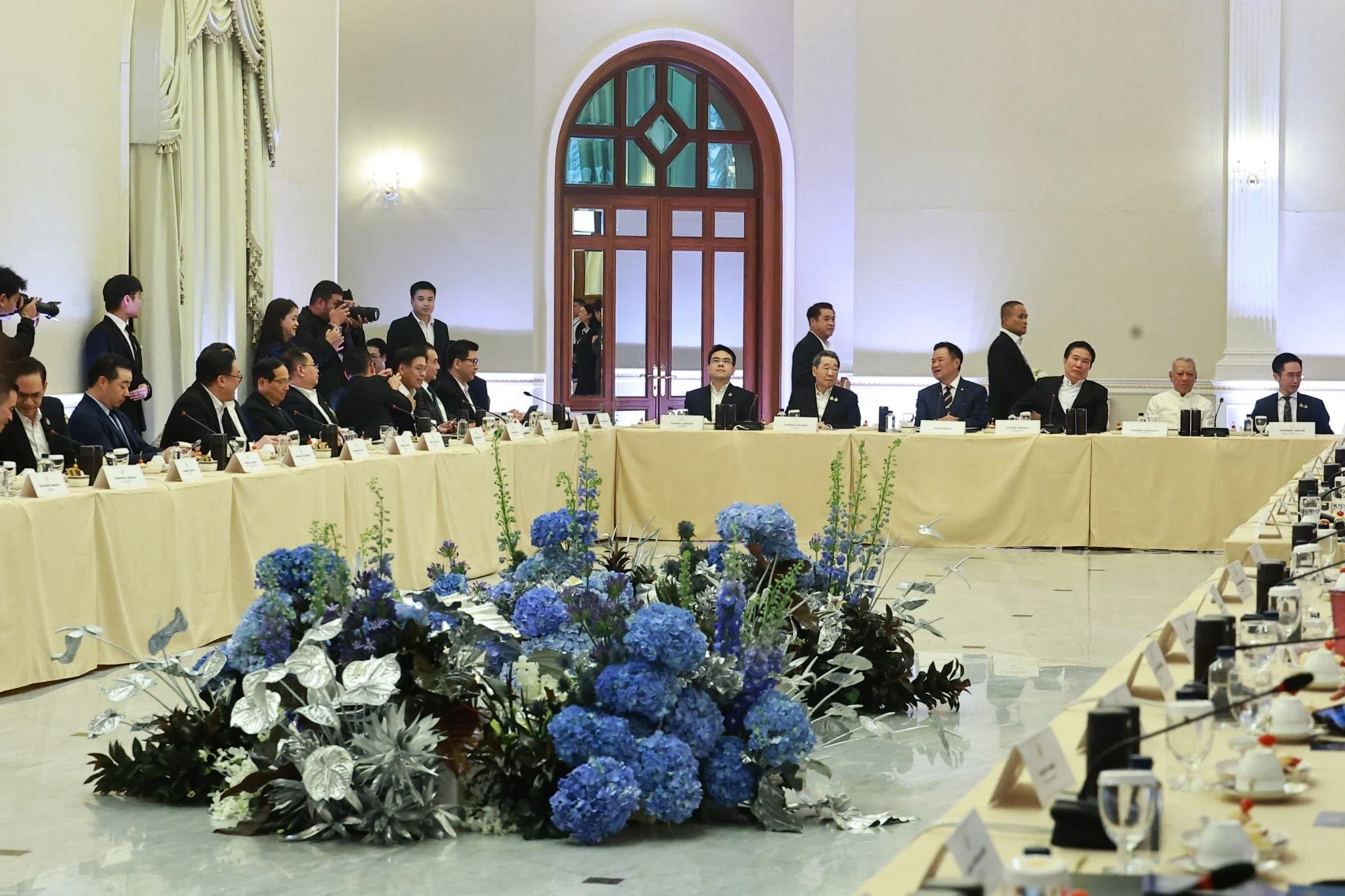
Prime Minister Anutin Charnvirakul meets business leaders at the "Entrepreneurs Speak, Government Listens" forum at Government House, 15 May 2026
Source: Daily News (เดลินิวส์)
The substantive question for the next eighteen months is not whether Thailand wants to be cleaner. It is which institutions will decide that being seen to engage costs them less than being seen to resist.
In Bangkok, that calculation has always been the real one. The OECD clock will eventually compel an answer. The question is which Thailand chooses to give.
— Ben Kiatkwankul, Partner & Co-Founder
mcg-asia.com | Bangkok
Maverick Consulting Group provides strategic advisory, government relations, and public affairs counsel across Thailand, Southeast Asia, and the Gulf. MCG advises international clients on regulatory strategy, market entry, stakeholder navigation, and political economy analysis in complex operating environments.