
Concrete Is Not Connectivity: What Thailand's Aviation Build-Out Actually Decides
Why Thailand's aviation hub ambitions will be decided by its carriers, its MRO and services ecosystem, and its policy choices, not by terminal capacity.
Key takeaways
Airport capacity across Southeast Asia has converged, and it no longer differentiates a hub.
Hub status is decided in the institutional layer: carriers, MRO, cargo rules, slots and bilateral rights.
Thai Airways' return from restructuring gives Thailand a credible home carrier for the first time in a decade.
The U-Tapao MRO project and air-cargo liberalisation are the highest-value, least-watched developments.
The decisions that lock in advantage are being made in 2026, including at head-of-government level in Paris.
Thailand is in the middle of its most ambitious aviation expansion in a generation. Airports of Thailand has put forward a five-year investment programme of around 80 billion baht, with the Suvarnabhumi East Expansion heading to tender and a revised master plan targeting 120 million passengers a year, roughly double current throughput; a new international passenger service charge rising to 1,120 baht from June 2026 is structured to fund it.
These numbers will make the headlines. They are also the least interesting part of the story. Capacity is necessary, but it is not what decides whether a country becomes an aviation hub. Those decisions are being taken elsewhere: in ministries, in boardrooms, and, as this is written, in Paris.
The capacity race: Southeast Asia's converging airport hubs
The visible contest is a capacity race, and the field has converged. By early 2026, Changi, Kuala Lumpur and Suvarnabhumi sat within a rounding error of one another in departing seats, each near 3.5 to 3.7 million in a peak month, while Vietnam's Long Thanh adds a large new node and Indonesia grows on a vast domestic market. When every serious player is building toward similar numbers, capacity stops being an advantage and becomes the cost of entry.
A hub is not a building that processes passengers. It is a system that concentrates connectivity: route density, transfer traffic, and the high-value services that anchor an aviation economy in place. That rests on two things a terminal cannot supply: a home carrier driving network density, and a regulatory architecture that lets the value settle locally rather than passing through. Both are now in motion in Thailand, and neither is getting the attention it deserves.
The carrier question: Thai Airways rebuilt as a network engine
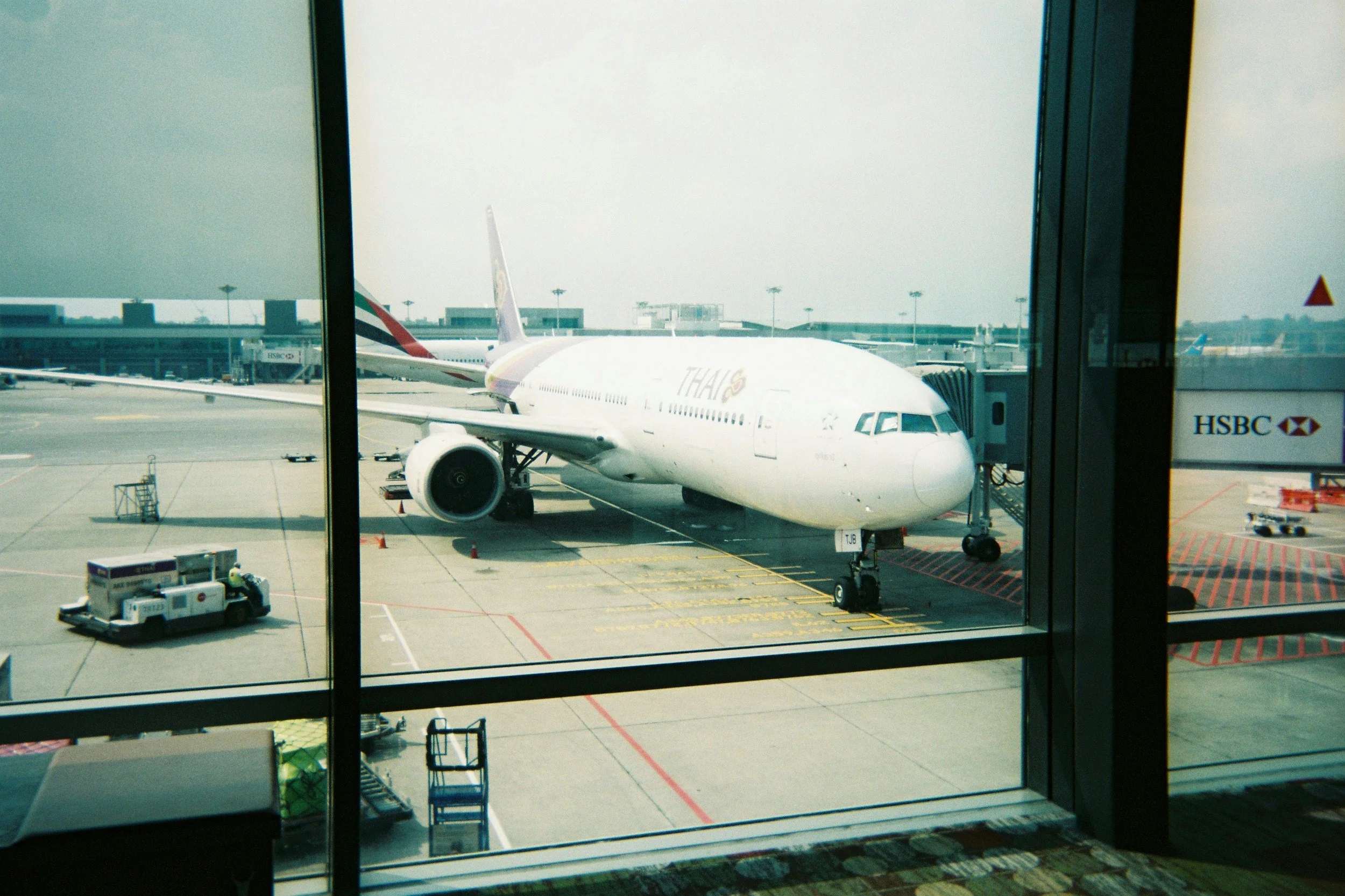
A hub needs a home carrier with the reach and incentive to build transfer traffic. For most of the past decade, Thailand's was a liability. That has changed.
Thai Airways is best understood against where it began. In early 2020 it was seeking a 58.1-billion-baht ($1.8 billion) state-guaranteed emergency loan to stay liquid; weeks later, a contentious bailout gave way to court-supervised restructuring. The airline won court approval of its rehabilitation plan in June 2021, addressing debt of around $12.9 billion, then spent four years executing it: halving its workforce, cutting routes, simplifying the fleet and converting debt to equity. It exited rehabilitation in mid-2025 and relisted on the Stock Exchange of Thailand that August, returning to profit on revenue of roughly 190 billion baht for 2025 and operating margins that, by some measures, ranked among the stronger full-service carriers globally.
None of this was unforeseeable. When the airline first sought rescue in 2020, our own assessment, offered publicly at the time, was that its problems were institutional rather than cyclical: recovery would depend less on capital than on shedding state-enterprise constraints, professionalising management and insulating the carrier from political influence. By the 2021 court approval, the diagnosis was unchanged, and the restructuring did, in substance, exactly that. We note it not to claim foresight but because it is the thesis in miniature: in this market the decisive constraints are institutional, and they are visible well before they are resolved.
Rebuilt as a connecting carrier, Thai Airways is consolidating to fewer aircraft and engine types while growing from around 80 aircraft toward 150 by the early 2030s, anchored by 45 Boeing 787s and incoming A321neos. A founding Star Alliance member at the crossroads of South Asia, Northeast Asia and the West, it aims to lift domestic market share from 26 to 35 percent by 2029 and win far more international transit. Transfer traffic is the connective tissue of a hub, and a flag carrier rebuilt to generate it is a central input into Thailand's ambitions.
Around it sits a layered ecosystem: Bangkok Airways in a profitable regional and premium-leisure niche built on routes such as Samui, and a low-cost segment, Thai AirAsia, Thai Vietjet, Nok Air and Thai Lion Air, supplying the point-to-point volume that keeps Don Mueang among the region's busiest low-cost hubs. Whether these layers are coordinated into a single network or left to compete is a question of policy, not fleet size. And connectivity is never the work of home carriers alone: it depends as much on the access, slots and bilateral rights extended to international and partner airlines. How open Thailand chooses to be, and how it allocates scarce capacity, is itself among the decisions that matter most.
Where does the value stay? MRO, cargo and the institutional layer
If carriers determine the network, the services ecosystem determines whether the value stays, and this is where the consequential decisions are being made now.
Asia's large-scale MRO capacity sits in Singapore and China; Thailand has long exported its heavy maintenance and the skilled jobs with it. The planned MRO complex at U-Tapao, in the Eastern Economic Corridor is meant to change that: a roughly 210-rai site on a 50-year lease, with Thai Airways committing about 10 billion baht to build hangars in phases, a Bangkok Airways sub-lease alongside, and early interest from Airbus, Boeing and Singapore's ST Engineering, with construction timed to the airport's second runway.
The strategy is in how the deal was restructured. When Thai Airways ceased to be a state enterprise, the Cabinet cancelled its exclusive development rights and the EEC shifted to a private-sector lease model, opening the project to broader investment. An asset ring-fenced inside a state monopoly became a competitive opportunity, through a quiet procedural change most observers never registered. The same logic runs through cargo: the Civil Aviation Authority has signalled a phased liberalisation of foreign ownership, long capped at 49 percent, toward eventual full ownership, alongside ambitions to make Suvarnabhumi a genuine logistics node. Each decision determines whether Thailand captures the sticky, high-margin layers of aviation, the maintenance contracts, freight platforms and regional headquarters, or merely moves traffic across its territory.
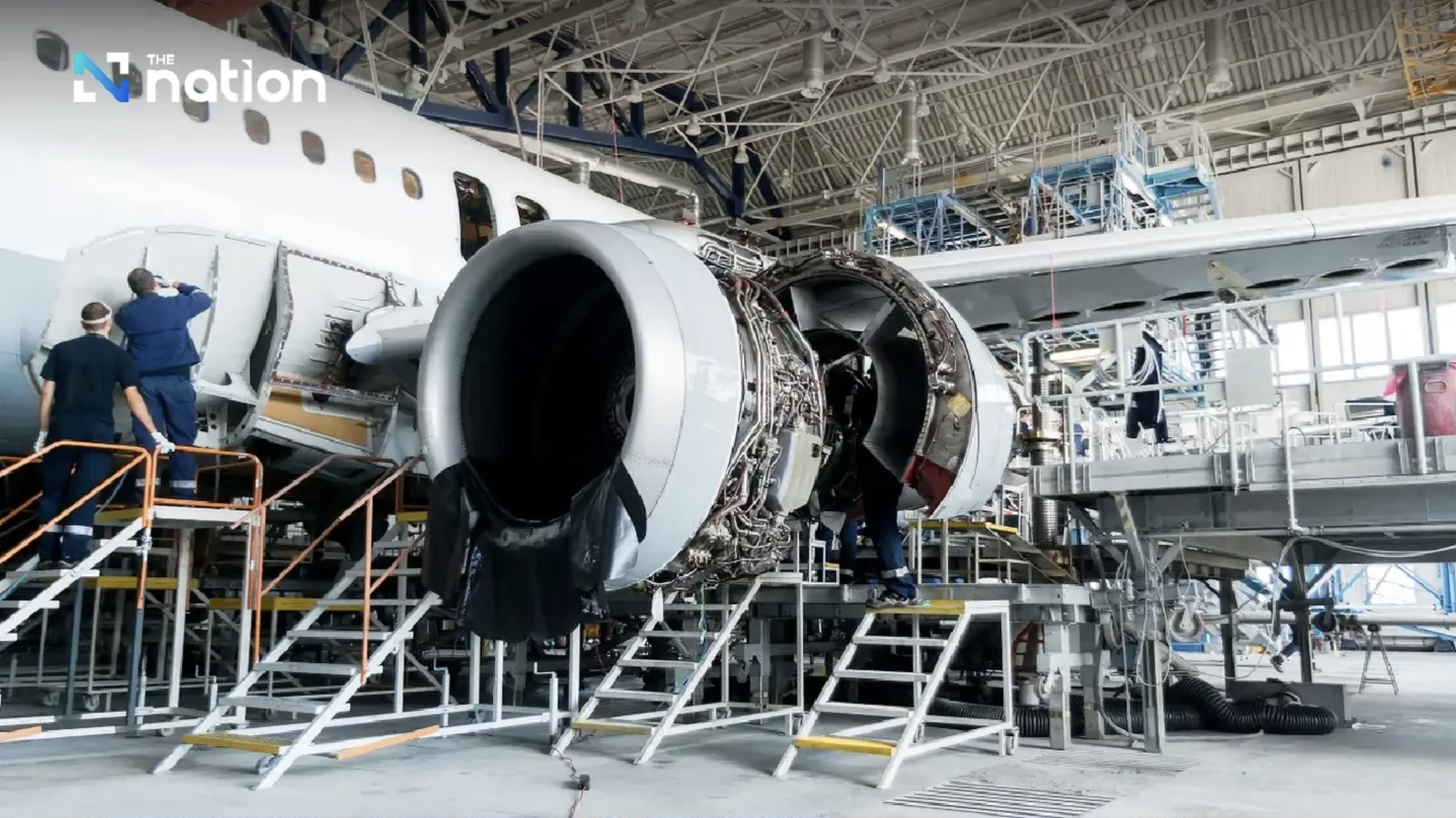
Heavy maintenance on a commercial jet. Thailand's planned U-Tapao complex aims to build the domestic MRO capability the region currently sources mainly from Singapore and China.
Source: The Nation
These dependencies also carry risk. The U-Tapao Aviation City project has stalled in renegotiation because the promised high-speed rail link has not proceeded as contracted, leaving investors exposed to a government obligation beyond their control. Here, contract structure and surrounding commitments matter as much as the commercial case.
Aerospace and defence diplomacy: reading the France visit
The ecosystem cannot be built domestically alone. It needs foreign technology, capital and industrial partners, and securing them is state-level work now being done abroad.
Prime Minister Anutin Charnvirakul's official visit to France in late May 2026 should be read this way. Beneath the working dinner with President Macron and the move toward a strategic partnership lies an economic mission with MEDEF International aimed at investment in aviation and aerospace, defence and clean energy. France holds the integrated aerospace stack Thailand needs: Airbus in airframes, Safran in engines, Thales in avionics, and the defence platforms on the same industrial base. Thai Airways already flies Airbus narrowbodies, and Airbus has signalled interest in the widebody maintenance U-Tapao is meant to anchor. The airport expansion, the carrier rebuild, the MRO complex and the France visit are not four stories but one strategy.
Aerospace and defence draw on the same industrial base, and Thailand is right to treat them as one conversation; a credible base serves civil and military aviation alike. That is why both sit on the Paris agenda, and it is the part that will rightly be conducted with the most discretion. The competitive context is plain: France has spent two years deepening these ties across the region, with an Airbus order in Vietnam and a defence package with Indonesia and an upgraded partnership with Singapore, positioning itself as a "third way" between the United States and China. Thailand is moving now, later than its neighbours, while the regional aerospace map is still being drawn, and the best industrial commitments tend to go to those who engage first.
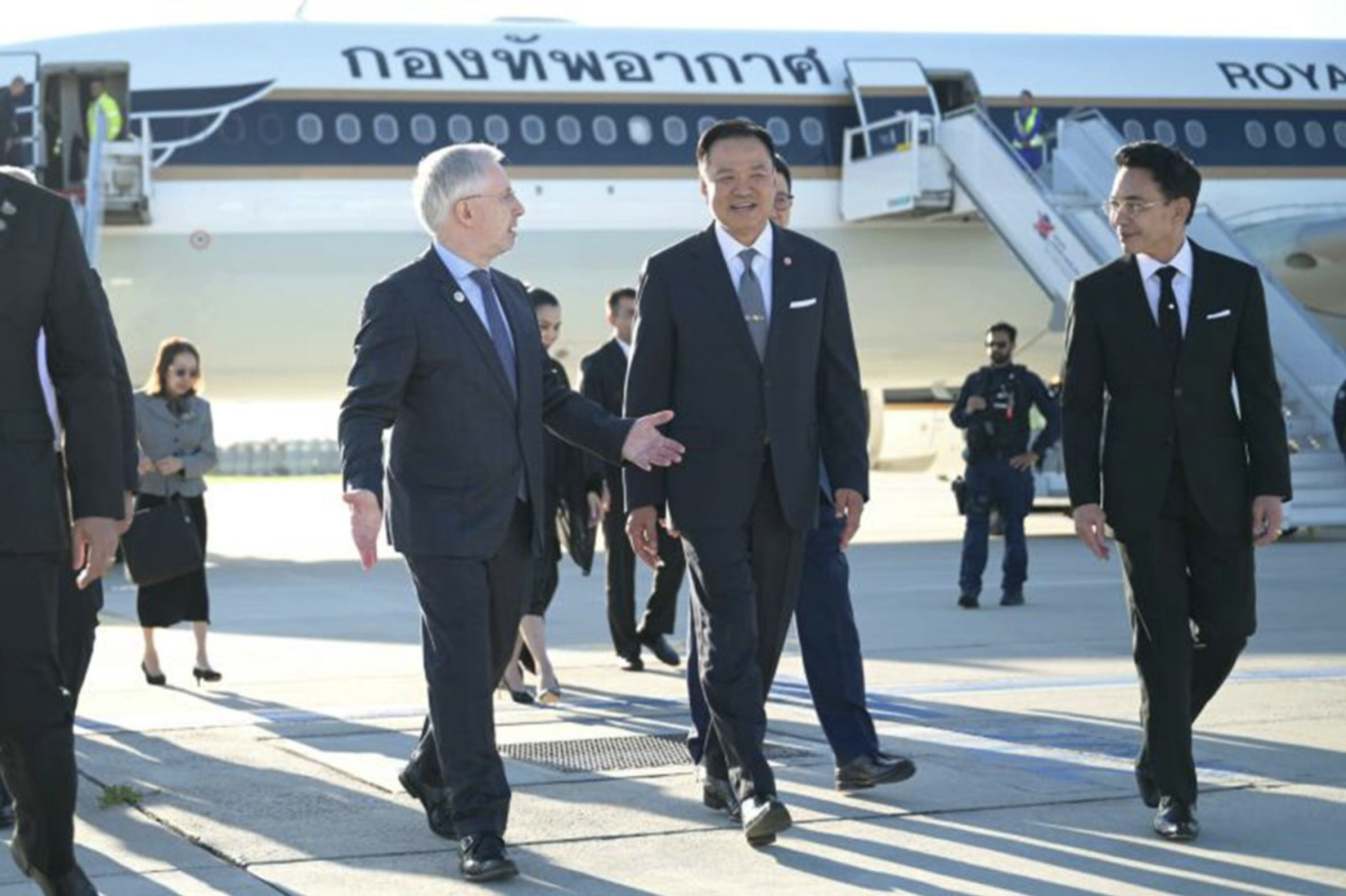
Thai PM Anutin Charnvirakul arrives in France for an official visit, May 2026.
Source: Bangkok Post
What are Singapore, Malaysia and Vietnam actually competing on?
Against its neighbours, the challenge is clear. Singapore's edge was never Changi's amenities but regulatory clarity, predictable institutions and an MRO base built over decades. Kuala Lumpur leans on cost and low-cost density. Vietnam's Long Thanh has the rarest advantage of all: a greenfield institutional slate, where rules can be designed for the hub rather than retrofitted around legacy interests. Thailand has scale, geography, a revitalised flag carrier and a credible MRO and cargo plan. What it must prove is that its institutions can move as coherently as its construction programme, aligning airport operator, regulator, ministry and carriers around one intent, faster than the window stays open.
Why timing matters: the decisions being made in 2026
The decisions in train, the MRO lease and its ownership, cargo thresholds, slot policy and bilateral rights, and whether the carrier layers are coordinated, are not incremental; they lock in advantage for a decade or more. Regulatory architecture, once set, is slow to revisit. The carriers, operators and investors who understand this are positioning now, while it is still being written. The capacity build-out signals intent; the value will accrue to those who engage the layer beneath it, who grasp how Thai aviation governance actually works, where the genuine decision points sit, and how recent shifts have opened doors that were closed.
The strategic read: what it means for airlines and investors
Three things follow.
Treat capacity as table stakes, not differentiation; the real questions are about the network and the ecosystem, including what access foreign and partner airlines are granted.
The highest-value opportunities sit in maintenance, cargo and services, the segments now opening and least settled, where state monopolies are giving way to partnership models, rather than in passenger volume. And timing is itself leverage: a case advanced after the architecture sets faces a far steeper path than the same case made while it is still forming.
Thailand has declared its capacity ambitions and rebuilt the carrier at their centre, and it is now sourcing the industrial partners to build the layer underneath. The capacity will come regardless.
The harder question, the one that separates the firms that benefit from those that merely watch, is who is reading the institutional layer correctly and engaging it now, while the architecture is still being set.
Ben Kiatkwankul advises governments, investors and international companies on regulatory positioning, market entry and stakeholder strategy across Thailand, Southeast Asia and the Gulf.
Parts of this article is also featured in Asia Sentinel.