
Thailand's Land Bridge: The Trillion-Baht Question Returns
Three feasibility studies. Zero committed foreign capital. Three hundred and forty-nine years of revivals. Thailand's Land Bridge is back on the cabinet agenda, and the version being prepared is materially different from the one Srettha's government marketed in 2024.
On 28 April 2026, Prime Minister Anutin Charnvirakul's cabinet directed Deputy Prime Minister and Finance Minister Ekniti Nitithanprapas to chair a fresh 90-day review of the Chumphon to Ranong corridor. Construction is targeted for 2030.
Deputy Prime Minister and Minister of Transport Pipat Ratchakitprakarn, whose ministry has held operational responsibility for the file, has confirmed a 2030 construction target and signalled that the review will broaden the project's scope to incorporate Middle East shipping scenarios and Southern Economic Corridor integration.
The morning after the directive entered the public record, Chulalongkorn University's Transport Institute convened nine of its research centres for a public academic forum on the project.
The framing this article borrows from that forum is the one Professor Emeritus Surachart Bamrungsuk used: a 21st-century geopolitical problem being answered with 20th-century heavy infrastructure, organised by what he called "Lego Politics."
From Kra Canal to Land Bridge: 349 Years of Revivals
The Land Bridge is the latest form of a question Thailand has been asking itself since the reign of King Narai. Each revival has been driven by what Thailand wanted, or feared, from the world at that moment. The economics have rarely been the reason it moved forward.
The first proposal dates to 1677, when King Narai commissioned the French engineer de Lamar to survey the Kra Isthmus. In 1882, Ferdinand de Lesseps visited the area at the height of Anglo-French rivalry over Indochina. King Chulalongkorn declined to permit detailed investigation.
In 1897, Siam signed the Anglo-Siamese Secret Convention, agreeing not to grant any canal concession across the Malay Peninsula without British consent. The purpose was to protect Singapore. The restriction was reaffirmed in Article 7 of the 1946 Anglo-Thai Peace Treaty, then revoked unilaterally in 1954.
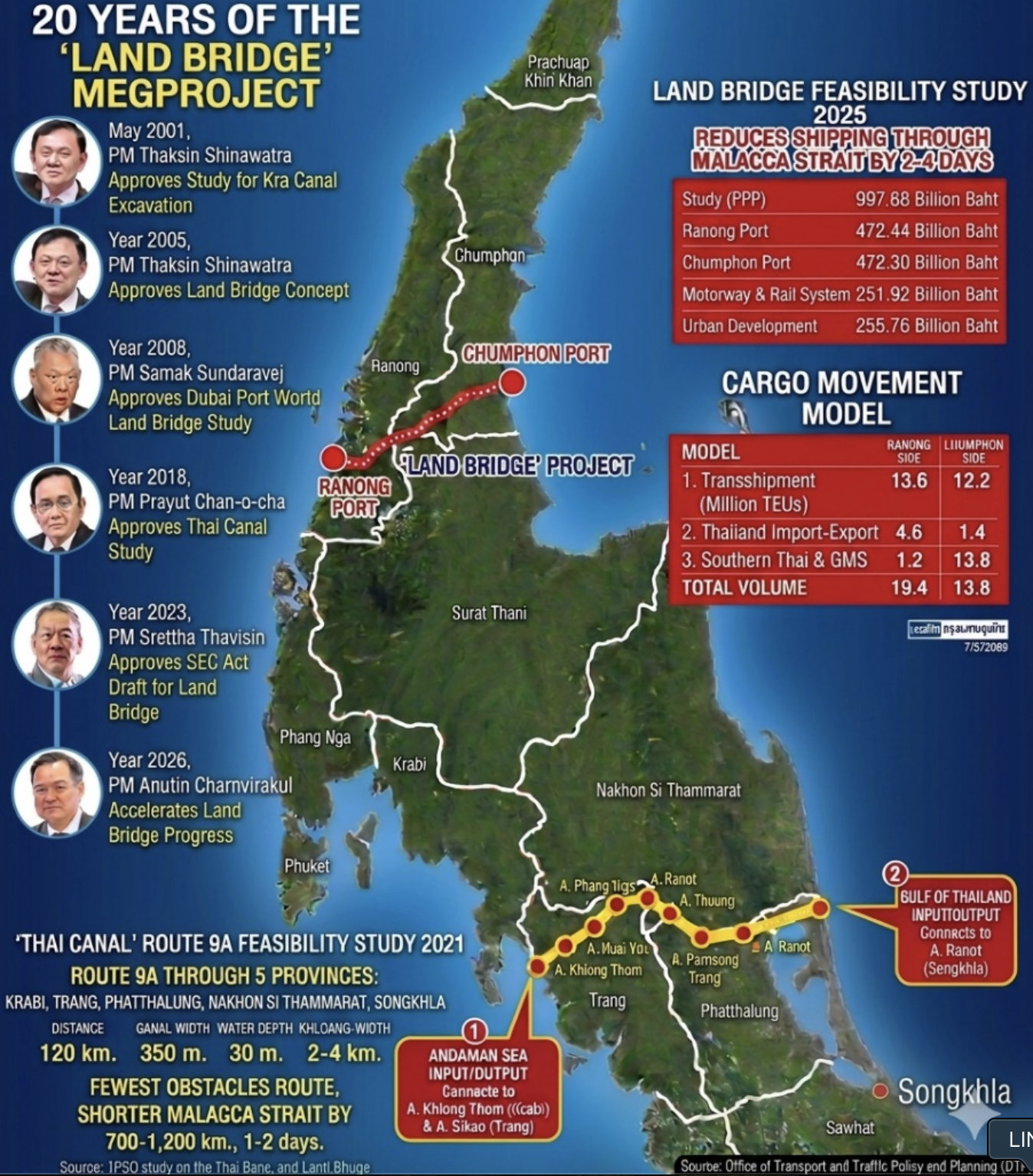
The modern revival pattern compresses neatly: a Thaksin-era committee suspended on national security grounds in 2003, a Chinese MOU signed and disavowed within four days in May 2015, Prayut's pivot from canal to land bridge in 2020, Srettha's 2023 revival, and Anutin's April 2026 directive.
Every revival has involved a foreign sponsor expressing interest. None has produced committed capital.
Source: Office of Transport and Traffic Policy and Planning
What the Land Bridge Project Actually Costs
The official scope, set out in the OTP feasibility study of May 2024, totals 1,001,206.47 million baht across four phases between 2030 and 2079.
The corridor comprises two deepwater ports, Laem Riu in Chumphon at 17 metres draft and Laem Ao Ang in Ranong at 21 metres, connected by 89 to 91 km of motorway, dual-track standard-gauge rail, and dual-track meter-gauge rail. Capacity at full build-out is 20 million TEUs per side. Sea reclamation runs to 6,975 rai. The structure is a 50-year PPP Net Cost concession.
Two scope additions are now in play. Deputy Transport Minister Siripong Angsakulkiat confirmed on 6 May 2026 that the Ekniti committee will fold OTP's revised study, prepared with private consultants, into its 90-day review. The most material addition is an oil and gas pipeline corridor linking the two coasts.
Until now, Thailand's hydrocarbon pipeline infrastructure has run only along the Eastern Seaboard. The Land Bridge alignment would extend it to the Andaman side. In the same briefing, Siripong cited internal cost comparisons placing the Land Bridge at approximately 900 billion baht against 2 trillion baht for a Thai Canal. He described the canal as a "last resort."
The 1.001 trillion baht headline is the marketed figure. It is not the full fiscal exposure. The OTP's own analysis acknowledges the project is only viable if accompanied by approximately 70,000 rai of industrial zones, including petroleum and petrochemical complexes.
Panellists at the 7 May forum called this the project's "industrial tail." It is not currently quantified in cabinet papers.
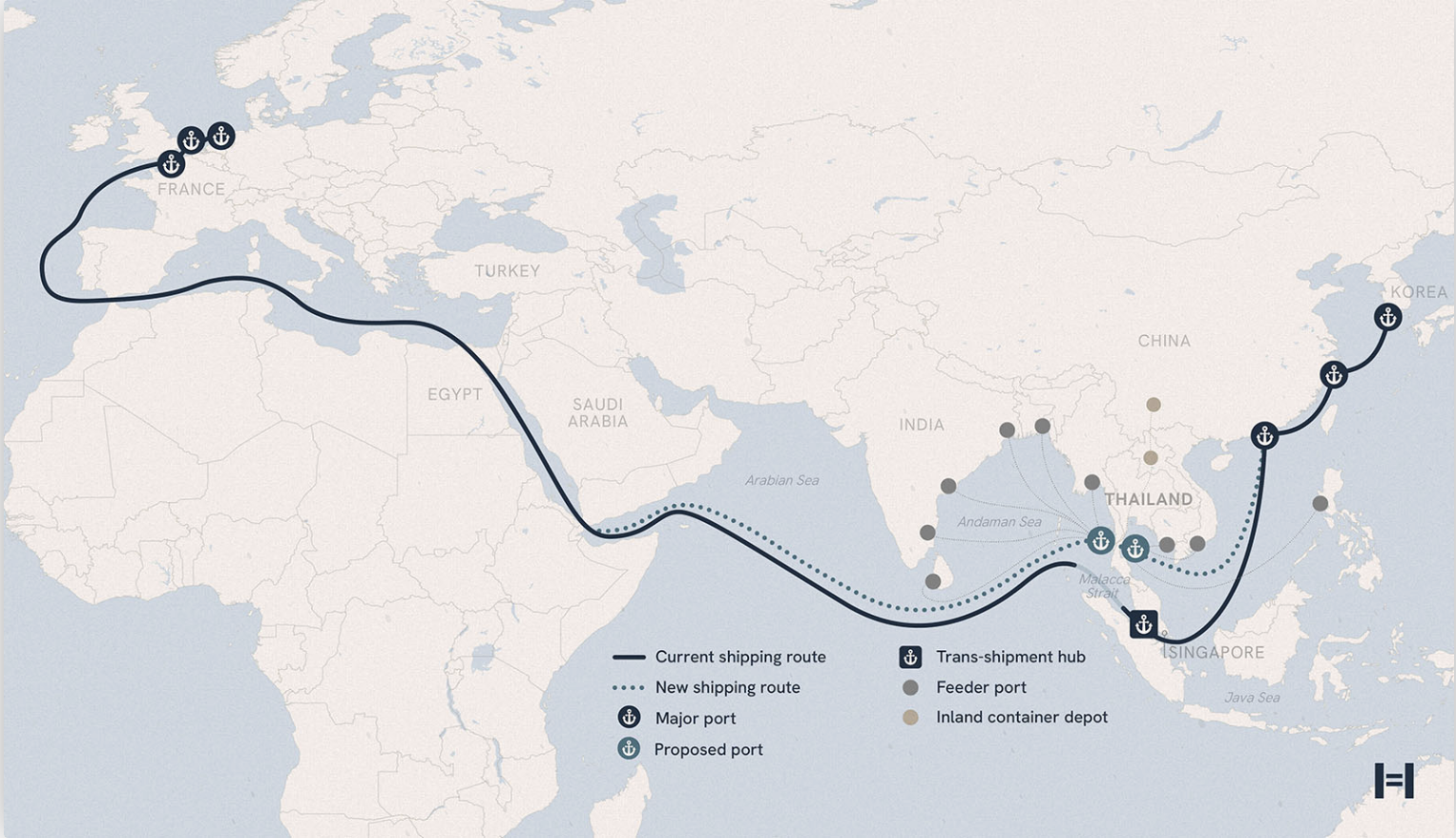
International shipping routes from Asia to Europe would be shortened by Thailand's Land Bridge project, bypassing the Strait of Malacca. Map by Emilie Languedoc. Source: HaRDstories.org
Three Feasibility Studies, Three Conclusions
Three feasibility studies sit on the public record. They do not agree.
The parliamentary committee report of January 2024 endorsed the project, drawing almost entirely from OTP figures dated 2023. The OTP feasibility study of May 2024 claimed cost savings on transhipment routes of 3% to 10% (USD 31 to 237 per TEU) and approximately five days of time savings against Malacca.
The NESDC and Chulalongkorn study of April 2025 reached a different conclusion. It found the project "not economically feasible." The arithmetic:
Total transhipment cost per TEU through the corridor: 4,640 baht
Time saved at sea by avoiding Malacca: maximum 2 days
Time lost to double handling at two ports: approximately 2 days
Net advantage: zero or negative
More than two-thirds of the headline investment goes into land infrastructure that plays a subordinate role to the ports themselves. The most exposing number is one the marketing materials do not lead with.
Approximately 78% of the 20 million TEU capacity is forecast to come from transhipment: cargo with no origin or destination in Thailand. Associate Professor Sompong Sirisopolpsil set out the implication at the 7 May forum: the corridor is being designed for trade Thailand does not own.
The instructive comparison sits a few hundred kilometres south. Malaysia's Port of Tanjung Pelepas, purpose-built and physically adjacent to Singapore, has captured only a fraction of regional transhipment market share despite three decades of state backing.
Location is not what shipping lines optimise for. Ecosystem is.
Why No Foreign Investor Has Committed
The chronology of foreign engagement does most of the work. In 2008, DP World funded a Royal Haskoning study that concluded the corridor could not compete with Malacca on Far East to Europe routes; the cost differential was USD 1.8 million per round trip.
Sultan Ahmed bin Sulayem visited in 2016 to meet Deputy Prime Minister Somkid.
In July 2024 he returned to meet Prime Minister Srettha. Both visits produced expressions of interest. Neither produced investment. The pattern attracts diplomatic attention but not committed capital. That distinction is analytically important.
Transport Minister Pipat's stated reason for adding Middle East scenarios to the 90-day review is the regional conflict context that emerged after the original OTP study was completed. The analytical question is which Gulf actors would feature in any updated modelling.
DP World, with two decades of expressed interest, sits at the centre of the Emirati track. Saudi Arabia's Vision 2030 logistics ambitions provide a second axis. Qatari and Omani port operators occupy a third, primarily concerned with how Asia-Europe routing affects existing terminal volumes.
None of this changes the underlying transhipment economics. It does change the political optics, particularly given Bhumjaithai's existing Gulf engagement portfolio.
The Strategic and Security Case Has Weakened
Every alternative routing developed since 2009 has eroded the case. China's Belt and Road rail to Europe is operational. The Myanmar to Kunming oil and gas pipelines are operational. The China-Pakistan Economic Corridor continues to develop. The Sunda Strait alternative remains available.
The security framing has been challenged on its own terms. The argument that the Land Bridge would protect Thailand against a Strait of Malacca closure assumes a contingency in which the Strait could be closed without the same dynamics affecting a land-based corridor on the same peninsula.
As Surachart argued at the 7 May forum, a closure severe enough to disable Malacca would render the Land Bridge either an immediate military target or commercially inaccessible.
The Land Bridge is not an insurance policy against the failure mode it is sold against.
Environmental Footprint and Local Economic Impact
The environmental footprint is substantial enough that even an economically viable project would face delivery risk.
The route affects 12.59 sq km of national reserved forest, 0.62 sq km of the Khwan Mae Yai Mom Wildlife Sanctuary, and 1.15 sq km of the Pak Khlong Kaper Ramsar wetland. Approximately 4,800 rai of conservation mangrove are potentially affected. The Andaman Marine Conservation Area was added to the UNESCO World Heritage Tentative List on 18 December 2021.
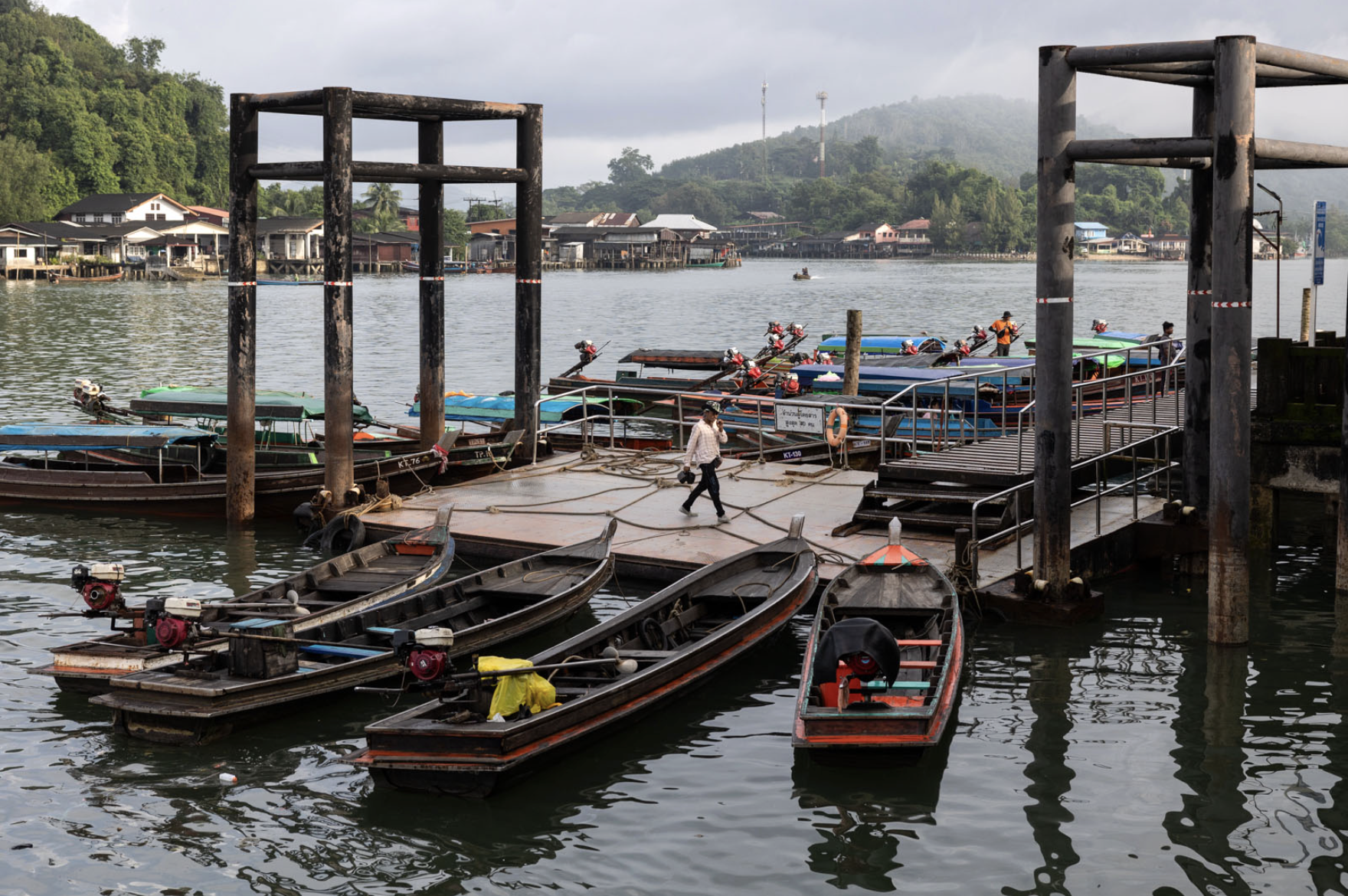
A man arrives by boat at the sleepy official immigration border crossing in Ranong. The crossing is the main entry point for many Burmese travelling to work in Thailand, given its proximity to Myanmar's southernmost tip. Photo: Luke Duggleby / HaRDstories.
The local economic base is rarely captured in feasibility studies because it does not appear in GDP statistics. Dr Wipawadee Poryangnoy presented evidence at the 7 May forum that a single Ranong community generates hundreds of millions of baht annually from red shrimp, used for kapi production, and durian. The 12-metre dredging required for deep-sea vessels would permanently degrade the substrate these economies depend on.
The EIA and EHIA processes have generated what panellists described as a total crisis of trust: hearings have produced visible local opposition, while government press releases have characterised the same hearings as community endorsement.
The SEC Bill: The Legislative Architecture Behind the Project
The Land Bridge cannot proceed at the marketed scale without a parallel legislative vehicle. That vehicle is the draft Southern Economic Corridor Act, modelled on the Eastern Economic Corridor Act of 2018 and covering Chumphon, Ranong, Surat Thani, and Nakhon Si Thammarat.
On 7 May 2026, Government Chief Whip Korawee Prisananantakul of Bhumjaithai stated publicly that the SEC Bill and the Land Bridge "are not the same matter," confirming the cabinet has not yet returned the bill to parliament.
The clarification is politically precise. It is also analytically incomplete. The 71-section draft prepared by the Office of Transport and Traffic Policy and Planning explicitly references the Land Bridge corridor in its operational scope.
The substantive concerns are textual. According to legal analysis published by iLaw, the EnLAW Foundation, and Thai PBS Policy Watch:
Section 11 allows the Policy Committee to bypass the Public Private Partnership Act of 2019
Section 31 permits the cancellation of existing town and country planning under the City Planning Act of 2020
Section 36 grants authority to approve, license, and grant concessions overriding multiple existing licensing regimes
The bill provides for foreign land leases of up to 99 years (structured as 50 plus 49) and a right to purchase land
Eighteen separate provisions exempt the corridor from existing Thai laws, including environmental, planning, and licensing frameworks
Constitutional law commentary has flagged tensions with Section 58 (environmental impact duty), Section 74 (right to work), and Section 75 (equitable economic distribution). The Land Bridge file and the SEC file are politically separable but operationally inseparable.
Public Support for the Land Bridge: Broad but Shallow
A NIDA Poll published on 3 May 2026, surveying 1,455 respondents across 14 Southern provinces, found that 67.22% of Southerners support the Land Bridge project. The substructure is more analytically interesting. Only 10.52% reported understanding the project very well. A further 26.67% reported some understanding. The remaining 62.81% had heard of the project but had minimal, no, or zero understanding of what it actually involves.
Among informed respondents, 38.03% flagged environmental impact, 29.71% flagged community impact and land expropriation, and 25.81% flagged corruption and lack of transparency. The pattern of concerns maps almost exactly onto the academic and civil society critique. The mandate is broad. It is not informed.
What Would Make a Thailand Land Bridge Workable
The forward question is not whether the trillion-baht headline is bankable. It is not. The forward question is what version of the corridor could be made to work, and on what terms.
A structurally smaller project, four to five times smaller than the current proposal and oriented around Thai exporter access rather than transhipment volume, could deliver real value at materially lower fiscal and environmental risk.
A focused investment in the double-track rail line from the Eastern Seaboard down to Ranong, configured to serve existing BIMSTEC trade routes, would capture most of the genuine domestic logistics benefit at a fraction of the headline cost.
Atavit Suwanpakdee, Deputy Leader of the United Thai Nation Party, framed the constructive position on 5 May 2026: the heart of the project is "value creation on Thai land," not transit. He pointed to a forcing function few in the public conversation have noticed.
The Oil Fund is expected to end biodiesel subsidies on 24 September 2026, a decision that would affect roughly one-third of Thai palm oil production. An SEC-anchored oleochemical industry, integrating palm oil with hydrogen from gas separation plants, is one of the few credible adjustments. The pipeline component now folded into the OTP scope is consistent with that logic.
The Land Bridge has now survived four governments, two recessions, a pandemic, and a complete shift in global shipping geography. It is not, primarily, an infrastructure proposition.
The question is which version will eventually move, who will be at the table when it does, and whether the second-order opportunities will be captured by those who read the system early or by those who keep waiting for the headline.
— Ben Kiatkwankul, Partner & Co-Founder
mcg-asia.com | Bangkok
Maverick Consulting Group provides strategic advisory, government relations, and public affairs counsel across Thailand, Southeast Asia, and the Gulf. MCG advises international clients on market entry, stakeholder navigation, and political economy analysis in complex operating environments.